Teaching inclusion through bedtime stories
Bedtime stories are the perfect time to teach inclusion. Here's how to weave moral lessons into your child's nightly reading routine.
✦ Key Takeaways
- •Bedtime stories work well for inclusion because children learn best in safe, repeated, emotionally warm moments.
- •The best bedtime stories about inclusion show belonging in action, not just in slogans.
- •The best way to discuss inclusion is to stay curious, brief, and child-led.
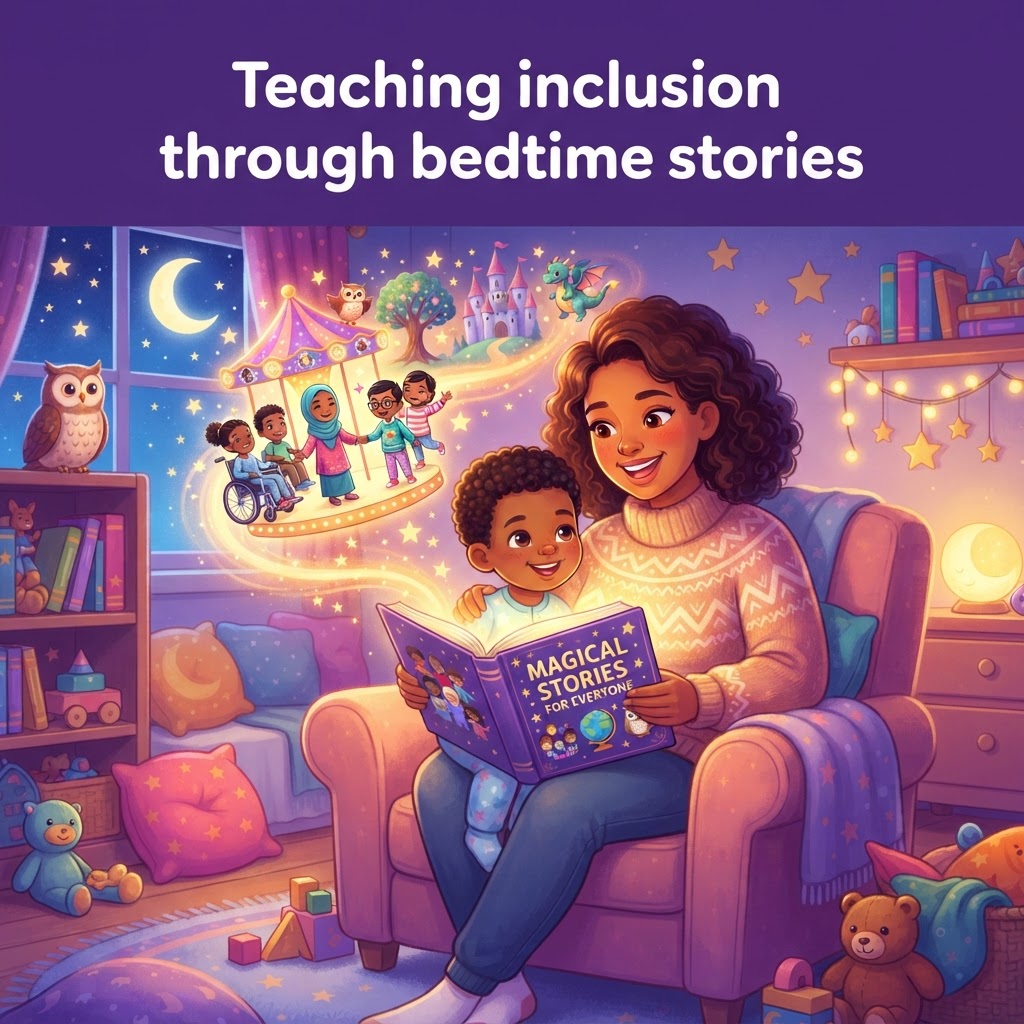
Bedtime is one of the best moments to teach kindness, empathy, and belonging because children are calm, close to you, and ready to imagine. If you want to start teaching inclusion at bedtime, you do not need a perfect script or a big lesson plan. You need thoughtful stories, simple follow-up questions, and a warm tone that helps your child notice how people can be different and still deserve respect, friendship, and care.
Why are bedtime stories so effective for teaching inclusion?
Bedtime stories work well for inclusion because children learn best in safe, repeated, emotionally warm moments. A familiar nightly routine helps children absorb values without feeling pressured or corrected.
Reading aloud supports language, empathy, and social understanding. The American Academy of Pediatrics recommends daily shared reading because it strengthens connection and supports development across early childhood. That connection matters when you are introducing big ideas like fairness, diversity, and belonging.
Children also learn through back-and-forth conversation. Harvard’s Center on the Developing Child explains that responsive “serve and return” interactions help build strong brain architecture. In simple terms: when your child comments on a character, asks a question, or names a feeling, and you respond warmly, the lesson goes deeper.
That is why inclusion bedtime stories can be so powerful. A child who hears, “Everyone is welcome on the team,” night after night begins to expect inclusion in real life too.
How can parents choose bedtime stories about inclusion that truly help?
The best bedtime stories about inclusion show belonging in action, not just in slogans. Look for stories where characters include others, notice unfairness, repair mistakes, and build friendships across differences.
When choosing books or AI-generated stories, look for these signs:
- Diverse characters with real roles: Children should see characters of different abilities, cultures, family structures, and personalities doing meaningful things.
- Inclusion as part of the plot: The story should show someone making space, sharing power, inviting participation, or standing up for another child.
- No “rescuer” framing: Avoid stories where one character is only there to be pitied or “fixed.”
- Everyday moments: Inclusion is not only about dramatic events. Joining a game, listening to a new classmate, or adapting a group activity are strong examples.
- Respectful language: Tone matters. A story should model curiosity, kindness, and dignity.
This is also a good place to mix values. A story about inclusion often overlaps with teaching respect through stories and teaching generosity at bedtime. In real life, children do not separate these values neatly, and stories should not have to either.
The National Association for the Education of Young Children notes that children notice differences early. That is exactly why moral stories for kids should present differences as normal, interesting, and worthy of respect.
How can you talk about inclusion without lecturing?
The best way to discuss inclusion is to stay curious, brief, and child-led. Instead of explaining the “moral” for five minutes, ask one or two gentle questions and let your child do some of the thinking.
Try a simple rhythm after the story:
- Ask what your child noticed.
- Name one feeling.
- Connect the story to one real-life situation.
For example:
- “How do you think Maya felt when no one saved her a seat?”
- “What changed when the group made room for her?”
- “Have you ever seen someone left out at school or at the park?”
This approach works better than a lecture because children learn values through reflection and repetition. If your child gives a short answer, that is fine. You are planting seeds.
A few helpful phrases:
- “Everyone deserves to belong.”
- “Being kind can mean making space for someone else.”
- “Differences can make a group stronger.”
- “What could the characters do next time?”
Keep your tone light and warm. If you use personalized stories, a platform that offers a kind tone can help model this naturally. When you create your own personalized bedtime story, you can shape the conflict gently, so the lesson feels reassuring rather than heavy. That matters, especially at bedtime, when children need emotional safety as much as guidance.
What does teaching inclusion at bedtime look like at different ages?
Teaching inclusion should match your child’s developmental stage. Young toddlers need simple actions and clear feelings, while older children can handle fairness, perspective-taking, and more complex social situations.
Ages 1-3: Keep it simple and concrete
For toddlers, focus on visible actions:
- “We make room.”
- “We share the blanket.”
- “We say, ‘Come play.’”
Use repetition and short plots. A bunny includes a new friend. A child notices someone sitting alone. A family welcomes a neighbor. At this age, the goal is not a deep discussion. The goal is positive emotional association.
Ages 4-6: Name feelings and choices
Preschoolers can understand basic fairness and friendship. Stories for this age can include:
- A child who is nervous because they are different
- Friends learning how to include someone in a game
- A misunderstanding that gets repaired with kindness
This is a strong age for bedtime stories about inclusion because children are starting school, joining groups, and noticing who gets included or excluded.
Ages 7-10: Explore perspective and problem-solving
Older children can think about intent, impact, and group dynamics. Stories can show:
- A class making an activity accessible for everyone
- A child realizing a joke excluded someone
- Friends learning how to listen to a classmate with a different background or need
They are also ready for richer follow-up questions: “Was that fair?” “What else could the group have done?” “How do small choices change whether someone feels welcome?”
If your child enjoys value-based themes, you can also rotate related topics from the InstaTales blog, such as forgiveness, patience, and responsibility, to help them see how social skills connect.
How can InstaTales help parents create inclusion bedtime stories that feel natural?
InstaTales can help by making moral storytelling personal, gentle, and easy to revisit. Personalized stories let children see themselves practicing inclusion, which often makes the lesson feel more real.
Two features are especially helpful here:
The moral story type
The moral story type gives structure to the value you want to teach. Instead of a random adventure, the story can center on welcoming someone new, making space in a game, or appreciating differences. That makes it easier to practice teaching inclusion at bedtime intentionally.
The kind tone
A kind tone matters because bedtime is not the moment for shame-based lessons. Stories that model empathy, repair, and warmth help children feel safe enough to learn. They also show that inclusion is not about being “perfect.” It is about noticing others and making better choices.
You can also use story templates when you want a quick starting point, then save favorites to your story library for rereading. Repetition is useful here. Hearing the same value in slightly different stories helps children internalize it over time.
For educators or homeschool families, inclusion stories can also support social-emotional learning beyond bedtime. That is one reason some families and schools explore InstaTales for teachers as well.
What are three story prompts you can use tonight?
The easiest way to start is with one clear situation and one clear value. These prompts are designed to create warm, practical inclusion bedtime stories that children can understand right away.
1. The new child at moonlight camp
“Create a gentle bedtime story about a child arriving at Moonlight Camp for the first time. They speak quietly and feel shy. The other children notice they are standing alone and find three different ways to include them before the campfire song begins.”
Why it works: It teaches children to notice exclusion and take action.
2. The game that changed its rules
“Write a bedtime story about animal friends playing a fast game in the forest. One friend cannot join the game in the usual way, so the group works together to change the rules so everyone can play and still have fun.”
Why it works: It shows that fairness is not always sameness.
3. The lantern parade of many families
“Tell a calm bedtime story about a town preparing for a lantern parade. Children from different families, traditions, and abilities each bring something special, and the parade becomes more beautiful because everyone is included.”
Why it works: It presents diversity as a strength, not a problem to solve.
When you use prompts like these, keep the message clear but not preachy. Children remember story actions more than speeches.
Frequently Asked Questions
What age should I start teaching inclusion through bedtime stories?
You can start in toddlerhood with simple stories about sharing space, welcoming others, and noticing feelings. Young children may not use the word “inclusion,” but they can understand what it means to make someone feel they belong.
How often should I read moral stories for kids?
A few times a week is enough if the stories lead to small, consistent conversations. Values stick through repetition over time, not through one “perfect” lesson.
What if my child says everyone should be treated exactly the same?
That is a great starting point. You can gently explain that kindness sometimes means giving people what they need to join in, which is why fairness and sameness are not always identical.
Can personalized AI stories really help teach inclusion?
Yes, when they are well-designed. Personalized stories can help children imagine themselves making inclusive choices, especially when the story uses a calm moral structure and a kind tone.
What should I do if a story includes stereotypes or feels uncomfortable?
Pause and talk about it simply. You can say, “That does not feel respectful,” and ask how the story could be changed so everyone is treated with dignity.
Are inclusion bedtime stories useful for classrooms too?
Yes. Stories about belonging, empathy, and respectful problem-solving fit naturally into social-emotional learning, circle time, and class discussions, especially in early elementary settings.
Ready to Create a Personalized Bedtime Story?
Use our free AI bedtime story generator to create a personalized illustrated story for your child in 30 seconds — no credit card needed.
Popular story types:
Maya Rodriguez
Lead Content Editor & Early Literacy Specialist
Maya is a former early childhood educator and literacy specialist with over a decade of experience helping children develop a love of reading. She leads content at InstaTales, where she writes about the science of storytelling, child development, and how families can use personalized AI stories to build literacy and emotional resilience.
instatales.ai