AI Stories for Reluctant Readers: Parent Guide
If your child is a reluctant reader, AI-generated stories might be the key. Here's how personalized, high-interest stories can turn things around.
✦ Key Takeaways
- •Reluctant readers usually avoid reading because it feels unpleasant, not because they do not want to learn.
- •Personalization and choice increase reading motivation because children are more likely to engage with texts that feel relevant to them.
- •Parents get the best results when they use AI stories as a bridge to reading success, not as a replacement for all other reading.
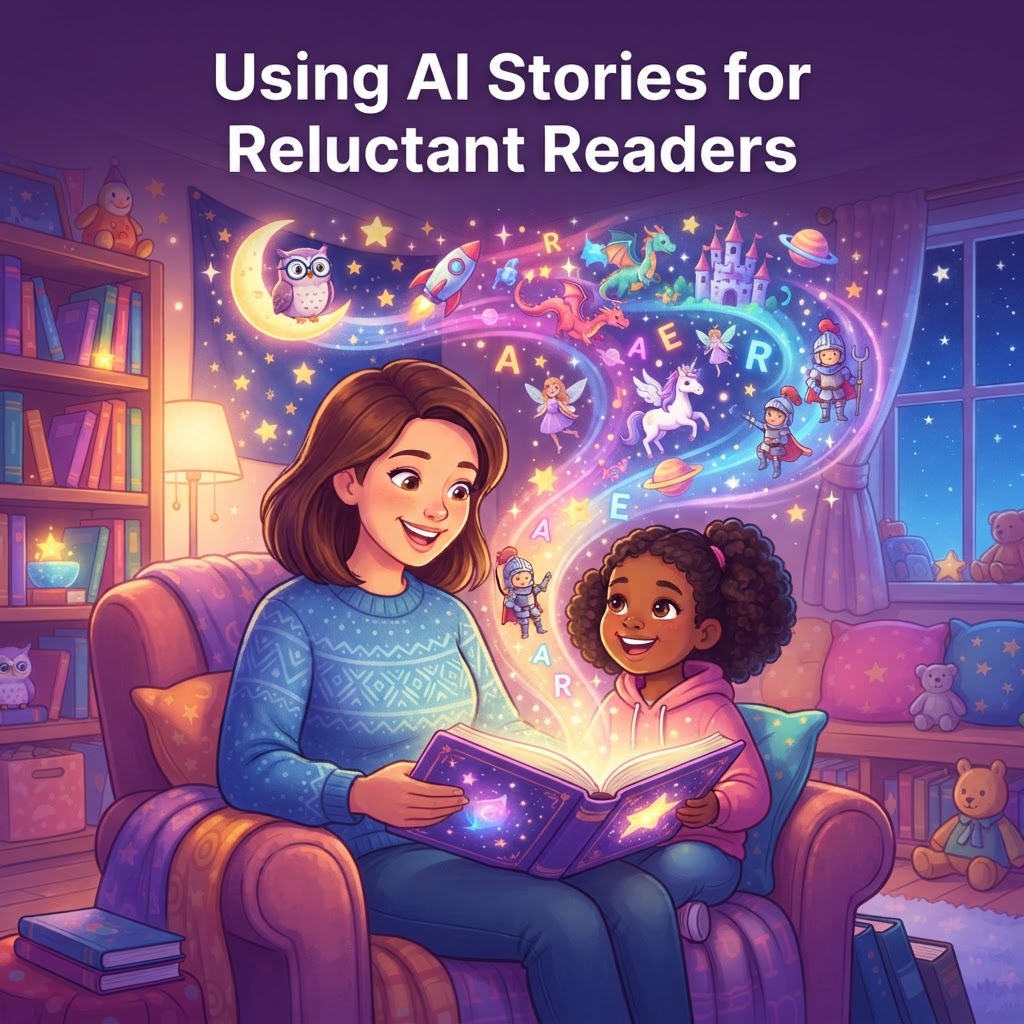
If your child groans when it is time to read, you are not alone. Many parents worry that a child who avoids books will fall behind, but resistance to reading does not usually mean a child is lazy or “not a reader.” Often, it means the reading experience feels too hard, too boring, or too disconnected from what that child actually loves. That is why AI stories for reluctant readers can be so useful: they make reading feel personal, doable, and interesting again. Used well, AI-generated stories can support reading motivation AI strategies and become one practical tool for helping struggling readers build confidence.
Why do reluctant readers push books away?
Reluctant readers usually avoid reading because it feels unpleasant, not because they do not want to learn. When books feel too difficult, too repetitive, or irrelevant to a child’s interests, avoidance makes sense.
Some children resist reading because they are still developing decoding skills. Others can read the words, but they do not yet see reading as rewarding. Research from John Guthrie and Allan Wigfield has consistently shown that motivation, interest, and choice strongly affect reading engagement and growth.
Common reasons children resist reading include:
- The text feels too hard or too long
- They have had repeated experiences of failure
- The topics do not match their interests
- They are tired after a structured school day
- They would rather do something more interactive
- They feel embarrassed about reading more slowly than peers
This is especially important for parents to understand: a child may love stories and still dislike reading. The gap is often not imagination. It is access.
Child development experts at the Center on the Developing Child at Harvard University emphasize that positive, low-stress learning experiences matter. When reading is tied to pressure or correction every few seconds, motivation drops fast. AI stories can help by lowering that emotional barrier.
How do personalization and choice increase reading motivation?
Personalization and choice increase reading motivation because children are more likely to engage with texts that feel relevant to them. A story about a child’s favorite animal, sport, or superhero-style adventure can turn “I don’t want to read” into “Read that one again.”
This fits well with motivation research. Self-determination theory, developed by Deci and Ryan, suggests that people are more engaged when they experience autonomy, competence, and connection. Personalized stories can support all three:
- Autonomy: the child helps choose the theme, setting, or character
- Competence: the story can be adjusted to a comfortable difficulty level
- Connection: the child sees familiar interests, emotions, or experiences in the story
That is one reason personalized story features can be so powerful for reluctant readers. A child who refuses a random leveled reader might happily try a short story about a soccer-playing dragon, a shy astronaut, or a puppy who loves construction trucks.
Choice also matters. Instead of saying, “Read this book,” try offering two or three options:
- A funny story
- A mystery
- A story starring your child
- A story based on a current obsession
When children feel ownership, resistance often softens. The goal is not to trick them into reading. The goal is to help them discover that reading can meet their interests, not compete with them.
How can parents use AI stories strategically at home?
Parents get the best results when they use AI stories as a bridge to reading success, not as a replacement for all other reading. The smartest approach is to match the story to the child’s interests, reading level, and emotional needs.
A practical routine works better than random use. You can create your own personalized bedtime story around one strong interest, keep it short, and reread it across several days. Familiarity supports fluency, and fluency supports confidence.
Here are a few effective ways to use AI stories strategically:
Start with high-interest, low-pressure reading
Choose topics your child already loves. If your child is into dinosaurs, ballet, racing cars, or space, begin there. Interest reduces resistance.
Keep stories short enough for success
For reluctant readers, finishing matters. A 250-word story they can complete with pride is often more powerful than a longer story they abandon halfway through.
Use read-aloud, echo reading, or shared reading
You do not have to hand over the story and walk away. Try:
- Read-aloud: you read while your child listens
- Echo reading: you read a sentence, then your child repeats it
- Shared reading: you take turns by paragraph or page
These methods are especially helpful for younger children and children with shaky fluency.
Reread favorite stories
Repeated reading is not cheating. It builds confidence, vocabulary, and automaticity. Save successful stories in your story library so your child can return to them often.
Use templates to reduce decision fatigue
Some parents want personalization without starting from scratch every time. Ready-made story templates can make it easier to create stories quickly while still tailoring the details.
Pair motivation with skill support
If your child is struggling with foundational reading skills, AI stories should complement direct instruction, not replace it. The What Works Clearinghouse highlights the importance of explicit support in areas like phonics, fluency, and comprehension. In other words, motivation matters, but so does the right teaching.
What are five AI story ideas for reluctant readers?
The best story ideas for reluctant readers are high-interest, emotionally safe, and easy to imagine. Stories work best when they meet children where they are, then gently stretch attention and confidence.
Here are five strong options:
-
The child as the hero
Put your child in the story as the main character. Maybe they rescue a lost baby dragon, solve a playground mystery, or help a robot make a friend. Children often engage more when they feel personally involved. -
A story based on their strongest current interest
Use whatever your child talks about nonstop: trucks, unicorns, sharks, gymnastics, Minecraft-style building, or outer space. High-interest reading is one of the simplest ways of helping struggling readers stay with a text longer. -
A funny problem-solving story
Humor lowers pressure. Try a story about a pirate who is scared of water, a knight who keeps sneezing in battle, or a cat who opens a taco stand. -
A “choose the ending” adventure
Give your child two possible outcomes and let them decide. Choice increases engagement and gives them a reason to pay attention. -
A confidence-building school story
Create a gentle story about first-day nerves, making a friend, speaking up in class, or learning something hard. These stories can help children process feelings while practicing reading.
If your child responds well to gamified goals, pair these stories with small routines like weekly reading challenges. A simple challenge such as “read for five minutes three times this week” can feel more achievable than a vague goal to “read more.”
How can you tell whether AI stories are helping struggling readers?
AI stories are helping when reading becomes easier, calmer, and more voluntary over time. The first signs are often emotional before they are academic.
Look for small wins such as:
- Your child asks for the same story again
- They stay with reading for a few extra minutes
- They talk about the characters afterward
- They volunteer to read one page or one line
- They seem less tense during reading time
- They begin choosing books or stories more often
Not every change will show up immediately in test scores. Motivation usually improves first, then stamina, then fluency and comprehension. The American Academy of Pediatrics also notes that warm, shared reading experiences support language and literacy development, especially when adults stay responsive and engaged.
If progress stalls, adjust the strategy. The story may be too long, the language too difficult, or the topic not compelling enough. Sometimes a child needs more listening support, more repetition, or a better match between text level and skill level.
Most of all, remember this: reluctant readers do not need more pressure. They need more successful reading experiences. AI stories can create those moments when used thoughtfully, consistently, and with your child’s real interests in mind.
Frequently Asked Questions
Are AI stories good for children with dyslexia or other reading difficulties?
They can be helpful, especially when stories are short, personalized, and used with read-aloud or shared-reading support. However, AI stories should not replace evidence-based intervention from a teacher or specialist.
How often should my child use AI-generated stories?
A few short sessions each week is enough to start. Consistency matters more than length, so even 5 to 10 minutes of positive reading time can help.
Can AI stories replace regular books?
No. AI stories work best as one tool in a balanced reading life that also includes print books, library books, and school materials. They are especially useful for boosting motivation and confidence.
What if my child only wants silly or repetitive stories?
That is usually fine at first. Repetition and humor often help reluctant readers feel safe and successful, which creates the foundation for trying new kinds of text later.
Are personalized AI stories safe for young children?
They can be, as long as parents preview the content and use child-appropriate settings. It is best to stay involved, especially with younger children, and choose stories that match your family’s values and your child’s developmental stage.
Get a new bedtime story every week
Free, personalized, and delivered to your inbox. No spam, ever.
Ready to Create a Personalized Bedtime Story?
Use our free AI bedtime story generator to create a personalized illustrated story for your child in 30 seconds — no credit card needed.
Popular story types:
Maya Rodriguez
Lead Content Editor & Early Literacy Specialist
Maya is a former early childhood educator and literacy specialist with over a decade of experience helping children develop a love of reading. She leads content at InstaTales, where she writes about the science of storytelling, child development, and how families can use personalized AI stories to build literacy and emotional resilience.
instatales.ai