Fifth Grade Math Stories That Make Learning Stick
Make math engaging for fifth grade students with stories. Practical strategies, story ideas, and classroom activities for teachers.
✦ Key Takeaways
- •Stories help fifth graders learn math because they turn abstract ideas into meaningful situations.
- •The strongest fit for story-based instruction is any topic that benefits from context, comparison, or decision-making.
- •These five activities are practical, standards-friendly ways to use teaching math with stories in a fifth grade classroom.
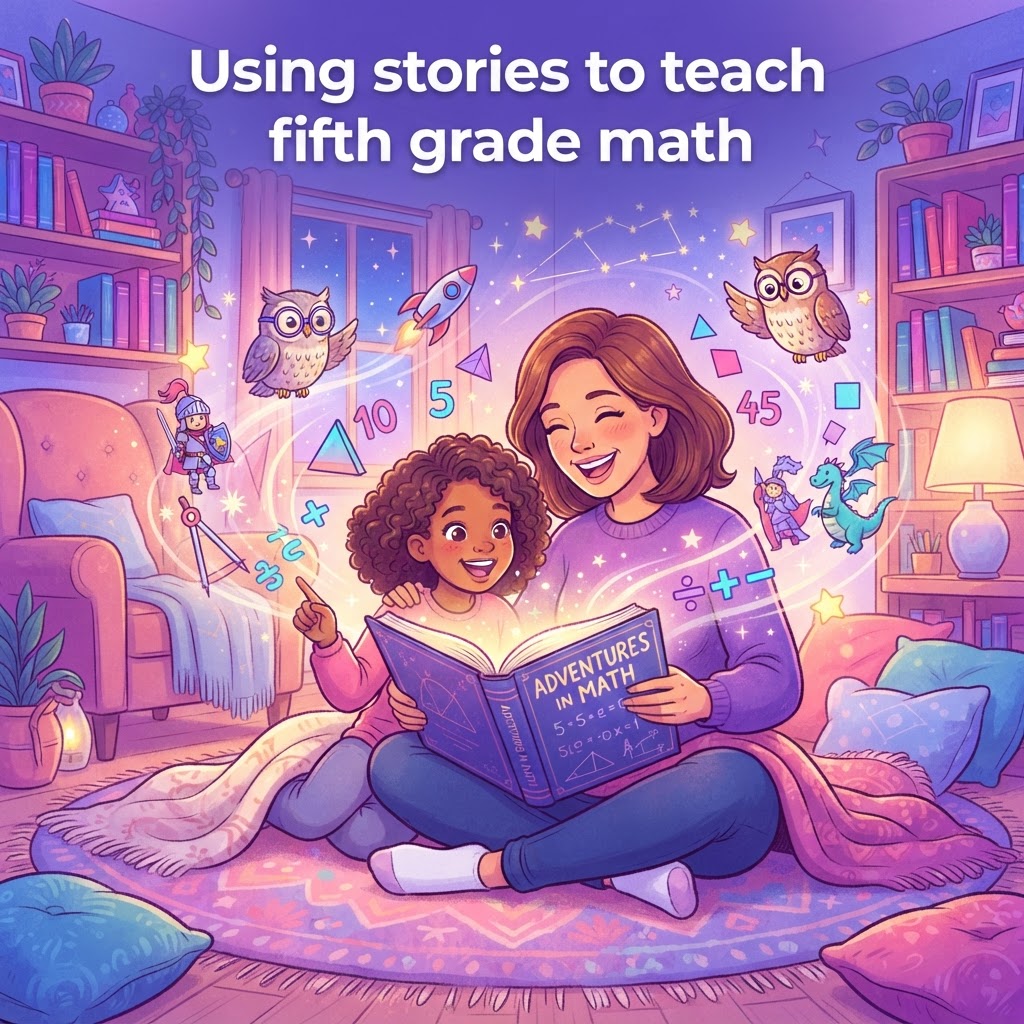
If you teach upper elementary math, stories can make fifth grade concepts clearer, stickier, and more engaging. The best fifth grade math stories do not water down rigor; they give fractions, decimals, volume, graphs, and multi-step problems a reason to matter.
For teachers, this matters because many ten- and eleven-year-olds can compute accurately but still struggle to explain why a strategy works. Teaching math with stories helps students connect procedure, language, and meaning. In this guide, you will find research-backed reasons to use narrative, five practical fifth grade math activities, differentiation ideas, and simple ways to use InstaTales for teachers in your math block.
Why do stories help fifth graders learn math?
Stories help fifth graders learn math because they turn abstract ideas into meaningful situations. When students can picture a character budgeting money, dividing supplies, or building a garden bed, math becomes easier to discuss and remember.
This is not just a motivational trick. Research in learning science shows that people remember information better when it is organized in meaningful structures, and narrative is one of the oldest structures we use. Jerome Bruner described narrative as a major way humans make sense of the world, and the National Council of Teachers of Mathematics emphasizes connecting math to real contexts, reasoning, and mathematical communication.
In practice, math stories for fifth grade support learning in several ways:
- They give vocabulary a clear context.
- They reduce resistance for students who feel anxious about math.
- They encourage discussion, prediction, and explanation.
- They make multi-step problems feel purposeful instead of random.
- They support memory by linking ideas to characters and events.
Stories work best when they are paired with strong instruction. The Institute of Education Sciences and other research groups consistently support explicit modeling, guided practice, and discussion in math. A story should frame the problem, not replace careful teaching.
Which fifth grade math topics work best with stories?
The strongest fit for story-based instruction is any topic that benefits from context, comparison, or decision-making. In fifth grade, that includes fractions, decimals, measurement, geometry, graphing, and multi-step problem solving.
Teachers often get the best results with these content areas:
- Fraction operations: sharing, scaling recipes, comparing portions
- Decimals and money: budgets, shopping, savings, scorekeeping
- Volume: packing boxes, designing rooms, building structures
- Coordinate planes: treasure maps, game boards, navigation
- Data and line plots: surveys, sports stats, classroom investigations
These topics naturally invite narrative because students can imagine a problem before they solve it. If you already use stories in literacy, you may notice similar benefits in comprehension and discussion. That crossover is one reason many teachers pair math with narrative-rich lessons in reading and content areas, like these guides on using stories in fifth grade reading and fifth grade science learning.
What are five story-based math activities for fifth grade?
These five activities are practical, standards-friendly ways to use teaching math with stories in a fifth grade classroom. Each one combines a simple narrative with explicit math work, partner talk, and written explanation.
1. How can a “Fraction Feast” story teach addition and subtraction of fractions?
A food story is an easy way to make fractions concrete. Tell students that a team of young chefs is preparing tasting plates for a school event, and each plate needs different fractional amounts of ingredients.
Ask students to solve problems such as:
- How much fruit is used in total?
- How much yogurt is left?
- Which recipe uses the greater amount?
Have students draw models, use equations, and justify their answers in words. This works especially well for unlike denominators because students can see why equivalent fractions matter.
2. How can a “Decimal Shop” story build place value and operations?
A store story gives decimals a real purpose. Create a narrative in which students help a character buy supplies for a class project while staying under budget.
Students can:
- Add and subtract decimal amounts
- Compare prices
- Estimate total cost before calculating
- Explain which purchase plan is smartest
This is one of the most effective fifth grade math activities because it combines number sense, estimation, and decision-making. It also connects easily to financial literacy.
3. How can a “Volume Builder” story make measurement meaningful?
Volume becomes much clearer when students must solve a design problem for a character. For example, a museum needs display boxes for artifacts, and students must determine which box design holds the most space.
Give students dimensions and ask them to:
- Calculate volume with unit cubes or formulas
- Compare different rectangular prisms
- Defend which design works best
The story context encourages students to think like problem solvers, not just answer-getters. It also opens the door to extension work on efficiency and constraints.
4. How can a “Coordinate Map Rescue” story teach graphing skills?
A map-based story is perfect for coordinate planes. Tell students that a missing class pet, robot, or explorer can only be found by plotting and interpreting ordered pairs.
Students might:
- Plot points to reveal a path
- Follow directions using coordinates
- Write clues for a partner to solve
- Describe movement using precise math language
This kind of story supports both spatial reasoning and communication. It is especially helpful for students who need a stronger visual anchor.
5. How can a “Data Detective” story develop analysis and reasoning?
Data becomes more engaging when students investigate a mystery or community question. For example, a school newspaper team wants to find the most popular recess activity and needs help organizing survey results.
Students can:
- Collect or interpret data
- Create line plots or graphs
- Compare categories
- Write conclusions based on evidence
This activity builds a key habit of mind: using numbers to support a claim. It also connects naturally to writing, which is why many teachers also explore story-based approaches in fifth grade writing instruction.
How can teachers differentiate story-based math lessons for diverse learners?
Story-based math lessons are easy to differentiate because teachers can adjust the language, numbers, and output without changing the core idea. The goal is to keep the story shared while varying the support.
Here are practical differentiation moves:
- For students who need support: pre-teach vocabulary, use visuals, shorten the number set, and provide sentence frames such as “I knew ___ because ___.”
- For multilingual learners: pair oral retelling with gestures, use illustrated word banks, and let students discuss the problem before writing.
- For advanced learners: add constraints, ask for multiple strategies, or require students to write the next problem in the story.
- For students with math anxiety: begin with a read-aloud and partner talk before independent solving.
One helpful approach is to keep a bank of reusable prompts in story templates. You can also build levels of the same lesson and save them in your story library for quick reuse across groups or throughout the year.
How can InstaTales support fifth grade math lessons?
InstaTales can support fifth grade math by helping teachers create custom stories that match a standard, skill, or student interest in minutes. Instead of searching for a perfect pre-made text, you can build one around the exact numbers, vocabulary, and scenario your class needs.
For example, you can generate a story about:
- a bakery using fraction operations
- a school market using decimals
- a game designer working on coordinates
- a builder comparing rectangular prisms by volume
This is especially useful for small-group instruction and review. Teachers can create your own personalized bedtime story with a math objective in mind, then adapt the reading level, character names, or complexity for different learners. If you want inspiration from related classroom uses, the fourth grade math story ideas here can also be scaled up for fifth grade.
To keep AI use instructionally strong, start with a clear prompt:
- name the math standard
- define the skill
- ask for 2-3 embedded problems
- request teacher discussion questions
- specify the reading level
The key is to treat the story as a teaching tool, not the entire lesson. Read it aloud, pause for predictions, model one problem, then move into guided and independent practice.
How should teachers assess learning from math stories?
Teachers should assess story-based math lessons the same way they assess any strong math lesson: by looking for reasoning, accuracy, and transfer. A good story should make understanding more visible, not harder to measure.
Try using a quick three-part check:
- Before: one warm-up question to activate prior knowledge
- During: observe partner talk and strategy use
- After: assign one independent problem and one written explanation
You can also ask students to retell the problem context in their own words. If they can explain both the story and the math, they are more likely to understand the structure of the task rather than guess at procedures.
Frequently Asked Questions
Are fifth grade math stories rigorous enough for standards-based instruction?
Yes. A strong math story adds context, but the rigor comes from the questions, models, discussion, and written reasoning you build around it. Teachers can align story tasks directly to grade-level standards.
How long should a story-based math lesson take?
Most story-based lessons fit into a 20-40 minute block. A short read-aloud or scenario can launch the lesson, followed by modeling, guided practice, and independent work.
What fifth grade standards are easiest to teach with stories?
Fractions, decimals, volume, coordinate graphing, and data analysis are often the easiest entry points. These topics naturally connect to real situations and invite rich problem solving.
Can AI-generated stories be used safely in the classroom?
Yes, when teachers review them first and use them with clear instructional goals. Check for mathematical accuracy, appropriate reading level, and bias-free language before sharing with students.
What if some students enjoy the story but miss the math?
That usually means the lesson needs stronger math stops. Add think-alouds, visual models, and required explanations so students connect the narrative to the strategy.
Do story-based math lessons work only for struggling learners?
No. They help a wide range of students because stories improve engagement, language, and retention. Advanced learners often benefit too, especially when they must create their own multi-step math stories.
Get a new bedtime story every week
Free, personalized, and delivered to your inbox. No spam, ever.
Ready to Create a Personalized Bedtime Story?
Use our free AI bedtime story generator to create a personalized illustrated story for your child in 30 seconds — no credit card needed.
Popular story types:
Maya Rodriguez
Lead Content Editor & Early Literacy Specialist
Maya is a former early childhood educator and literacy specialist with over a decade of experience helping children develop a love of reading. She leads content at InstaTales, where she writes about the science of storytelling, child development, and how families can use personalized AI stories to build literacy and emotional resilience.
instatales.ai