Fourth Grade Math Stories That Teach Skills
Make math engaging for fourth grade students with stories. Practical strategies, story ideas, and classroom activities for teachers.
✦ Key Takeaways
- •Stories help fourth graders learn math because they give abstract ideas a clear context.
- •Many fourth grade standards work well with stories, especially topics that involve relationships, comparison, and real-world reasoning.
- •Teachers can use story-based math activities to make practice more purposeful without lowering rigor.
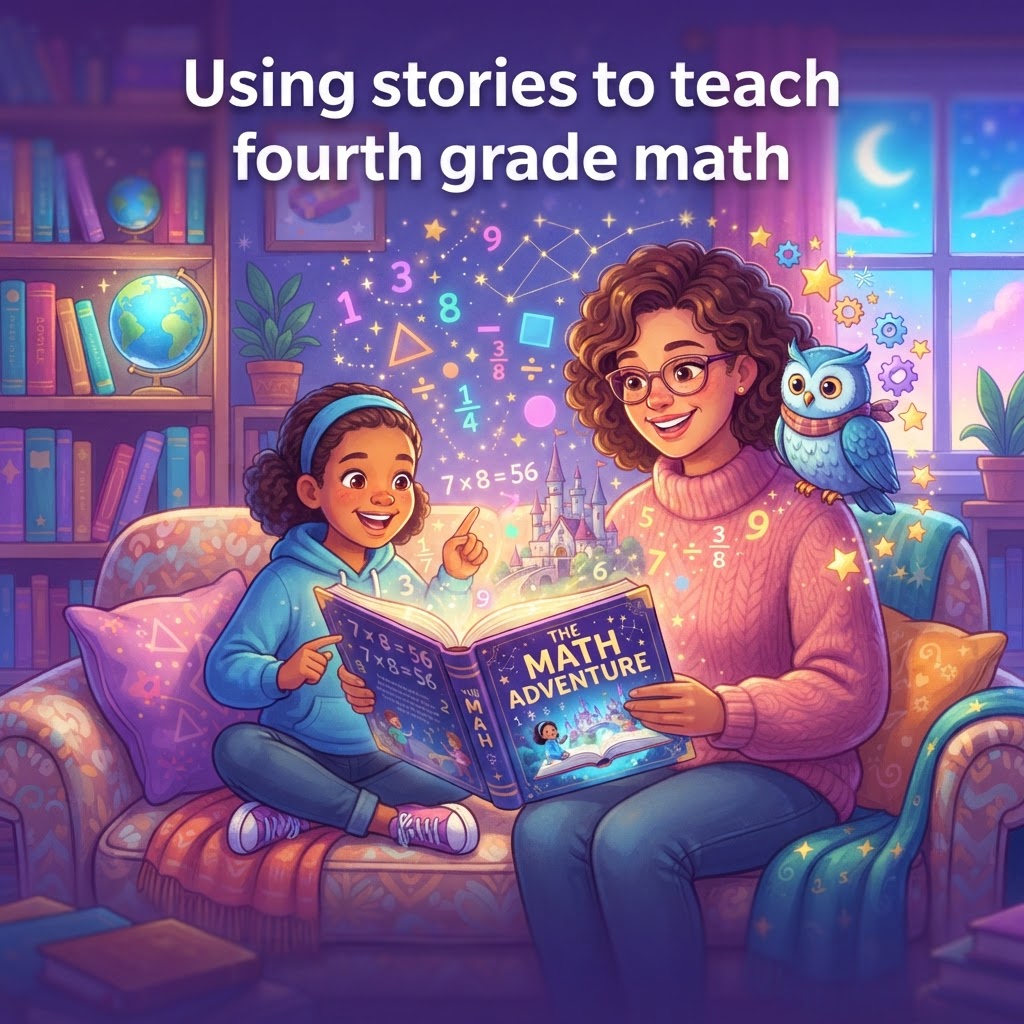
Fourth graders are ready for bigger numbers, deeper reasoning, and richer problem solving—but they still learn best when ideas feel meaningful. That is why fourth grade math stories can be so effective. A strong story gives numbers a purpose, helps students picture what is happening, and turns abstract math into something they can talk about, draw, and solve.
For teachers, this approach is practical as well as engaging. Story-based lessons can support computation, fractions, measurement, geometry, and multi-step word problems while also building language and confidence. If you already use narrative to support literacy, you may also enjoy these guides on fourth grade reading stories and fourth grade writing stories.
Why do stories help fourth graders learn math?
Stories help fourth graders learn math because they give abstract ideas a clear context. When students can imagine a situation, they are more likely to understand the relationships between numbers and remember the strategy they used.
This fits what we know from learning research. Jerome Bruner’s work on narrative cognition showed that people naturally organize meaning through stories. In math education, the What Works Clearinghouse emphasizes explicit problem-solving instruction, visual representation, and discussion—all easier to do when a problem lives inside a meaningful scenario.
Stories also support working memory. Instead of treating numbers as isolated facts, students connect them to characters, goals, and events. That matters in fourth grade, when students are often asked to solve multi-step problems, explain their thinking, and choose among strategies.
In practice, teaching math with stories helps students:
- understand why the math matters
- visualize quantities and actions
- discuss mathematical reasoning with more confidence
- persist longer through challenging problems
- connect math to reading, speaking, and writing
Research on schema-based instruction by Jitendra and colleagues also suggests that students solve word problems more successfully when they learn to recognize the structure of a situation. A story gives that structure a natural home.
Which fourth grade math topics work best with stories?
Many fourth grade standards work well with stories, especially topics that involve relationships, comparison, and real-world reasoning. The best fits are multi-step word problems, place value, multiplication and division, fractions, measurement, area and perimeter, and data.
A story context can make each of these more concrete. For example, students can help a character plan a school fair budget, divide supplies into equal groups, compare fraction-sized portions, or map out a playground using perimeter and area.
Some especially effective pairings include:
- Place value: a treasure map with clues based on digits and value
- Multiplication and division: packing, sharing, arranging, or scheduling tasks
- Fractions: recipes, collections, and equal-part puzzles
- Measurement: travel routes, building projects, and conversion challenges
- Area and perimeter: room design, gardens, playgrounds, and city blocks
- Data and line plots: surveys, weather logs, or classroom investigations
If your students need a bridge from earlier concepts, it can help to revisit simpler narrative models first. This guide to third grade math story ideas can be useful for scaffolding.
What are five story-based fourth grade math activities teachers can use?
Teachers can use story-based math activities to make practice more purposeful without lowering rigor. The key is to start with a clear math objective, then build a short narrative that requires students to use that skill to move the story forward.
How can a place-value rescue mission build number sense?
Create a story in which students must “unlock” clues using numbers in standard, expanded, and word form. For example, a museum robot has mixed up artifact codes, and students must compare numbers, identify the value of digits, and round to the nearest place to restore the exhibit.
This works well because students are not just naming place value rules—they are using them to make decisions.
How can a fraction bakery challenge make fractions easier to see?
Tell students a baker is filling orders for a festival, but recipes and serving trays must be adjusted. Students compare fractions, find equivalent fractions, and decide how much of each item is needed.
Add fraction strips, area models, or paper “trays” so students can represent the quantities visually. This supports the National Council of Teachers of Mathematics recommendation that students connect symbols to models and reasoning.
How can a field trip budget story strengthen multi-step problem solving?
Set up a class trip where students must calculate ticket costs, bus seats, snack packs, and time schedules. Include enough information for several steps, and ask students to explain which operations they chose and why.
This is one of the most useful fourth grade math activities because it mirrors the complexity of real assessments while staying engaging.
How can a neighborhood design story teach area and perimeter?
Invite students to design a new mini-neighborhood for story characters. Each building or park must fit a perimeter requirement, and each space must cover a target area.
Students can sketch arrays on grid paper and compare different shapes with the same area or perimeter. This helps them notice patterns rather than memorizing disconnected rules.
How can a data detective story turn graphs into problem solving?
Frame students as detectives collecting clues from survey results, weather charts, or line plots. They might compare categories, find differences, or use data to make a recommendation for a character.
This is especially effective for discussion. Students can defend claims using evidence from the graph, which supports both math talk and academic language.
How can teachers differentiate math stories for fourth grade learners?
Teachers can differentiate math stories for fourth grade by adjusting language, representation, and task complexity while keeping the same core concept. The goal is not to give different math to different students, but to provide different entry points.
For students who need more support:
- shorten the story and highlight key information
- use visuals, manipulatives, and sentence frames
- chunk the task into one step at a time
- preteach important vocabulary such as total, difference, factor, or equivalent
For multilingual learners:
- pair images with keywords
- allow partner talk before written responses
- let students act out the scenario
- connect new vocabulary to familiar real-life experiences
For students who are ready for extension:
- add extra constraints or missing information
- ask for multiple solution paths
- invite students to write their own solvable story problems
- include justification prompts such as “How do you know?” or “Which method is most efficient?”
Differentiation also includes choice. Some students may solve best with drawing, some with equations, and some with manipulatives. The InstaTales blog and ready-made story templates can help teachers quickly adapt the same lesson format for different learners.
How can InstaTales support fourth grade math lessons?
InstaTales can support fourth grade math lessons by helping teachers generate personalized story contexts that match a specific math objective. Instead of spending planning time inventing fresh scenarios, teachers can build stories around the interests, reading levels, and classroom themes that already motivate their students.
For example, you might create a story about soccer statistics, dragon treasure, animal rescue, or space travel, then embed fraction comparisons, area challenges, or multi-step budgeting inside the plot. Personal relevance increases attention, and attention supports memory.
Teachers can use InstaTales for teachers to:
- generate story prompts tied to a standard
- personalize names, settings, and interests
- create small-group versions at different reading levels
- build repeated problem-solving routines with new story contexts
- save successful lesson ideas for future use
This is especially helpful when you want consistent structure with fresh content. A teacher might reuse the same “mission” format each week but swap in new numbers, settings, and characters to keep the lesson novel. If you want cross-curricular alignment, story-based math can also connect naturally to reading comprehension and written explanation.
How can teachers keep story-based math instruction rigorous?
Story-based math stays rigorous when the story serves the standard, not the other way around. Start with the exact skill you want students to master, then design or choose a story that requires that skill.
A few best practices help:
- state the math objective clearly before reading
- ask students to identify relevant and irrelevant information
- require models, equations, and written explanations
- compare multiple strategies during discussion
- end with an exit ticket that checks the target skill without the story scaffold
This matters because engagement alone is not enough. Strong teaching math with stories combines motivation with precise instruction, rich discussion, and evidence of learning. When done well, stories do not water math down—they make mathematical thinking more visible.
Frequently Asked Questions
Are fourth grade math stories only useful for struggling students?
No. Fourth grade math stories help a wide range of learners because they support reasoning, discussion, and engagement. Advanced students often benefit from richer, multi-step story problems that require explanation and strategy comparison.
How long should a story-based math activity take?
Most activities work well in 15 to 30 minutes. A short story hook, focused problem set, and quick reflection are usually enough to keep the lesson purposeful.
Can I use stories for test preparation?
Yes. Stories are a strong way to prepare students for multi-step word problems because they build comprehension and strategy use. Just make sure students also practice solving without extra narrative support as they get closer to assessments.
What if students get distracted by the story details?
Keep the narrative simple and tightly connected to the math goal. If needed, teach students to underline important information and cross out details that do not affect the solution.
How often should I use story-based math lessons?
Two or three times a week is often enough to build routine without making every lesson feel the same. Many teachers use stories for launching a unit, introducing word problems, or reviewing skills in a more engaging format.
Ready to Create a Personalized Bedtime Story?
Use our free AI bedtime story generator to create a personalized illustrated story for your child in 30 seconds — no credit card needed.
Popular story types:
Maya Rodriguez
Lead Content Editor & Early Literacy Specialist
Maya is a former early childhood educator and literacy specialist with over a decade of experience helping children develop a love of reading. She leads content at InstaTales, where she writes about the science of storytelling, child development, and how families can use personalized AI stories to build literacy and emotional resilience.
instatales.ai