Third Grade Math Stories That Make Learning Stick
Make math engaging for third grade students with stories. Practical strategies, story ideas, and classroom activities for teachers.
✦ Key Takeaways
- •Stories help third graders learn math because narrative gives numbers a purpose.
- •Many third grade standards fit naturally into stories because they involve action, grouping, comparison, and change.
- •The most effective third grade math activities combine a simple narrative, a clear math goal, and time for students to explain their reasoning.
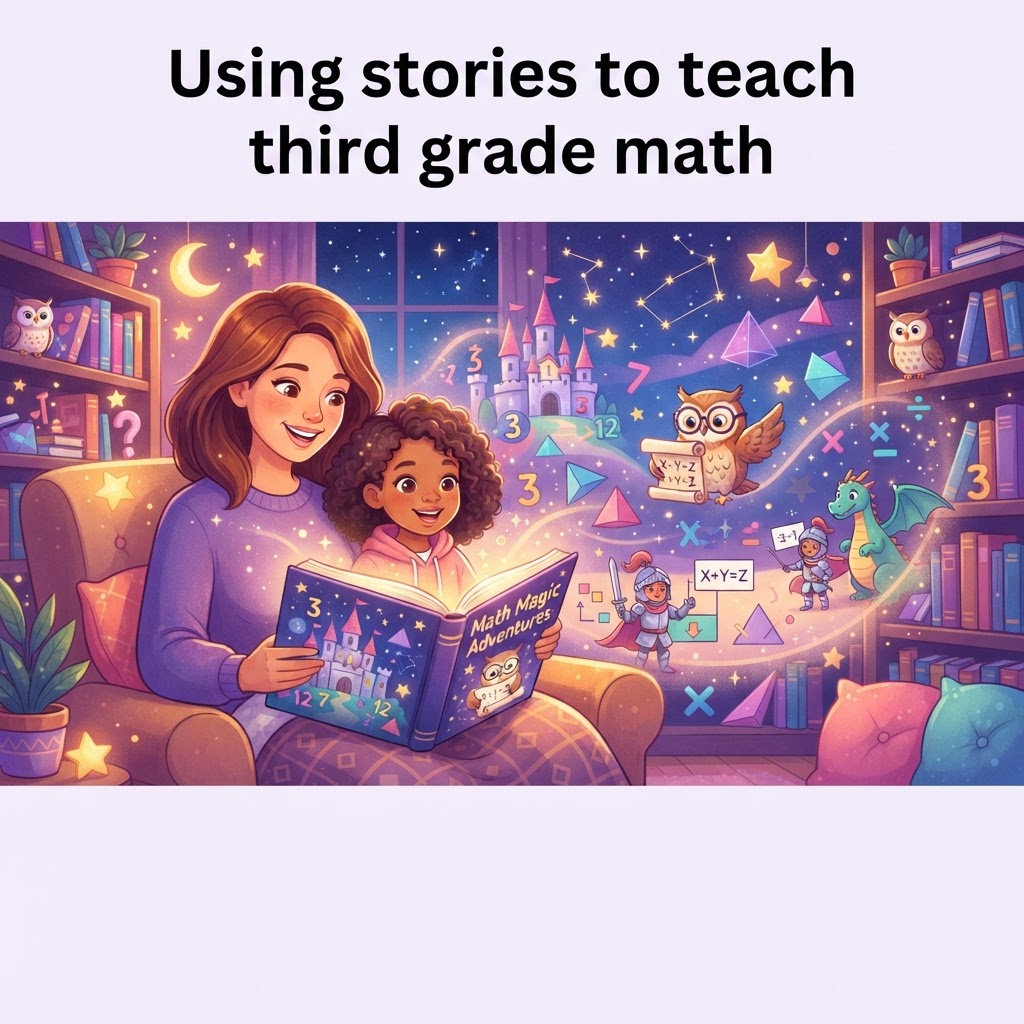
Third graders are ready for bigger math ideas, but they still learn best when those ideas feel concrete, meaningful, and fun. That is why third grade math stories can be such a powerful teaching tool. A well-told story gives students a reason to multiply, compare, measure, sort, and solve.
For teachers, storytelling is not a “cute extra.” It is a practical way to improve attention, build vocabulary, and make abstract math easier to picture. When you use teaching math with stories as part of your lesson design, students are more likely to engage with the problem, talk through their thinking, and remember the strategy later.
Why do stories help third graders learn math?
Stories help third graders learn math because narrative gives numbers a purpose. Instead of solving isolated problems, students solve problems that happen to characters, which makes the math easier to understand and remember.
This matters in third grade, when students move into multiplication, division, area, fractions, and multi-step word problems. These skills demand more working memory and stronger language processing. Research on learning and development suggests that meaningful context supports attention, memory, and comprehension. Jerome Bruner’s work on narrative learning also showed that stories help children organize information in memorable ways.
This approach also aligns with guidance from the National Council of Teachers of Mathematics, which emphasizes reasoning, communication, and connecting math to meaningful situations. The What Works Clearinghouse likewise highlights explicit problem-solving instruction, visual representations, and discussion of mathematical thinking. Stories naturally support all three.
In classrooms, teachers often see a few immediate benefits:
- Students persist longer with word problems
- Math vocabulary becomes easier to teach in context
- Reluctant readers feel more motivated to participate
- Students explain strategies more clearly during partner talk
- Concepts stick because they are tied to characters and events
In short, math stories for third grade help students connect skills to meaning, and meaning improves learning.
Which third grade math skills work especially well in stories?
Many third grade standards fit naturally into stories because they involve action, grouping, comparison, and change. The best matches are skills that benefit from visualizing a situation.
Strong story-based topics include:
- Multiplication and division: equal groups, arrays, sharing, repeated addition
- Fractions: fair sharing, parts of a set, parts of a whole
- Measurement: length, time, liquid volume, and mass in real-world scenes
- Area and perimeter: gardens, rooms, treasure maps, animal habitats
- Place value and addition/subtraction within 1,000: shopping, collecting, trading, and comparing
- Data and graphing: class surveys, weather journals, pet counts, favorite snacks
For example, “24 shells arranged in 4 rows” is fine. But “Maya the beach explorer sorts 24 shells into 4 display trays for the school museum” gives students a mental image, a purpose, and a reason to care.
If you already use literacy integration, teaching math with stories can also support comprehension routines you use in reading. That is one reason these lessons pair well with third grade reading lessons through stories.
Which story-based math activities work best in third grade?
The most effective third grade math activities combine a simple narrative, a clear math goal, and time for students to explain their reasoning. Below are five classroom-tested options.
Story problem picture walks
Start with a short illustrated story or a teacher-read paragraph. Before students solve the problem, ask them to “walk through” the scene and name the quantities, actions, and relationships they notice.
This works especially well for multiplication and division. Students learn to slow down, visualize, and identify what the problem is really asking.
Try prompts like:
- What is happening in the story?
- What numbers matter?
- Are we combining, comparing, grouping, or sharing?
- What model would help us show this?
Character challenge cards
Create a set of recurring characters with math-related missions. One character may run a bakery, another may build tree houses, and another may organize a pet parade. Each card includes a short story setup and one math task.
Because the characters repeat, students spend less energy decoding the context and more energy solving. This is useful for centers, partner work, or exit tickets.
Examples:
- A baker arranges 35 muffins in 5 boxes. How many muffins go in each box?
- A gardener plants rows with 6 flowers in each row. If there are 8 rows, how many flowers are there?
- A party planner cuts 3 sandwiches into fourths. How many fourths are made?
Build-the-ending math stories
Give students the beginning of a story and let them write the ending using math. This flips the usual routine and turns students into authors of math stories for third grade.
For example, start with: “Kai is setting up chairs for the school play. He makes 7 rows with the same number of chairs in each row.” Students then choose a total, draw an array, write an equation, and finish the story.
This activity strengthens:
- multiplication facts
- equation writing
- math language
- creativity
- explanation skills
It is also a strong formative assessment because you can see who truly understands the structure of the math situation.
Story mapping for fractions
Fractions become clearer when students can see fair sharing inside a story. Use a simple story map with these boxes: characters, whole, parts, equal shares, and math sentence.
Example: “Four friends share 2 small pizzas equally.” Students draw the pizzas, partition them, decide how much each friend gets, and explain their thinking.
Story mapping helps students move between:
- concrete images
- fraction vocabulary
- visual models
- symbolic notation
This is especially helpful for students who struggle when fractions are introduced only as numbers on a worksheet.
Math theater and role-play
Let students act out a problem before solving it. Role-play works well for measurement, time, money, and multi-step word problems because it makes the quantities visible.
A quick example: one student plays a shopkeeper, two play customers, and another tracks the total on the board. Students physically combine, compare, or separate amounts as the story unfolds.
Role-play supports oral language, collaboration, and memory. It also gives multilingual learners a low-pressure way to join the math conversation.
How can teachers differentiate story-based math lessons for all learners?
Story-based lessons are easy to differentiate because you can adjust the language, numbers, visuals, and output without changing the core concept. The goal is to keep the math target consistent while making access easier or more challenging.
Helpful differentiation strategies include:
-
For students who need support
- Pre-teach key vocabulary with pictures
- Use shorter stories with one clear action
- Add number lines, arrays, or manipulatives
- Offer sentence frames such as “I know this is division because…”
-
For multilingual learners
- Use familiar settings and repeated character routines
- Pair oral retelling with visuals
- Let students discuss in partners before writing
- Highlight important verbs like share, group, compare, and left
-
For students ready for extension
- Add a second step or extra condition
- Ask for two solution methods
- Have students write a new version of the story
- Invite them to critique whether a classmate’s answer fits the story context
Support for attention and working memory matters too. The Harvard Center on the Developing Child notes that children learn better when cognitive load is managed well. Stories can help by organizing information into a sequence students can follow.
If you want scaffolded ideas from earlier grades, it can also help to look at strategies used in second grade math storytelling.
How can InstaTales support third grade math lessons?
InstaTales can support third grade math lessons by helping teachers quickly create custom stories that match a specific skill, class theme, or student interest. Instead of searching for the perfect word problem, you can build one around multiplication arrays, fractions, measurement, or any concept you are teaching.
With InstaTales for teachers, educators can create narrative prompts for whole-group lessons, centers, intervention, or homework. You might generate a short story about a soccer team sharing snacks, a dragon measuring treasure piles, or a space explorer arranging moon rocks into equal groups.
A few practical ways to use it:
- Use story templates to create fast warm-ups for the week’s standard
- Create your own personalized bedtime story and adapt it into a class math read-aloud
- Save leveled versions in your story library for small groups and reteaching
- Build themed stories that connect math to science, reading, or writing units
This cross-curricular approach works especially well when you want consistent characters or topics across the day. Teachers who integrate multiple subjects often find that story-based math complements literacy and content-area instruction, making the school day feel more connected rather than fragmented.
Frequently Asked Questions
What makes a good third grade math story?
A good third grade math story has a clear situation, numbers that matter, and a problem students can visualize. It should be simple enough to follow but rich enough to support discussion and modeling.
Are math stories only useful for word problems?
No. Teaching math with stories can support fluency, vocabulary, reasoning, and concept development, not just word-problem practice. Stories are especially helpful for multiplication, fractions, measurement, and area.
How long should a story-based math activity take?
Most story-based activities work well in 10 to 20 minutes. You can use them as a warm-up, mini-lesson, center, exit ticket, or a full problem-solving block depending on how much discussion you include.
Can story-based math help struggling learners?
Yes. Stories provide context, visuals, and repeated language patterns that can make math easier to understand. They also give teachers more ways to scaffold with pictures, acting, manipulatives, and discussion.
How often should teachers use math stories in third grade?
Using math stories for third grade two to four times a week is a practical starting point. Regular use helps students build confidence with problem types and see math as something meaningful, not just procedural.
Can I use AI-generated stories for classroom math?
Yes, as long as you review them for accuracy, clarity, and grade-level fit. AI tools are most useful when teachers guide the content, adjust the numbers, and align the story to a specific learning target.
Ready to Create a Personalized Bedtime Story?
Use our free AI bedtime story generator to create a personalized illustrated story for your child in 30 seconds — no credit card needed.
Popular story types:
Maya Rodriguez
Lead Content Editor & Early Literacy Specialist
Maya is a former early childhood educator and literacy specialist with over a decade of experience helping children develop a love of reading. She leads content at InstaTales, where she writes about the science of storytelling, child development, and how families can use personalized AI stories to build literacy and emotional resilience.
instatales.ai