Kindergarten Math Stories That Make Learning Click
Make math engaging for kindergarten students with stories. Practical strategies, story ideas, and classroom activities for teachers.
✦ Key Takeaways
- •Stories help children learn math because they make abstract ideas concrete and memorable.
- •The best kindergarten math stories are simple, visual, and easy to pause during.
- •The most effective story-based math activities are short, interactive, and easy to repeat.
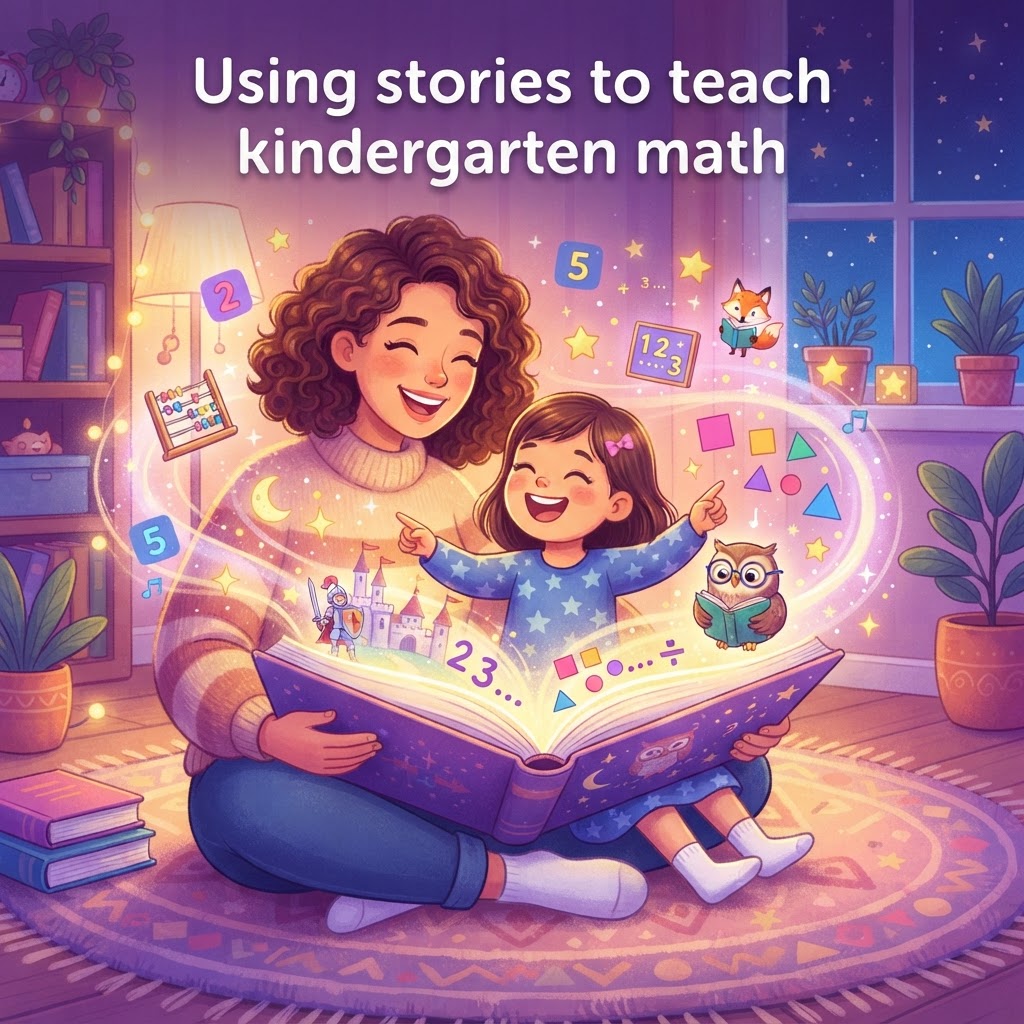
Kindergarten math does not have to start with worksheets. Kindergarten math stories can turn counting, comparing, patterning, and shapes into ideas children can see, act out, and remember.
For teachers, stories offer something especially powerful: a shared context. When children help three bears set the table or count six stepping stones for a frog, math stops feeling abstract. It becomes part of a meaningful event, which is why teaching math with stories works so well in early childhood classrooms.
Why do stories help children learn kindergarten math?
Stories help children learn math because they make abstract ideas concrete and memorable. In kindergarten, children understand new concepts best when those concepts are tied to language, pictures, movement, and real-life situations.
A well-chosen story naturally supports early math talk. You can ask children to count objects, compare sizes, predict what comes next, notice patterns, or describe positions like under, behind, and next to. That kind of discussion builds both math vocabulary and reasoning.
This approach also matches what early childhood research tells us. The National Association for the Education of Young Children has highlighted how storybooks can support number, geometry, and problem-solving when teachers pair read-alouds with intentional questions. The National Council of Teachers of Mathematics also emphasizes that young children learn math through rich experiences, communication, and meaningful contexts. And the Center on the Developing Child at Harvard University has long noted that strong early language experiences support later learning across domains, including math.
In practice, math stories for kindergarten work because they:
- lower anxiety by making math feel playful
- give children visual and verbal clues
- support attention through character and plot
- create repeated chances to hear and use math language
- invite hands-on follow-up activities
When teachers revisit the same story over several days, children often deepen their understanding quickly. The first read builds comprehension. The second and third reads open space for counting, classifying, and explaining.
What should teachers look for in strong kindergarten math stories?
The best kindergarten math stories are simple, visual, and easy to pause during. A strong math story gives you obvious places to ask questions, model thinking, and connect the text to manipulatives or movement.
Not every picture book is a math book, and that is okay. Many ordinary classroom stories can become kindergarten math activities if they include quantity, order, shape, size, or problem-solving.
Look for stories with:
- clear quantities children can count or compare
- repetition that supports repeated math language
- visuals that make sets, patterns, or positions easy to see
- simple plots so the math idea stays manageable
- action that children can act out with counters, blocks, or drawings
For example, a story about animals lining up can support order and position. A story about sharing snacks can support addition, subtraction, and fair shares. A story about building houses can support shape and measurement language.
If you already use stories across the day, this approach fits naturally with literacy too. Many teachers find that combining math talk with read-aloud routines strengthens comprehension and oral language at the same time, much like these story-based reading lessons.
What are five story-based math activities for kindergarten?
The most effective story-based math activities are short, interactive, and easy to repeat. These five ideas help teachers turn a read-aloud into meaningful kindergarten math activities without adding a lot of prep.
1. How can you use a count-and-move retell?
A count-and-move retell turns the story into a physical counting task. After reading, invite children to act out the events while counting each step, jump, clap, or object.
Try prompts like:
- “Let’s help the rabbit take 5 hops to the garden.”
- “Can we place 3 apples in the basket?”
- “How many children are left if 2 go home?”
This works well for one-to-one correspondence and cardinality. It is especially helpful for children who learn best through movement.
2. How can you act out addition and subtraction in a story?
Story acting makes joining and separating feel real. Use puppets, counters, or students as characters to model what happens in the story.
For example:
- “Two ducks were in the pond. One more duck came. How many ducks now?”
- “Five cookies were on the plate. The bear ate two. How many are left?”
Keep the numbers small and visible. In kindergarten, the goal is not speed. It is understanding what the action means.
3. How can you build patterning into a story lesson?
Patterns become easier when children can connect them to repeated events or objects in a story. After reading, ask children to recreate a pattern they noticed or invent a new one from the story world.
Ideas include:
- red-blue-red-blue capes for superheroes
- leaf-rock-leaf-rock for a forest path
- clap-stomp-clap-stomp for a character’s marching rhythm
Let children name the unit of repeat. That simple conversation strengthens algebraic thinking in age-appropriate ways.
4. How can you teach comparing and sorting with story objects?
Sorting and comparing help children notice attributes. After a story, give students picture cards or manipulatives based on the characters or objects and ask them to sort by size, color, shape, or type.
Then ask:
- “Which group has more?”
- “Which has fewer?”
- “How do you know?”
- “Can you sort them a different way?”
This activity supports reasoning because children must justify their choices, not just complete a task.
5. How can you explore shapes and positions through the setting?
Story settings are perfect for geometry and spatial language. Children can identify shapes in illustrations and describe where objects are located.
You might ask:
- “What shapes do you see in the house?”
- “Is the cat under or beside the table?”
- “Can you build the bridge from rectangles and triangles?”
This makes geometry feel purposeful rather than isolated. It also supports oral language development for young learners.
How can teachers differentiate math stories for kindergarten learners?
Differentiation works best when teachers keep the same story but adjust the task, language, or level of support. That way, the whole class shares a common experience while each child works at an appropriate level.
Here are practical ways to differentiate teaching math with stories:
- For emerging learners: use smaller numbers, visual supports, and concrete objects. Focus on counting, matching, and yes-or-no comparison questions.
- For on-level learners: add “How do you know?” and “What comes next?” prompts. Encourage drawing or showing thinking with manipulatives.
- For advanced learners: extend the story problem. Ask children to create a new ending with different numbers, compare two solutions, or explain a pattern rule.
- For multilingual learners: preteach key vocabulary like more, less, first, and next. Use gestures, pictures, and repeated sentence frames.
- For children needing extra support: keep routines predictable. Re-read the same text over several days and use consistent question types.
Small-group follow-up is often where growth becomes visible. A whole-group read-aloud introduces the idea, and centers or table work give children time to rehearse it.
How can teachers use InstaTales for kindergarten math lessons?
InstaTales can support math instruction by helping teachers create short, personalized stories around specific math goals. Instead of searching for the perfect book, you can build a story that matches your class theme, target skill, and students’ interests.
With InstaTales for teachers, educators can design stories about counting dinosaurs, comparing jungle animals, sharing snacks, or finding shapes in a town. You can also create your own personalized bedtime story for a lesson opener, small-group intervention, or home connection.
A few smart ways to use it in math lessons:
- generate a story focused on one skill, like counting to 10
- personalize characters to boost engagement
- create multiple versions of the same lesson for differentiation
- use story templates for faster planning
- save successful lessons in your story library for re-use and re-reading
A sample teacher prompt might be:
“Write a short kindergarten story about Maya the fox collecting 7 acorns. Include counting, comparing who has more, and one simple pattern in the pictures.”
That kind of customization is helpful when you want math stories for kindergarten that match seasonal units, classroom interests, or intervention goals. It also gives teachers a flexible bridge between literacy, play, and math.
How can teachers check understanding after a math story?
The best assessment after a math story is quick, observable, and tied to the lesson goal. In kindergarten, you often learn the most by listening to children explain, show, or act out their thinking.
Try simple checks like:
- asking a child to show the quantity with counters
- having partners explain who has more and why
- using an exit ticket with a quick draw
- inviting students to retell the math event from the story
- noting who uses math vocabulary independently
If a child can count the objects, explain the action, and connect it back to the story, that is strong evidence of understanding. Keep your focus on reasoning, not just right answers.
Frequently Asked Questions
What makes a good math story for kindergarten?
A good math story for kindergarten has simple language, clear pictures, and an obvious math idea such as counting, comparing, shapes, or patterns. It should also give the teacher natural places to pause and ask questions.
How often should teachers use kindergarten math stories?
Teachers can use kindergarten math stories several times a week, even in short 10-15 minute lessons. Re-reading the same story across a few days often leads to better understanding than always using a new text.
Can teachers use made-up stories instead of published books?
Yes, made-up stories can work very well, especially when they match a specific math goal. Personalized stories are often even more engaging because they reflect children’s names, interests, and classroom themes.
Are story-based math lessons enough on their own?
Story-based lessons are powerful, but they work best when paired with hands-on practice. Children usually need time to act out, build, sort, count, and talk about the math after the read-aloud.
Do math stories help struggling learners?
Yes, many struggling learners benefit from the added context, visuals, and repetition that stories provide. A narrative can make math feel safer and more understandable, especially when teachers use manipulatives and repeated language.
Can story-based math connect to other subjects?
Absolutely. Story-based math fits naturally with literacy, science, writing, and social studies themes, which makes planning more efficient and learning more connected for young children.
Ready to Create a Personalized Bedtime Story?
Use our free AI bedtime story generator to create a personalized illustrated story for your child in 30 seconds — no credit card needed.
Popular story types:
Maya Rodriguez
Lead Content Editor & Early Literacy Specialist
Maya is a former early childhood educator and literacy specialist with over a decade of experience helping children develop a love of reading. She leads content at InstaTales, where she writes about the science of storytelling, child development, and how families can use personalized AI stories to build literacy and emotional resilience.
instatales.ai