Second Grade Social Studies Stories That Teach
Make social studies engaging for second grade students with stories. Practical strategies, story ideas, and classroom activities for teachers.
✦ Key Takeaways
- •Stories work well because they turn big social studies concepts into experiences children can follow.
- •Many second grade units fit stories beautifully because the standards focus on people, communities, and change over time.
- •The best second grade social studies activities use stories as a launch point, not the whole lesson.
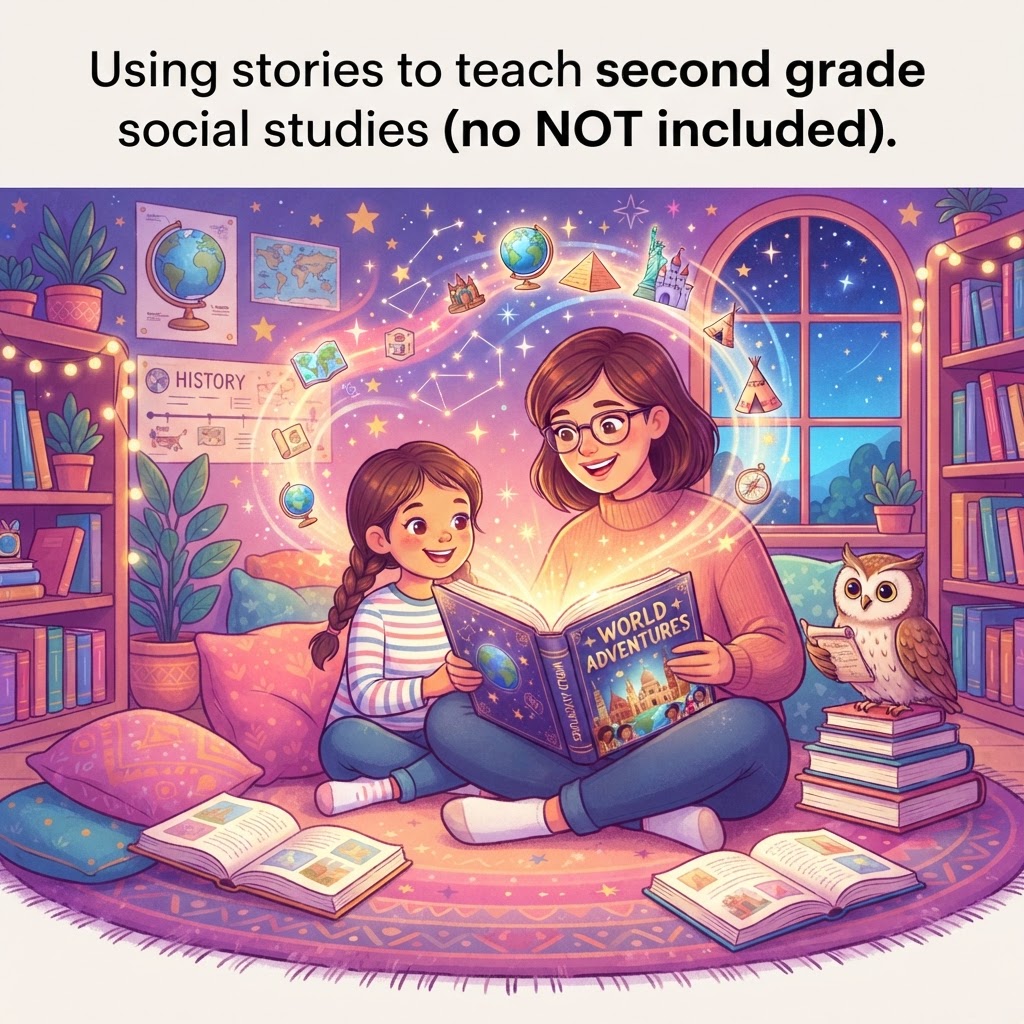
When you use stories in social studies, second graders do more than remember facts. They begin to see how communities work, why rules matter, how the past shapes the present, and where they fit in the wider world. That is why second grade social studies stories can be one of the most effective tools in an elementary classroom.
For teachers, the real benefit is practical: stories make abstract standards feel concrete. Whether you are teaching citizenship, geography, timelines, or cultural traditions, teaching social studies with stories helps students connect ideas to people, places, and problems they can understand.
Why do second grade social studies stories work so well?
Stories work well because they turn big social studies concepts into experiences children can follow. For second graders, a narrative gives structure, emotion, and meaning to ideas like community, fairness, history, and geography.
Developmentally, most second graders are still concrete thinkers. They learn best when content is tied to characters, actions, and clear cause-and-effect. A story about a child moving to a new neighborhood can teach maps, community helpers, and local rules more effectively than a worksheet alone.
Research supports this approach. Jerome Bruner’s work on narrative learning showed that people naturally organize information through stories. The Center on the Developing Child at Harvard University also emphasizes that children learn best through meaningful, connected experiences rather than isolated facts.
In practice, social studies stories for second grade also support:
- Vocabulary growth through repeated exposure to words like citizen, tradition, landmark, and responsibility
- Listening and comprehension during read-alouds and discussion
- Empathy and perspective-taking when students consider how different people live and make choices
- Memory and recall because story events are easier to remember than disconnected details
If you are already using narrative in literacy blocks, it is easy to extend that strength into social studies. These second grade reading lessons with stories often pair naturally with social studies content.
Which second grade social studies topics fit stories best?
Many second grade units fit stories beautifully because the standards focus on people, communities, and change over time. Topics that work especially well are the ones students can imagine through everyday life.
The National Council for the Social Studies highlights themes such as culture, time, continuity and change, people and places, and civic ideals. In second grade, that often looks like:
- Families and cultural traditions
- Communities and community helpers
- Maps, neighborhoods, and landmarks
- Rules, citizenship, and fairness
- Past and present comparisons
- Goods, services, and simple economics
A good rule is simple: if students can picture a person living the concept, it can become a story. A character delivering mail, visiting a market, celebrating a holiday, or helping solve a playground conflict gives the lesson a clear human anchor.
What are five story-based second grade social studies activities teachers can use?
The best second grade social studies activities use stories as a launch point, not the whole lesson. Start with a short narrative, then move students into talk, drawing, mapping, writing, or problem-solving.
1. How can a community helper story build local knowledge?
Use a story about a firefighter, librarian, nurse, crossing guard, or bus driver to teach how communities meet people’s needs. After the read-aloud, ask students to identify the helper’s job, tools, and service.
Then extend the lesson with:
- A community helper chart
- A “Who helps us when...?” matching activity
- A class map showing where that helper works
This is an easy entry point for teaching social studies with stories because second graders already know these people from daily life.
2. How can a then-and-now story teach timelines?
Read or tell a story set in two time periods, such as a grandparent’s school day compared with a child’s school day now. Students can listen for what stayed the same and what changed.
Follow up with a simple timeline:
- First
- Next
- Then
- Now
This activity builds chronological thinking without making history feel too distant. It also works well alongside second grade writing lessons with stories, especially when students write their own “then and now” mini books.
3. How can a neighborhood adventure story teach map skills?
Use a story in which a character travels from home to several places in the community. As students listen, they track the route and identify landmarks.
Afterward, have students create:
- A map with a title
- Symbols and a legend
- A compass rose
- A route from one place to another
For extra depth, pair the lesson with primary images or local history materials from the Library of Congress. This helps students connect fictional narratives to real places and sources.
4. How can a citizenship story support classroom discussions about rules and fairness?
Choose a story where a character faces a problem involving fairness, responsibility, or helping others. Pause at key moments and ask, “What should the character do next?” and “Which choice helps the community most?”
This activity works because it lets students rehearse civic thinking in a safe way. You can end with a class anchor chart on:
- Rights
- Responsibilities
- Rules
- Respectful choices
These conversations often transfer directly into classroom management, making them especially valuable social studies stories for second grade classrooms.
5. How can a family tradition story expand cultural understanding?
Read a story about a family tradition, celebration, meal, or special place. Then invite students to compare the story with their own experiences.
A strong extension is a “tradition share” where students:
- Draw or write about one family tradition
- Interview a family member
- Compare two traditions using a Venn diagram
This helps children see both differences and common ground. It also supports inclusive teaching by making every student’s background part of the curriculum.
How can teachers differentiate social studies stories for second graders?
Differentiation matters because second graders vary widely in reading level, language development, attention, and background knowledge. The good news is that stories are flexible and easy to adjust without watering down the social studies content.
Try these simple supports:
- For multilingual learners: preteach 3-5 key words with pictures and gestures
- For emerging readers: keep texts short, repetitive, and supported by visuals
- For students who need structure: use story sequence cards and sentence frames
- For advanced learners: ask them to compare perspectives or add a research extension
- For students with writing challenges: allow oral responses, drawing, or partner talk first
You can also vary the final product. One student may label a map, another may write a paragraph, and another may act out the story sequence. The learning goal stays the same even if the output changes.
How can InstaTales support second grade social studies lessons?
InstaTales can support social studies by helping teachers create stories that match a specific topic, class interest, or local context. Used thoughtfully, it saves planning time while keeping lessons personal and engaging.
With InstaTales for teachers, you can build custom stories around second grade topics such as neighborhoods, citizenship, cultural traditions, or simple history. For example, you might generate a story about a child learning how mail gets delivered, a family comparing past and present school life, or classmates solving a fairness problem on the playground.
A few practical ways to use it:
- Start with one of the ready-made story templates and adapt it to your unit
- Create multiple versions of the same story for small-group differentiation
- Include familiar settings, names, or community landmarks to build relevance
- Save useful stories in your story library for review, centers, or sub plans
The key is to treat AI-generated stories as a teaching tool, not a replacement for instruction. Read the story aloud, pause for discussion, add visuals, and connect it back to your standards. When used that way, InstaTales can make second grade social studies activities more responsive and easier to prep.
Frequently Asked Questions
What can stories teach in second grade social studies?
Stories can teach community roles, map skills, timelines, citizenship, fairness, culture, and simple economics. They help students understand these ideas through characters and events instead of isolated vocabulary words.
How long should a story-based social studies lesson be?
A strong lesson can fit into 20 to 35 minutes. Many teachers use a short read-aloud, 5 to 10 minutes of discussion, and a quick follow-up task such as mapping, sequencing, or writing.
Can fictional stories be used for social studies?
Yes, if the social studies content is accurate and clearly connected to the learning goal. Fiction is especially useful for introducing concepts, building empathy, and sparking discussion before students examine real examples or sources.
How do I assess learning from social studies stories?
Use simple checks such as exit tickets, labeled drawings, oral retells, map tasks, or short written responses. The best assessments ask students to apply the concept, not just repeat details from the story.
How do stories support cross-curricular learning?
Stories naturally combine social studies with reading, speaking, listening, and writing. That makes them ideal for integrated instruction, especially in classrooms where time for social studies is limited.
Ready to Create a Personalized Bedtime Story?
Use our free AI bedtime story generator to create a personalized illustrated story for your child in 30 seconds — no credit card needed.
Popular story types:
Maya Rodriguez
Lead Content Editor & Early Literacy Specialist
Maya is a former early childhood educator and literacy specialist with over a decade of experience helping children develop a love of reading. She leads content at InstaTales, where she writes about the science of storytelling, child development, and how families can use personalized AI stories to build literacy and emotional resilience.
instatales.ai