Third Grade Social Studies Stories That Teach
Make social studies engaging for third grade students with stories. Practical strategies, story ideas, and classroom activities for teachers.
✦ Key Takeaways
- •Stories help third graders remember content because they organize facts into a meaningful sequence.
- •The best topics for stories are the ones that involve people, choices, systems, and change.
- •These third grade social studies activities work in whole-group lessons, small groups, centers, or project-based units.
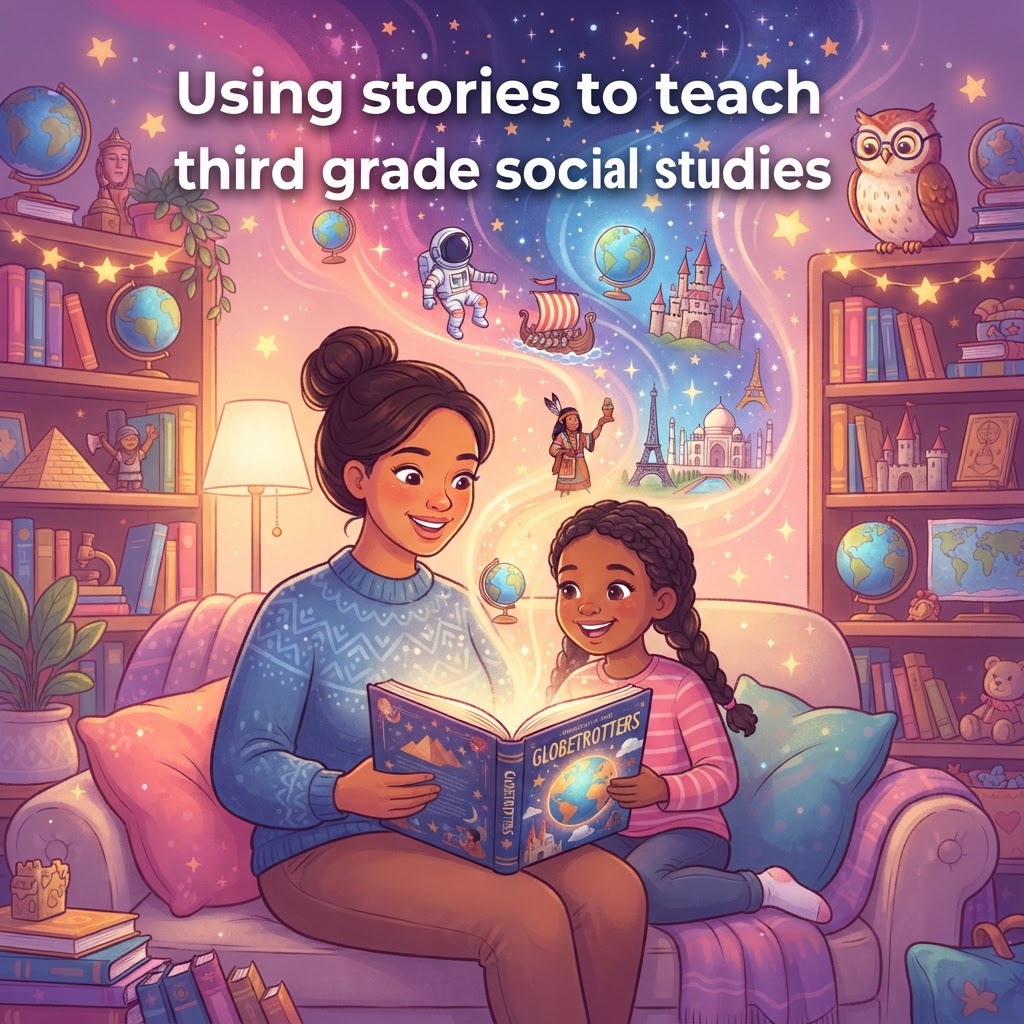
Third grade is a great time to make social studies feel alive. At this age, students are ready to think about communities, geography, citizenship, economics, and change over time—but they still learn best when ideas are concrete, human, and memorable. That is why third grade social studies stories work so well. Instead of asking children to memorize isolated facts, teachers can use narrative to help them understand how people, places, and decisions connect.
Why do stories work so well in third grade social studies?
Stories help third graders remember content because they organize facts into a meaningful sequence. When students follow a character, a problem, and a solution, social studies ideas become easier to understand and discuss.
This fits what we know from education research. Jerome Bruner wrote about narrative as a powerful way humans make meaning, and cognitive scientist Daniel Willingham has described stories as especially memorable because they follow clear cause-and-effect patterns. Research from Harvard’s Center on the Developing Child also highlights how attention, memory, and emotional connection support learning.
In practical terms, teaching social studies with stories helps students:
- Build background knowledge
- Understand perspective and point of view
- Remember vocabulary in context
- Grasp chronology, cause, and change over time
- Connect social studies ideas to real life
Stories are especially useful in third grade because students are developing stronger empathy and perspective-taking. A lesson about local government becomes more meaningful when students follow a child trying to improve a park. A lesson on economics sticks better when students meet a farmer, a shop owner, and a customer in the same story.
The National Council for the Social Studies also emphasizes meaningful, inquiry-based learning. Narrative supports that goal by giving students a reason to ask questions, compare choices, and explain how communities work.
Which third grade social studies topics are best taught through stories?
The best topics for stories are the ones that involve people, choices, systems, and change. In third grade, that includes many core standards.
Social studies stories for third grade are especially effective for:
- Communities and community roles: firefighters, farmers, librarians, mayors, sanitation workers
- Geography and maps: landforms, regions, landmarks, routes, natural resources
- Civics and citizenship: rules, rights, responsibilities, leadership, problem-solving
- Economics: producers, consumers, goods, services, saving, spending
- History and continuity/change: how towns, transportation, schools, or jobs have changed over time
A simple way to choose a story-friendly lesson is to ask: Can students understand this better through a person’s experience? If the answer is yes, a narrative approach will likely help.
For many teachers, story work also builds naturally from earlier grades. If your students benefited from second grade social studies stories, third grade is the perfect year to deepen the strategy with more comparison, discussion, and writing.
What are five effective story-based social studies activities for third grade?
These third grade social studies activities work in whole-group lessons, small groups, centers, or project-based units. Each one connects narrative with clear social studies goals.
1. Community Helper Diary
Have students write or listen to a first-person diary from a community member. This could be a crossing guard, nurse, bus driver, or park ranger.
- Start with: “My job helps the community because…”
- Add a problem the character faces during the day
- Ask students to identify the goods, services, or responsibilities in the story
This activity teaches interdependence and helps students see how communities function.
2. Map Quest Story
Create a short adventure in which a character must travel across town using a map. The story should include cardinal directions, landmarks, and map symbols.
- Give students a simple map
- Pause during the read-aloud to ask, “Which way should the character go next?”
- Have students retell the route using geographic language
This works well for geography standards because students apply map skills for a purpose, not just as a worksheet exercise.
3. Then-and-Now Town Tale
Use a story that compares the same town in two different time periods. One character might live in the past and another in the present, or a modern student might “visit” the town long ago.
- Compare transportation, homes, jobs, and communication
- Use a T-chart for “same” and “different”
- End with a discussion about why communities change
This helps students understand continuity and change over time, which is a major third grade social studies idea.
4. Market Day Mini-Drama
Turn economics into a classroom story and role-play. Create characters such as a baker, farmer, shopper, and delivery worker, then give them a problem to solve.
- One character produces goods
- Another provides a service
- Students act out buying, selling, and decision-making
Because the story is social and active, students quickly understand producer/consumer relationships. It also gives strong oral language practice.
5. Citizenship Story Circle
Present a classroom or community problem in story form: a broken playground bench, litter in a park, or a school rule students do not understand. Then invite students to continue the story with possible solutions.
- Ask: “What should the character do first?”
- Discuss fairness, responsibility, and community action
- End with a short reflection or class vote
This is one of the strongest ways to teach civics. Students are not just naming good citizenship; they are applying it.
How can teachers differentiate social studies stories for third grade learners?
Differentiation works best when the content stays the same but the support changes. In social studies, that means all students can explore the same big idea through different reading levels, response formats, and language supports.
Here are practical ways to differentiate:
- Adjust text complexity: Use a shorter version of the story for some students and a richer version for others.
- Read aloud first: Many students understand grade-level concepts well when the decoding demand is removed.
- Preteach vocabulary: Introduce words like citizen, region, producer, and government with visuals before reading.
- Use sentence frames: Try frames such as “The community changed because…” or “The character showed responsibility when…”
- Offer response choices: Students can draw a map, act out a scene, write a diary entry, or record an oral retelling.
- Support multilingual learners: Add picture cards, gestures, home-language discussion, and repeated phrases.
- Chunk the lesson: Pause often for partner talk, sketch-notes, or quick checks for understanding
Story-based lessons also pair well with literacy instruction. If you want to strengthen comprehension alongside content, these ideas connect nicely with third grade reading instruction.
Research from the Institute of Education Sciences consistently supports explicit vocabulary teaching, comprehension scaffolds, and discussion-rich instruction. Stories make all three easier to build into one lesson.
How can InstaTales support third grade social studies lessons?
InstaTales can help teachers create engaging, standards-aligned stories quickly. It is especially useful when you want to match a story to a specific unit, reading level, or local community topic.
A practical classroom workflow might look like this:
- Choose a standard, such as communities, maps, or economics
- Generate a custom story based on that goal
- Personalize the setting with local landmarks, student interests, or familiar community roles
- Read it aloud, annotate together, and pause for discussion
- Follow with a map, photo, timeline, primary source, or writing task
For classroom planning and assignments, InstaTales for teachers is the best place to start. Teachers can also use ready-made story templates to speed up lesson prep and save differentiated versions in your story library for small groups, centers, or re-reading.
The strongest use of AI is not to replace social studies instruction, but to support it. A custom story can introduce a unit, model a concept, spark discussion, or provide an accessible entry point before students move into nonfiction texts and source analysis.
That balance matters. High-quality third grade social studies stories should lead students back to real-world thinking: comparing evidence, asking questions, and understanding how people live together in communities.
Frequently Asked Questions
What social studies topics are usually taught in third grade?
Third grade often includes communities, geography, civics, economics, and local or regional history. Exact standards vary by state, but these themes are common across many classrooms.
How long should a social studies story be for third graders?
Short is usually best for direct instruction. Aim for 300 to 700 words for a read-aloud or small-group lesson, then extend the learning with discussion, maps, writing, or role-play.
Can AI-generated stories be used in social studies class?
Yes, when teachers review them carefully for accuracy, bias, and alignment to standards. AI stories work best as a teaching tool alongside nonfiction texts, visuals, and class discussion.
How do stories help struggling readers in social studies?
Stories give students context, repetition, and a clear structure, which makes new content easier to follow. A strong read-aloud also lets students access grade-level ideas even if decoding is still developing.
Should social studies stories replace textbooks or informational texts?
No. Stories are most effective as a bridge into the content, not a replacement for all other materials. Use them to build interest and understanding, then connect students to maps, primary sources, and informational reading.
Ready to Create a Personalized Bedtime Story?
Use our free AI bedtime story generator to create a personalized illustrated story for your child in 30 seconds — no credit card needed.
Popular story types:
Maya Rodriguez
Lead Content Editor & Early Literacy Specialist
Maya is a former early childhood educator and literacy specialist with over a decade of experience helping children develop a love of reading. She leads content at InstaTales, where she writes about the science of storytelling, child development, and how families can use personalized AI stories to build literacy and emotional resilience.
instatales.ai