Why Your Child Keeps Asking for the Same Story (and Why That's a Good Thing)
If your child demands the same bedtime story every night, you're not alone. Here's the science behind why kids love repetition — and why it's great for their development.
✦ Key Takeaways
- •Repetition is one of the most powerful learning tools in early childhood — and children are wired to use it instinctively.
- •Every time your child hears a familiar story, their brain is literally rewiring itself for the better.
- •Hearing the same story multiple times is one of the most effective ways young children acquire vocabulary and grammar.
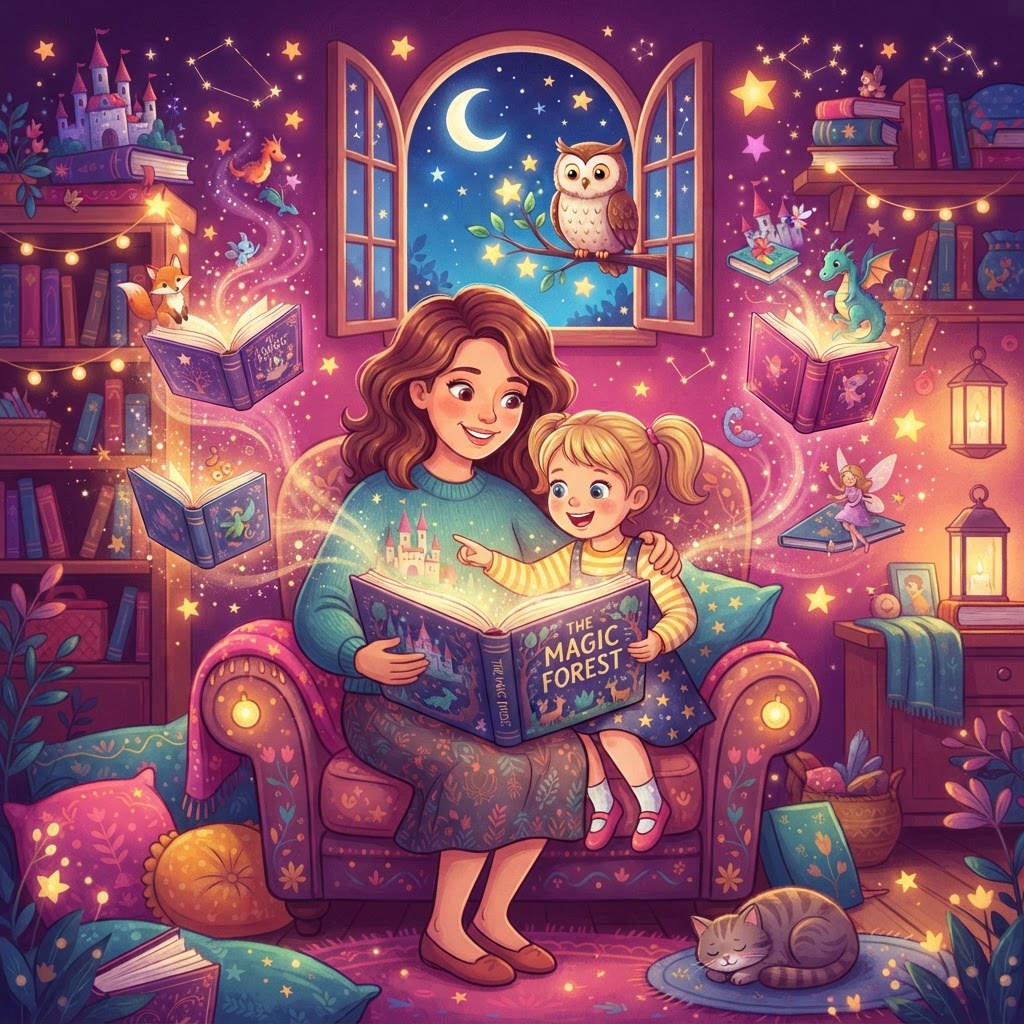
If you've read Goodnight Moon forty-seven times this month, you're in excellent company. Parents everywhere know the particular mix of love and quiet exasperation that comes with a child who insists — demands — the exact same story, night after night. Before you quietly hide the book behind the couch cushions, take a breath. What looks like stubbornness is actually something remarkable happening inside your child's developing brain.
Why Do Children Love Repetition So Much?
Repetition is one of the most powerful learning tools in early childhood — and children are wired to use it instinctively. When a child hears the same story again, their brain isn't experiencing boredom. It's doing deep, focused work.
According to research from the American Psychological Association, repeated exposure to the same material helps children consolidate memory, build comprehension, and strengthen neural connections. Each re-reading is a fresh opportunity to notice something new — a word, a feeling, a pattern — that slipped past them the first time.
Think of it like a song you know by heart. The familiarity doesn't make it less enjoyable; it makes it richer.
How Does Repetition Build a Child's Brain?
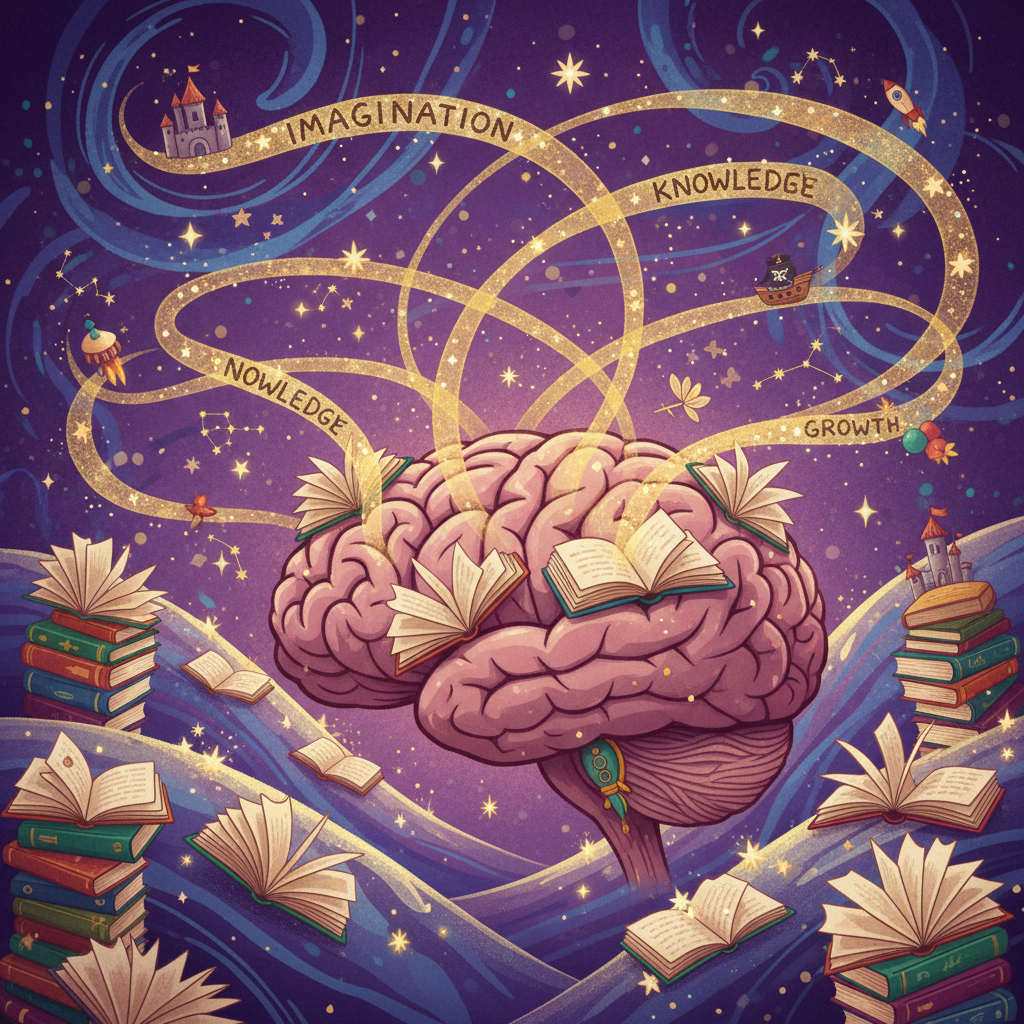
Every time your child hears a familiar story, their brain is literally rewiring itself for the better. Repetition strengthens neural pathways — the connections between brain cells that form the foundation of language, memory, and thought.
Dr. Maryanne Wolf, a cognitive neuroscientist and author of Proust and the Squid, has written extensively about how the reading brain develops through repeated exposure to language patterns. When children encounter the same words and sentence structures again and again, those patterns become automatic, freeing up cognitive resources for higher-level thinking like inference and imagination.
This is especially significant for children aged 1–5, when the brain is at its most plastic and receptive. Repetitive stories during this window aren't a quirk — they're a biological strategy.
What Does Repetition Do for Language Development?
Hearing the same story multiple times is one of the most effective ways young children acquire vocabulary and grammar. Research published by the National Institutes of Health found that children learned significantly more new words from repeated readings of the same book than from a single reading of multiple different books.
Here's why that matters in practice:
- The first time a child hears an unfamiliar word, they might barely notice it.
- The second time, they begin to attach meaning to it.
- By the third, fourth, or fifth time, that word is becoming part of their active vocabulary.
Repeated stories also help children internalise sentence rhythm, story structure, and cause-and-effect relationships — all foundational skills for reading comprehension and communication. When your toddler "reads" their favourite book aloud from memory, that's not just adorable. That's early literacy in action.
Why Does the Same Story Feel Safe for a Child?
Children crave predictability because it makes the world feel manageable. This is deeply tied to emotional development, not just cognitive development.
Young children live in a world where so much is uncertain and new. They don't fully control their environment, their schedule, or what happens next. A familiar story — one where they know the wolf huffs and puffs, where they know the bunny gets tucked in — offers something deeply comforting: certainty.
Child development specialists at Zero to Three, a leading nonprofit focused on infant and toddler development, note that predictable routines help regulate children's stress responses and build emotional resilience. A beloved bedtime story isn't just a story. It's a ritual, a signal that all is well, and a safe space where the ending is always good.
This is also why children often become upset when you skip a page or change a word. They're not being precious — they're protecting something that feels emotionally important to them.
What Is the 'Mastery' Effect in Children's Repetition?
There's a specific kind of satisfaction children get from knowing something completely — and repeated stories feed that need beautifully. Developmental psychologists call this the mastery effect: the joy of competence, of understanding something so thoroughly that you can predict, recite, and even correct others.
When your four-year-old solemnly corrects you for saying "ran" instead of "scurried," they're not being pedantic. They're experiencing the profound pleasure of expertise. This sense of mastery builds confidence, self-esteem, and a positive relationship with learning itself — qualities that will serve them throughout their education.
How Can Parents Gently Introduce New Stories?
The goal isn't to eliminate the comfort of repetition — it's to gradually expand the library alongside it. A simple and effective approach is the 'one old, one new' method: read the beloved familiar story first, then introduce something new as a bonus.
This works because the familiar story satisfies your child's emotional need for security and mastery. With that need met, they often have more openness and curiosity available for something unfamiliar.
A few practical tips:
- Let them lead the new story. Offer two or three new choices and let your child pick. Agency increases buy-in.
- Link new to familiar. If they love a bunny story, find another story featuring a bunny. Build bridges.
- Don't force it. If they want the old story again tonight, that's fine. Try again tomorrow.
- Try AI-generated stories like those from InstaTales, where a beloved character — say, their favourite brave little fox — can appear in a brand-new adventure every night. It's the comfort of the familiar and the excitement of something new, all at once.
When Should Parents Stop Worrying About Story Repetition?
In almost every case, you shouldn't worry at all. The desire for the same story typically peaks between ages 2 and 5, then naturally fades as children's cognitive and social worlds expand. This is a normal, healthy, and time-limited phase.
The exceptions worth noting: if repetitive behaviour extends far beyond stories and seems compulsive, rigid, or distressing to the child, it's always worth a gentle conversation with your paediatrician. But for the vast majority of children, repeated story requests are simply part of healthy development unfolding exactly as it should.
Frequently Asked Questions
Is it normal for my child to want the same bedtime story every night?
Absolutely — it's one of the most common behaviours in early childhood. Children aged 2–5 in particular use repetition as a developmental tool, not out of limited imagination. It's a sign their brain is working hard, not that they're bored or stuck.
How many times is too many times to read the same story?
There's no firm upper limit from a developmental standpoint. If your child is engaged, asking questions, or reciting along — the repetition is still doing meaningful work. Most children naturally move on when they're developmentally ready.
Does reading the same book repeatedly help with reading skills?
Yes, significantly. Research shows that repeated readings of the same book lead to greater vocabulary acquisition, improved comprehension, and stronger phonological awareness than single readings of multiple books. Familiar stories are a powerful early literacy tool.
How can I introduce new stories without upsetting my child?
Try the 'one old, one new' approach — read the favourite first, then offer a new story as an extra. Giving your child a sense of choice and control also helps. AI story tools like InstaTales can ease this transition by featuring familiar characters in fresh narratives, making new stories feel safer and more exciting.
Why does my child get upset when I change a word in their favourite story?
Because they know the story so well that any deviation feels wrong — and that's actually a cognitive achievement. Your child has memorised the text, rhythm, and meaning well enough to detect an error. It shows strong auditory memory and attention to language detail.
At what age do children usually stop wanting the same story repeated?
Most children begin to naturally seek more variety between ages 5 and 7, as their reading ability, social life, and imaginative capacity expand. Until then, embrace the repetition — it's doing far more good than you might realise.
Your child's insistence on the same story, again, please is not a quirk to be corrected. It's a window into a beautifully developing mind — one that is learning, growing, and finding comfort in the magic of story.
When you're ready to gently expand their bedtime library, InstaTales makes it easy to create personalised, AI-generated stories that feature the characters your child already loves, in brand-new adventures every night. New story, familiar heart — the best of both worlds.
Ready to Create a Personalized Bedtime Story?
Use our free AI bedtime story generator to create a personalized illustrated story for your child in 30 seconds — no credit card needed.
Popular story types:
Maya Rodriguez
Lead Content Editor & Early Literacy Specialist
Maya is a former early childhood educator and literacy specialist with over a decade of experience helping children develop a love of reading. She leads content at InstaTales, where she writes about the science of storytelling, child development, and how families can use personalized AI stories to build literacy and emotional resilience.
instatales.ai