World Book Day Stories for Kids: 7 Activities
Celebrate World Book Day with these story-based activities for kids — book stories, reading tales, and literary adventures.
✦ Key Takeaways
- •World Book Day stories for kids matter because they connect reading with joy, identity, and relationships.
- •A costume parade becomes more meaningful when each child has a mini story mission.
- •A cozy reading fort can turn a familiar read-aloud into a full sensory story experience.
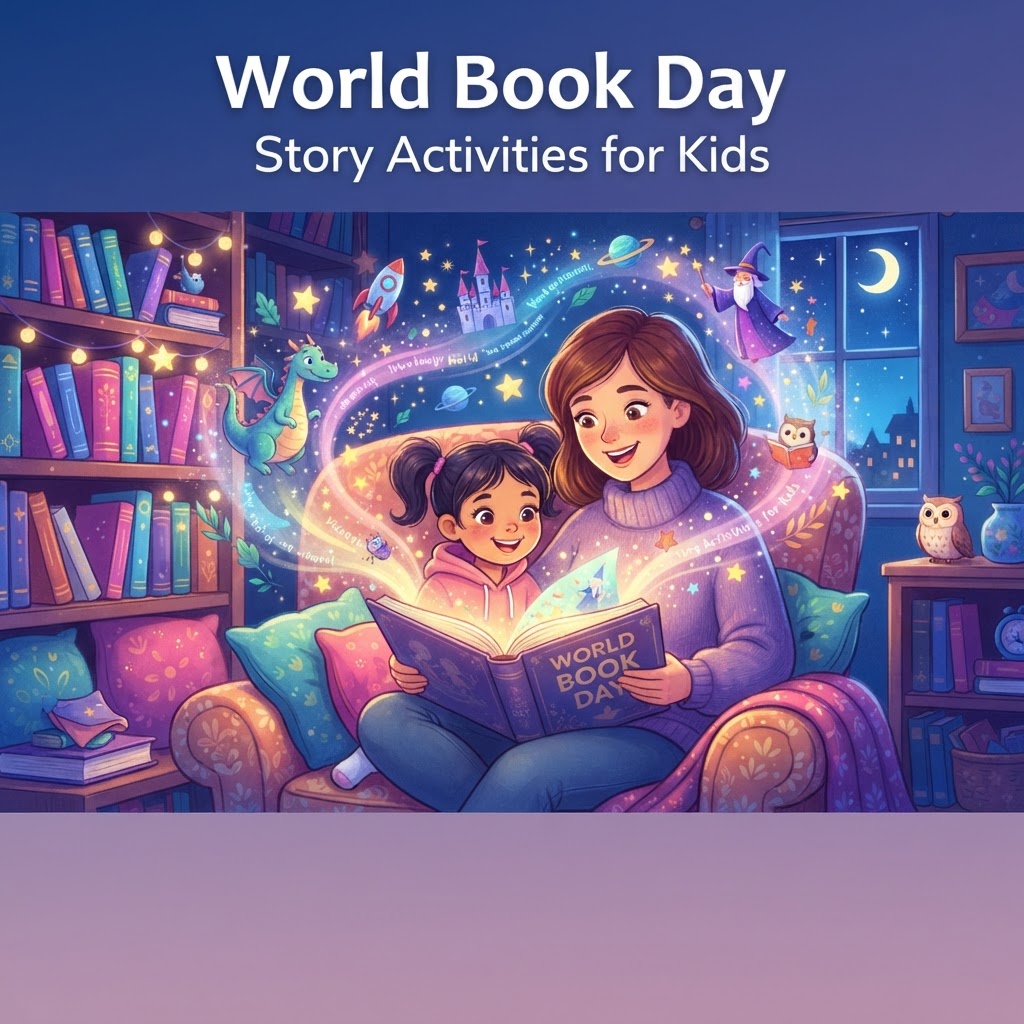
World Book Day is the perfect moment to turn reading into play. With a few simple props and a strong story prompt, you can create World Book Day stories for kids that feel festive, meaningful, and easy to remember.
These book day story activities work well at home, in classrooms, and in libraries. They are designed for children ages 1-10, with simple ways to scale up or down. If your family already enjoys seasonal storytelling, you may also like these spring story activities for another reading-rich celebration.
Why are World Book Day stories for kids such a powerful celebration?
World Book Day stories for kids matter because they connect reading with joy, identity, and relationships. When children dress up, retell, act, and imagine, books stop feeling like assignments and start feeling like adventures.
That matters for development. Shared reading supports vocabulary, listening, emotional connection, and early literacy. The American Academy of Pediatrics and Reach Out and Read both highlight how reading together strengthens language and bonding. Research on dialogic reading, developed by Grover Whitehurst and colleagues, also shows that children learn more when adults ask questions and invite them to join the story, a strategy explained clearly by Reading Rockets.
World Book Day, recognized globally by UNESCO, is a great excuse to build those habits. The best reading celebration stories are simple, interactive, and centered on the child’s voice.
How can you turn a costume parade into a story quest?
A costume parade becomes more meaningful when each child has a mini story mission. Instead of only showing a costume, children step into character and solve a gentle story problem.
- Story prompt: “Your book character has lost something important on World Book Day. What is missing, and how will you find it before the celebration begins?”
- Materials: Dress-up clothes or simple costume items, name tags, paper stars, crayons.
- Instructions:
- Ask each child to choose a favorite character from a book.
- Help them answer three quick questions: Who are you? What is your mission? Who can help you?
- Let children parade, then stop at “story stations” where they act out one part of the quest.
- End with a short share: “My character found the missing item by…”
This activity supports oral language and sequencing. For younger children, keep it to one event. For older children, add a beginning, middle, and end.
How can a blanket-fort reading nook become a literary adventure?
A cozy reading fort can turn a familiar read-aloud into a full sensory story experience. Children often listen longer and engage more deeply when the space feels special.
- Story prompt: “Tonight, the reading fort transforms into a secret library. One magical book glows on the shelf. Where does it take you?”
- Materials: Blankets, pillows, flashlight, a stack of favorite books, stuffed animals.
- Instructions:
- Build a small reading nook on the floor or under a table.
- Read one short book aloud, then ask the child which part should continue beyond the final page.
- Invite them to add one new place, one new helper, and one small challenge.
- Let them dictate the ending while you write it down.
This works especially well for toddlers and preschoolers because it combines comfort, repetition, and imagination. If you want a quick starting point, InstaTales offers helpful story templates that make it easy to generate a story in the same cozy, magical style.
How can you run a pass-the-story circle for mixed ages?
A pass-the-story circle is one of the easiest book day story activities for groups. It gives every child a turn and works for siblings, classrooms, or mixed-age library sessions.
- Story prompt: “On World Book Day morning, a mysterious bookmark appears. Whoever holds it can add the next part of the story.”
- Materials: A bookmark or soft object to pass, chart paper or whiteboard, markers.
- Instructions:
- Start with one sentence: “The bookmark shimmered in the sunlight.”
- Pass the bookmark around the circle.
- Each child adds one sentence, one sound effect, or one action.
- Write down the final story and read it back with expression.
For ages 1-4, children can contribute a character, sound, or animal instead of a full sentence. For ages 6-10, encourage richer details such as setting, dialogue, and problem-solving.
How can a story map treasure hunt build comprehension?
A story map treasure hunt helps children understand plot while staying active. It is especially useful for children who learn best through movement.
- Story prompt: “A book-loving explorer must follow story clues hidden around the room to unlock a secret ending.”
- Materials: Sticky notes, simple picture clues, one favorite book, a small prize or paper certificate.
- Instructions:
- Hide 4-6 clues that match story elements: character, setting, problem, helper, solution.
- After reading, ask the child to find each clue and explain how it fits the story.
- At the final clue, invite them to invent a new ending or sequel.
- Celebrate with a “World Book Day Explorer” certificate.
This activity strengthens comprehension, memory, and recall. In classroom settings, teachers can adapt it for stations or partner work through InstaTales for teachers, especially when students are creating follow-up stories from the same prompt.
How can puppet retelling help children remember and express stories?
Puppet retelling is a strong choice because children often express more through play than through direct questioning. When a puppet “tells” the story, even shy children tend to participate.
- Story prompt: “A puppet librarian discovers that the books are whispering after bedtime. What are they trying to say?”
- Materials: Paper bags or socks, markers, scraps of paper, glue, craft sticks.
- Instructions:
- Make two or three simple character puppets.
- Read a short story, then ask the child to retell it using the puppets.
- Add one new scene that did not happen in the original book.
- Record the child’s words if you want to revisit the story later.
Retelling builds narrative structure and comprehension. It also gives parents and educators a window into what the child truly understood, not just what they can answer in a quiz-like format.
How can a reading celebration story jar inspire reluctant readers?
A story jar lowers the pressure for children who feel unsure about reading. Small prompts make the task feel playful, brief, and doable.
- Story prompt: Pull three slips and combine them: a character, a place, and a problem. For example: “A dragon, a library, and a missing moon-shaped bookmark.”
- Materials: Jar or bowl, paper slips, crayons, optional stickers.
- Instructions:
- Write prompts on slips: characters, settings, objects, feelings, and simple problems.
- Let children pull two or three slips at random.
- Ask them to tell, draw, or write a mini story from the combination.
- Display the finished stories on a wall or shelf.
This is one of the most flexible reading celebration stories activities because it meets children where they are. A pre-reader can draw and dictate. A confident reader can write a full page.
How can you use InstaTales for World Book Day stories?
InstaTales makes World Book Day stories for kids more personal, faster to create, and easier to revisit. It is especially helpful when a child wants to become the hero of the story or when adults need an activity that fits different ages.
Here is a simple way to use it:
- Start with a child’s World Book Day costume, favorite book theme, or dream setting.
- Use InstaTales to create your own personalized bedtime story based on that idea.
- Add details that increase engagement, such as the child’s name, favorite animal, or reading goal.
- Save the finished story in your story library so children can re-read it later or share it with family.
For example, a child dressed as a pirate could become “Captain Maya and the Missing Library Treasure.” A child who loves fairies could star in “The World Book Day Fairy Parade.” Personalized stories are often powerful because children see themselves as capable, curious readers inside the narrative.
If you want to extend the celebration beyond one day, pair World Book Day with short weekly read-alouds, re-reading rituals, or more seasonal ideas from the InstaTales blog. That helps turn a special event into a lasting reading habit.
Frequently Asked Questions
What ages are these World Book Day story activities best for?
These activities are designed for ages 1-10, with easy adaptations. Younger children can point, act, and dictate, while older children can write, sequence, and expand the stories independently.
How long should a World Book Day activity last?
Most activities work well in 10-25 minutes. Shorter sessions are often better for younger children, especially if you want to keep the celebration joyful rather than tiring.
Do children need to read independently to join in?
No. Many of the best book day story activities are oral, dramatic, or art-based. A child can fully participate by listening, talking, drawing, or acting out the story.
How can parents make reading celebration stories more engaging?
Use the child’s interests. Favorite animals, costumes, family names, and silly plot twists all help children feel emotionally connected to the story.
Can teachers use InstaTales for classroom World Book Day plans?
Yes. Teachers can use it to generate class stories, differentiated prompts, and follow-up writing tasks. It works especially well when students need the same theme presented at different reading levels.
Ready to Create a Personalized Bedtime Story?
Use our free AI bedtime story generator to create a personalized illustrated story for your child in 30 seconds — no credit card needed.
Popular story types:
Maya Rodriguez
Lead Content Editor & Early Literacy Specialist
Maya is a former early childhood educator and literacy specialist with over a decade of experience helping children develop a love of reading. She leads content at InstaTales, where she writes about the science of storytelling, child development, and how families can use personalized AI stories to build literacy and emotional resilience.
instatales.ai