10 Math Storytelling Tips That Make Learning Fun
Want to make math fun with stories? Here are 10 tips for using storytelling to teach math concepts.
✦ Key Takeaways
- •Start with a familiar story structure, because children learn new math ideas more easily when the plot feels safe and predictable.
- •Put numbers inside the character’s problem, not beside it.
- •The best counting stories use one-to-one action that children can picture clearly.
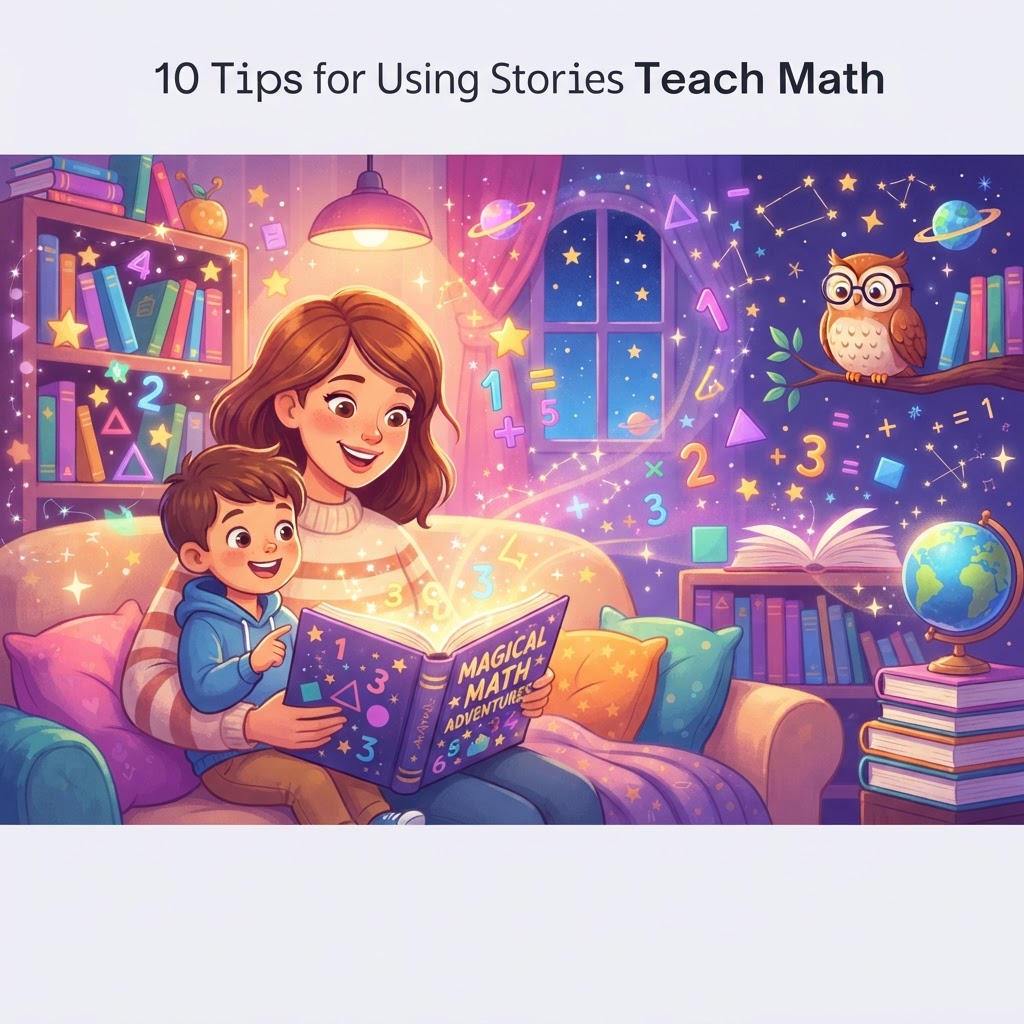
Stories can turn math from an abstract subject into something a child can see, feel, and care about. When a rabbit needs 3 more carrots, a pirate shares treasure equally, or a child counts steps to a castle, numbers suddenly have a purpose.
That is why teaching math through stories works so well for young children. Research from the National Association for the Education of Young Children and child development experts like Douglas Clements and Julie Sarama shows that early math grows best through meaningful, playful experiences. If you want practical math stories tips, the goal is simple: make math part of the adventure, not a quiz at the end.
A short, predictable reading rhythm also helps. If you are still building the habit, a simple story-time routine can make daily math storytelling much easier.
How can you start with a story your child already understands?
Start with a familiar story structure, because children learn new math ideas more easily when the plot feels safe and predictable. A simple quest, bedtime routine, or treasure hunt gives math a clear place to live.
For example, use a story where the character must collect 5 stars before sunrise. The child already understands the goal, so counting becomes part of following the plot. This is especially helpful for toddlers and preschoolers, who benefit from repetition and clear sequence.
How can you weave numbers into the plot naturally?
Put numbers inside the character’s problem, not beside it. Children remember math better when numbers help move the story forward.
Instead of saying, “Let’s count to 10,” try, “Mila needed 10 shells to build a bridge, but she had only 6.” Now the child has a reason to count. This kind of math storytelling builds number sense because children connect quantity with action, not just memorization.
What makes counting stories especially effective?
The best counting stories use one-to-one action that children can picture clearly. Each item counted should matter and appear in a steady order.
Think of stories like:
- 1 bear putting away 2 boots
- 3 ducks finding 4 pebbles
- 5 monkeys climbing 6 steps
Young children learn best when they can match each number word to one object or action. ZERO TO THREE emphasizes that early math grows through everyday interactions like counting, comparing, and noticing amounts, which stories can support beautifully.
How can characters turn word problems into something children understand?
Use character dilemmas to make word problems feel real. A child is more likely to solve “How many are left?” when the answer helps a dragon share cupcakes or a squirrel store acorns.
Try a simple structure:
- State what the character has
- Add or take away something
- Ask what happens next
For example: “Leo had 7 apples. He gave 2 to his sister. How many stayed in his basket?” This is one of the most useful strategies for teaching math through stories, because it builds comprehension and problem-solving at the same time.
Why should you repeat math words on purpose?
Repeated math language helps children understand concepts, not just answers. Words like more, less, equal, before, after, near, and far are the bridge between story and math thinking.
Use the same terms several times in the same story. “The tower was taller. The tree was shorter. Which one is taller now?” This repetition supports vocabulary growth too, especially if you are also trying to build vocabulary through stories.
How can you use stories to teach patterns, shapes, and measurement?
Math stories should include more than counting. You can also teach patterns, geometry, and measurement by making them part of the setting and the challenge.
A character might cross a path made of circle, square, circle, square stones. Another might need a rope longer than the boat but shorter than the dock. These details help children notice shape, size, length, and pattern in a meaningful context. That kind of rich math talk supports the flexible thinking highlighted by the Harvard Center on the Developing Child, especially when adults ask children to observe and explain.
How can you pause for prediction instead of rushing to the answer?
Pause often and invite your child to guess what comes next. Prediction builds reasoning, attention, and confidence, even when the guess is wrong.
You might ask:
- “If the bunny finds 2 more carrots, what will happen?”
- “Which jar will hold more marbles?”
- “What number do you think comes next?”
These short pauses give children time to think mathematically. They also make story time interactive, which helps many children stay engaged longer than they would with direct drill practice.
What kinds of hands-on extensions make math stories stick?
Hands-on follow-up is one of the best ways to deepen learning. After the story, let children touch, move, sort, or build the math they just heard.
Try simple extensions like:
- Counting buttons, blocks, or snacks from the story
- Acting out “add one more” with toys
- Drawing the pattern from the plot
- Measuring stuffed animals with string
This matters because young children learn through action as much as language. The strongest math stories tips do not end at the last page; they continue into play.
How should you match math stories to your child’s age and attention span?
Keep the math just one small step above what your child already knows. When the story is developmentally right, children feel capable instead of overwhelmed.
For ages 1-3, focus on counting, naming shapes, and simple comparison like big/small. For ages 4-6, add small story problems, patterns, and sequencing. Older children can handle skip counting, time, money, or multiplication stories. If your child needs shorter, more active reading sessions, these ideas pair well with strategies for reading with children who have ADHD.
How can personalized stories keep math practice fresh?
Personalized stories make math more motivating because the child cares about the character and the outcome. A story featuring your child, favorite animal, or current obsession can turn repeated math practice into something they ask for again.
This is where AI can help families and educators create fast, flexible story prompts. You can create your own personalized bedtime story built around counting, sharing, shapes, or simple problem-solving, then save favorites in your story library for easy re-reading. Repetition matters in early learning, but personalization keeps repetition from feeling stale.
When you use stories well, math stops being “the right answer” and becomes a way of making sense of the world. That is the real power of math storytelling: it helps children see numbers, patterns, and problems as part of everyday life.
Frequently Asked Questions
What age is best for teaching math through stories?
You can start as early as age 1 with simple counting, size words, and repetition. As children grow, you can add patterns, story problems, measurement, and more complex number concepts.
Do math stories really help children learn?
Yes, especially when stories include discussion and hands-on practice. Research in early childhood education consistently shows that children learn math best through meaningful, language-rich experiences rather than isolated drills alone.
What math concepts work best in stories?
Counting, comparing, patterns, shapes, addition, subtraction, sharing, and measurement all work well. The best concepts are the ones that can connect naturally to a character’s goal or problem.
How long should a math story be?
Keep it short enough for your child to stay engaged. For younger children, even 3-5 minutes can be enough; older children may enjoy longer stories with more detailed problem-solving.
Can teachers use math storytelling in the classroom?
Absolutely. Math stories work well for read-alouds, small-group discussion, math centers, and writing prompts because they combine literacy, listening, and number thinking in one activity.
What if my child does not like math yet?
Start with a topic they already love, such as dinosaurs, trucks, unicorns, or space. When the story feels fun and personal, math often becomes less intimidating and much more approachable.
Explore More Stories
Ready for more? - free AI bedtime story generator
Get a new bedtime story every week
Free, personalized, and delivered to your inbox. No spam, ever.
Ready to Create a Personalized Bedtime Story?
Use our free AI bedtime story generator to create a personalized illustrated story for your child in 30 seconds — no credit card needed.
Popular story types:
Maya Rodriguez
Lead Content Editor & Early Literacy Specialist
Maya is a former early childhood educator and literacy specialist with over a decade of experience helping children develop a love of reading. She leads content at InstaTales, where she writes about the science of storytelling, child development, and how families can use personalized AI stories to build literacy and emotional resilience.
instatales.ai