AI Story Generator vs Storytelling Apps
How do AI story generators compare to traditional storytelling apps? We compare features, quality, cost, and educational value.
✦ Key Takeaways
- •The main difference is simple: AI story generators create new stories on demand, while traditional storytelling apps offer a fixed library or lesson system.
- •AI story generators are much better at personalization.
- •AI usually wins on variety, while traditional apps often win on consistency.
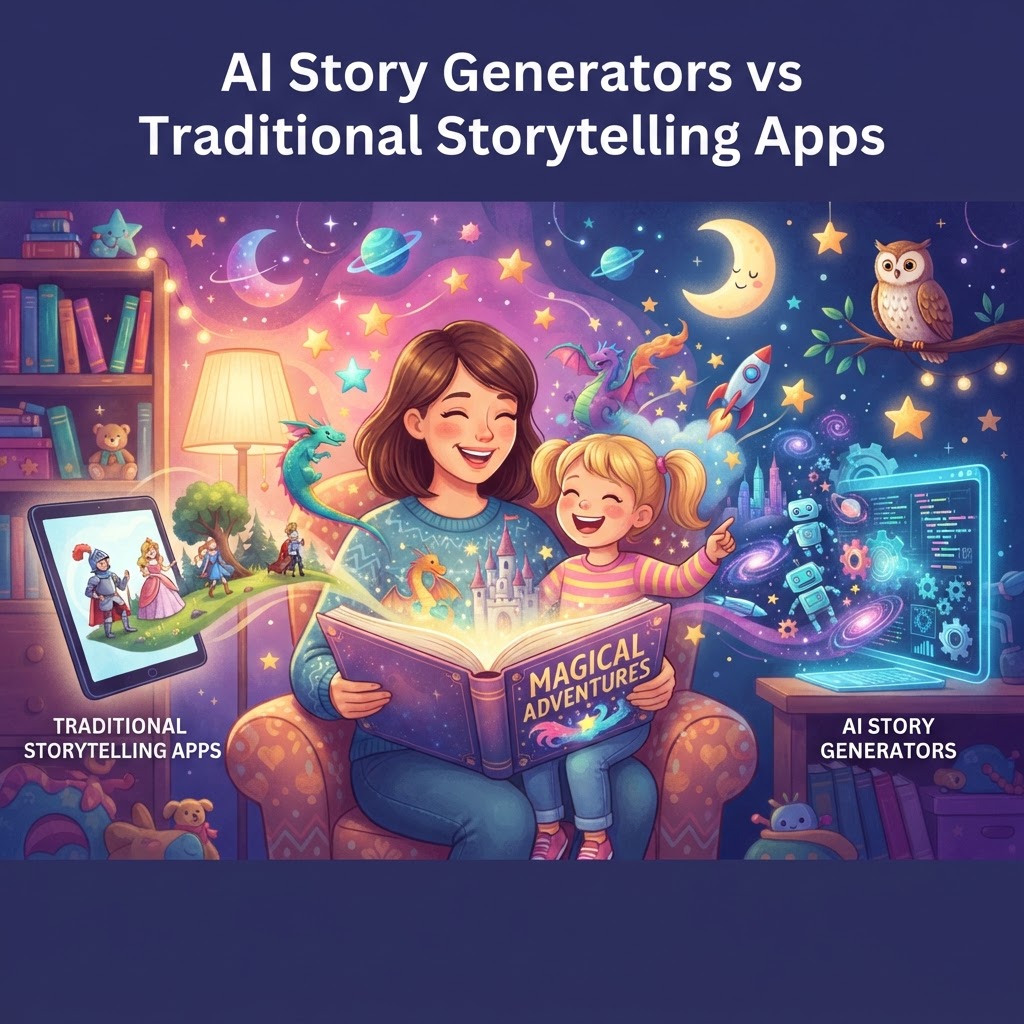
If you are comparing an ai story generator vs storytelling apps, the right choice depends on what your child needs most: fresh personalization, a large book library, or structured reading practice. AI tools like InstaTales and Oscar can create original stories around your child’s name, interests, or current challenges, while traditional apps like Epic and Reading Eggs shine with curated content and proven lesson paths.
For most families, this is not really AI vs story apps in an all-or-nothing sense. It is about choosing the best format for bedtime, learning, travel, and your child’s age. Below, I’ll compare personalization, variety, cost, educational value, and offline access so you can decide on the best story app for kids in your home.
What is the difference between an AI story generator and a traditional storytelling app?
The main difference is simple: AI story generators create new stories on demand, while traditional storytelling apps offer a fixed library or lesson system. That difference shapes everything else, from personalization to internet needs.
AI story generators such as InstaTales and Oscar let a parent enter details like a child’s name, favorite animal, bedtime theme, reading level, or emotional goal. The app then builds a custom story from those inputs. With InstaTales, parents can even create your own personalized bedtime story in minutes instead of searching through a long catalog.
Traditional apps work differently. Epic gives children access to a large digital library of existing books, while Reading Eggs focuses more on guided reading and phonics activities. These platforms are strong when you want trusted, repeatable content, but they are less flexible when your child suddenly wants “a story about a brave panda on the moon who misses Grandma.”
In short:
- AI story generators: best for custom, original, child-specific stories
- Traditional apps: best for curated books, established series, and structured literacy practice
Which option offers better personalization for your child?
AI story generators are much better at personalization. If your child engages more when stories feel “about them,” AI has a clear advantage.
Personalization matters because young children often learn best when new ideas connect to familiar people, routines, and interests. AI can weave in a child’s name, favorite toy, fears, cultural details, or even a recent life event. That can be especially helpful for bedtime resistance, potty training, moving house, or starting school.
Traditional apps do offer some personalization, but it is usually limited. Epic may recommend books by age or interest, and Reading Eggs adapts lesson levels, but they do not truly generate a one-of-a-kind story around your child’s day.
This is where AI tools stand out:
- A dinosaur-loving preschooler can get endless dinosaur adventures
- A sensitive child can get gentle stories about worries or friendship
- A reluctant reader can get simpler language and shorter scenes
- Siblings can each hear the “same” theme told in age-appropriate ways
From a child development perspective, this kind of connection can support attention and motivation. The Harvard Center on the Developing Child emphasizes responsive back-and-forth interactions, and personalized storytelling naturally gives parents more chances to pause, ask questions, and relate the story to real life.
How do story variety and story quality compare?
AI usually wins on variety, while traditional apps often win on consistency. Families should think about whether they value endless novelty or carefully edited content more.
With AI, the variety is almost unlimited. A child can request underwater castles one night and a shy robot baker the next. Apps like InstaTales and Oscar make it easy to generate stories that match changing moods and obsessions. If your child craves novelty, AI can feel magical.
Traditional apps have a different strength: editorial quality control. Books in Epic are written and reviewed by human authors, publishers, and educators. Reading Eggs lessons are designed around specific literacy outcomes. That usually means more reliable pacing, language quality, and age fit.
The trade-off looks like this:
- AI story generators
- More original combinations
- Better at matching niche interests
- Quality can vary based on prompt and platform
- Traditional storytelling apps
- More polished and predictable
- Stronger authorial voice and illustration quality
- Less flexibility when a child wants something very specific
A practical middle ground works well for many parents: use AI for custom bedtime stories and use library-style apps for daytime reading or independent browsing. If your child enjoys making up their own tales, AI can also support creative writing with AI stories rather than replacing imagination.
Which choice offers more educational value?
Traditional apps usually provide more structured educational value, but AI can be highly educational when used intentionally. The best option depends on whether you want a curriculum or a flexible teaching tool.
Reading Eggs is the clearest example of structured literacy support. It is built around phonics, decoding, and reading progression. Epic supports reading volume and book access, which also matters for literacy growth.
AI story generators are different. They are not usually a full reading curriculum, but they can reinforce language, comprehension, and social-emotional learning in powerful ways. A parent can request a story that practices new vocabulary, models kindness, or gently explains routines like dentist visits or first-day nerves.
Research supports this interactive approach. The American Academy of Pediatrics encourages shared reading, and children learn more when adults talk about the story rather than simply pressing play. The National Association for the Education of Young Children also emphasizes developmentally appropriate, relationship-based learning.
Educationally, AI works best when parents:
- Read together instead of handing over the device
- Ask simple “what do you think happens next?” questions
- Reuse new vocabulary from the story in real life
- Choose prompts linked to current learning goals
In my experience as an education writer, AI shines most for:
- social-emotional learning
- language-rich bedtime bonding
- motivation for reluctant readers
Traditional apps still lead for:
- systematic phonics
- leveled reading pathways
- teacher-aligned practice
How do cost and subscriptions compare?
Traditional apps often feel simpler to budget, while AI story generators can offer better value for families who want frequent customization. The cheaper option depends on how you actually use it.
Epic and Reading Eggs generally use straightforward subscription models. You pay for access to a library, lessons, or both. That can be easy for families who want predictable monthly costs.
AI apps vary more. Some charge a subscription, some use credits, and some gate premium features such as illustrations, audio, or longer story generation. If your child wants brand-new personalized stories several times a week, an AI subscription may feel worthwhile. If you only want occasional novelty, a fixed library app may be more cost-effective.
When comparing value, ask:
- How often will my child use it?
- Do I want custom stories or a large book catalog?
- Will multiple children use the same app?
- Are audio, illustrations, and saving features included?
If cost is a deciding factor, it helps to review current plans directly. You can compare InstaTales pricing plans and think about whether personalization is something your family will use often or only once in a while.
What about offline access and screen-time concerns?
Traditional storytelling apps usually have the edge for offline use, while AI tools are often better when you have internet access. For travel, waiting rooms, or low-connectivity moments, this can matter a lot.
Epic and similar library apps often allow downloaded books on certain plans or devices. Reading Eggs also offers more stable access to preloaded lessons than a tool that must generate fresh content in real time. By contrast, most AI story generators need an internet connection to create a new story.
That said, once a story is made, saving it matters. With InstaTales, parents can keep favorites in your story library for easy re-reading, which is important because repetition supports comprehension and comfort for young children.
Screen-time concerns are also worth keeping in perspective. A personalized story read aloud with a parent is very different from passive, fast-paced media. If you want a practical framework, our guide to healthy screen-time balance can help you use story apps thoughtfully rather than fearfully.
My rule of thumb:
- For airplanes and offline trips, traditional apps are safer
- For bedtime bonding at home, AI can be wonderful
- For young children, adult co-use matters more than the app category
Which is the best story app for kids in different situations?
The best story app for kids depends on the goal. No single app wins every category, so the smartest choice is matching the tool to the moment.
Choose an AI story generator like InstaTales or Oscar if you want:
- highly personalized bedtime stories
- fresh stories every night
- stories about emotions, routines, or specific interests
- motivation for children who tune out generic books
Choose a traditional storytelling app like Epic if you want:
- a large curated digital bookshelf
- recognizable authors and series
- more independent browsing for older children
- better offline reading options
Choose a structured educational app like Reading Eggs if you want:
- phonics and early reading instruction
- skill progression
- activity-based literacy support
- clearer academic goals
For many families, the strongest approach is blended:
- AI for connection and personalization
- traditional apps for breadth and consistency
- structured reading apps for formal skill-building
If you are exploring AI tools, it is also wise to think about content review, age fit, and family values. We cover that more deeply in our article on AI story ethics.
Frequently Asked Questions
Are AI story generators good for young children?
Yes, they can be very good for young children when used with an adult. The biggest benefits come from personalization, shared reading, and the ability to tailor tone, length, and themes to a child’s developmental stage.
Is Epic or Reading Eggs better than an AI app?
Not universally. Epic and Reading Eggs are better for curated books and structured literacy practice, while AI apps are better for custom stories and engagement around a child’s specific interests or experiences.
Do AI story generators replace reading with real books?
No, and they work best when they do not try to. AI stories are most helpful as one tool alongside print books, library books, and parent-child read-aloud time.
Which option is best for bedtime?
For bedtime, AI often has the advantage because it can create calm, child-specific stories on demand. Traditional apps are still useful if your child prefers favorite books, familiar characters, and repeated routines.
Can AI stories help with learning?
Yes, especially for vocabulary, listening, comprehension, and social-emotional topics. They are most effective when a parent reads along, asks questions, and connects the story to everyday life.
What is the best story app for kids overall?
The best story app for kids is the one that matches your child’s needs. If you want custom storytelling, choose AI; if you want a broad library, choose Epic; if you want reading instruction, choose Reading Eggs.
Get a new bedtime story every week
Free, personalized, and delivered to your inbox. No spam, ever.
Ready to Create a Personalized Bedtime Story?
Use our free AI bedtime story generator to create a personalized illustrated story for your child in 30 seconds — no credit card needed.
Popular story types:
Maya Rodriguez
Lead Content Editor & Early Literacy Specialist
Maya is a former early childhood educator and literacy specialist with over a decade of experience helping children develop a love of reading. She leads content at InstaTales, where she writes about the science of storytelling, child development, and how families can use personalized AI stories to build literacy and emotional resilience.
instatales.ai