Arthurian Stories for Kids: Magic & Brave Quests
Exciting Arthurian stories for kids — gods, heroes, monsters, and adventures from Arthurian mythology, retold for young readers.
✦ Key Takeaways
- •Arthurian stories for kids are child-friendly retellings of the legends about King Arthur, Camelot, Merlin, and the Round Table.
- •Children usually connect best with characters who are easy to understand: Arthur, Merlin, Guinevere, Gawain, and the Lady of the Lake.
- •Arthurian tales work well for children because they turn big values into memorable adventures.
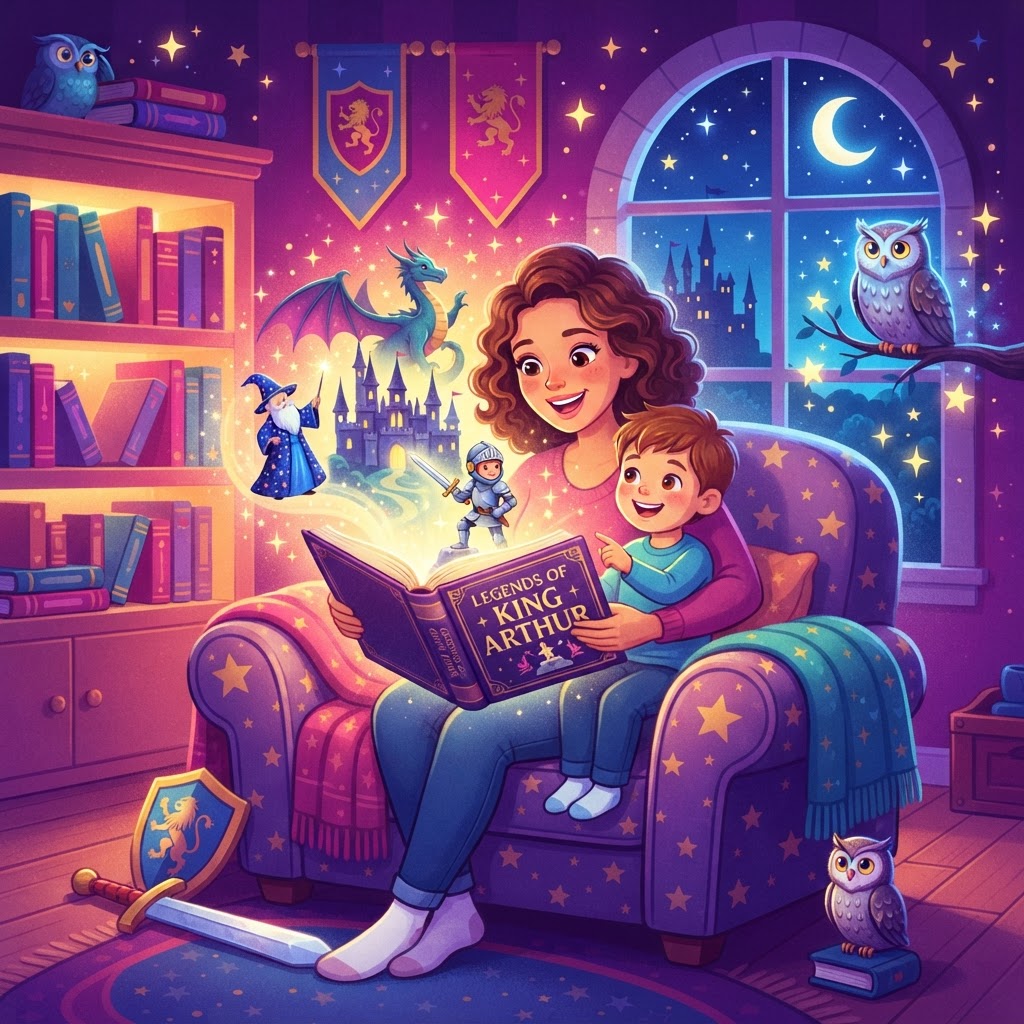
Arthurian stories for kids are a wonderful way to introduce children to brave heroes, wise mentors, enchanted lakes, and big-hearted adventures. These classic legends, centered on King Arthur, Merlin, and the Knights of the Round Table, offer action and magic without needing the heavy themes found in many adult retellings.
For children ages 5-8, the best Arthurian tales are simple, hopeful, and easy to follow. With a few thoughtful changes, parents and teachers can turn old legends into warm bedtime stories that spark imagination, support language development, and open the door to other world traditions, like gentle Polynesian myths or Arctic legend ideas.
What are Arthurian stories for kids?
Arthurian stories for kids are child-friendly retellings of the legends about King Arthur, Camelot, Merlin, and the Round Table. They keep the wonder, bravery, and magic of the originals while simplifying plots and removing mature content.
These stories come from a long tradition of medieval legend rather than one single book. Families looking for a reliable overview can explore The Camelot Project at the University of Rochester, a helpful .edu source on Arthurian literature and characters.
For young readers, kids Arthurian stories usually focus on:
- A young hero learning to lead
- Magical helpers and mysterious objects
- Friendship, fairness, and keeping promises
- Quests with clear goals
- Good choices in difficult moments
That mix makes Arthurian legend feel epic, but still emotionally safe for children.
Which characters from Arthurian mythology do children enjoy most?
Children usually connect best with characters who are easy to understand: Arthur, Merlin, Guinevere, Gawain, and the Lady of the Lake. Each one represents a clear role that young listeners can follow.
Here are the best-known figures from Arthurian mythology children can enjoy:
- King Arthur: The brave but kind ruler who learns that leadership means serving others.
- Merlin: The wise magician who guides rather than controls. He works especially well for children because he can be funny, mysterious, or gentle.
- Queen Guinevere: In child-friendly versions, she can be shown as thoughtful, brave, and skilled at helping people cooperate.
- Sir Lancelot: Best adapted as a loyal knight known for courage and practice rather than romance.
- Sir Gawain: A strong choice for younger readers because his stories often center on honesty, bravery, and keeping one’s word.
- The Lady of the Lake: A magical figure linked to Excalibur, wonder, and nature.
- Morgana or Morgan le Fay: Usually best softened into a tricky enchantress rather than a frightening villain.
Young children do better when each character has a clear motivation. Instead of long backstories, give them one memorable trait: brave, wise, loyal, fair, or clever.
What themes make Arthurian tales so useful for young readers?
Arthurian tales work well for children because they turn big values into memorable adventures. Courage, kindness, teamwork, and responsibility are easier to understand when they appear in a story.
For ages 5-8, the strongest themes are:
- Bravery: Trying something hard even when you feel small
- Fairness: The Round Table symbolizes equal worth and respect
- Belonging: Camelot feels like a shared home and community
- Service: Heroes use strength to help others
- Wonder: Magic keeps children engaged and curious
These themes matter because storytelling supports development, not just entertainment. The American Academy of Pediatrics has highlighted how shared reading supports language, attention, and parent-child connection, while the National Association for the Education of Young Children emphasizes storytelling and imaginative play as part of healthy learning and social-emotional growth. Resources from AAP and NAEYC are useful starting points for adults who want research-backed reading practices.
In practical terms, Arthurian stories give children a safe way to think about power, rules, promises, and doing the right thing.
Which Arthurian stories for kids work best for ages 5-8?
The best Arthurian stories for kids are short, quest-shaped, and emotionally clear. A child this age usually enjoys one central problem, a touch of magic, and a comforting ending.
Here are 7 age-appropriate story ideas:
The Sword in the Stone
Arthur discovers he can pull a sword from a stone when no one else can. This story teaches that true strength is often quiet, humble, and unexpected.
Merlin’s Forest Lesson
Merlin takes Arthur into the woods to learn from animals, weather, or stars. This version works beautifully at bedtime because it can be calm, magical, and reflective.
The Gift of Excalibur
The Lady of the Lake offers Arthur a special sword, but only after he promises to rule fairly. The focus stays on responsibility rather than battle.
The Round Table Promise
Arthur invites knights to sit at a round table so nobody is “above” anyone else. This is one of the best Arthurian tales for teaching inclusion and cooperation.
Sir Gawain and the Brave Promise
A simplified Gawain story can center on keeping a promise, even when it feels difficult. Keep the challenge mysterious rather than scary.
The Lost Crown of Camelot
A crown, banner, or royal book goes missing, and the knights must solve the mystery together. This gives you Camelot adventure without conflict-heavy scenes.
The Lantern Quest
Inspired by Grail-style quests, children can follow a search for a glowing lantern that brings hope to the kingdom. This keeps the spirit of wonder while avoiding complicated religious symbolism.
These story shapes also work well if you want to create your own personalized bedtime story with a child’s name, favorite animal, or favorite color added in.
What should adults adapt when sharing kids Arthurian stories?
Adults should adapt violence, romance, betrayal, and tragedy before sharing Arthurian legend with young children. The goal is not to erase the heart of the legend, but to present it in a way that matches a child’s stage of development.
Here’s what to change:
- Reduce violence: Replace battles with tournaments, rescues, riddles, or peaceful problem-solving.
- Remove adult romance: Skip the Lancelot-Guinevere triangle and keep relationships simple.
- Simplify villains: Use “tricky,” “jealous,” or “misguided” instead of deeply cruel.
- Shorten politics: Children do not need complex family trees or court disputes.
- Choose hopeful endings: Younger listeners usually do best with safety, repair, and emotional closure.
- Keep language concrete: Say “magic sword” instead of “symbol of royal legitimacy.”
A helpful rule is this: if a scene would create fear without understanding, change it. Research on early childhood learning consistently shows that children absorb emotional tone as strongly as plot, so calm storytelling matters as much as content.
How can parents and teachers use InstaTales to create Arthurian-inspired stories?
InstaTales makes it easy to turn Arthurian themes into personalized stories that feel fresh, gentle, and age-appropriate. You can keep the magic of Camelot while adjusting tone, length, and character details for your child or class.
A simple process works best:
- Start with one clear setup: “A child visits Camelot” or “Merlin needs help solving a forest mystery.”
- Choose one theme: bravery, fairness, friendship, or honesty.
- Add one magical element: a silver lake, talking raven, hidden castle, or glowing sword.
- Keep the ending reassuring: the problem is solved, someone learns a lesson, and everyone is safe.
You can begin with a prompt like:
“Write a gentle Arthurian bedtime story for a 6-year-old about a child who visits Camelot, meets Merlin, and helps the Round Table solve a kindness quest. Keep it warm, magical, and non-scary.”
For busy families, it also helps to save favorites in your story library so children can revisit beloved characters and story worlds. In classrooms, Arthurian themes can support units on legend, leadership, and medieval literature, and educators can adapt the same approach through InstaTales for teachers.
Why do Arthurian stories still matter for children today?
Arthurian stories still matter because they give children timeless values in a vivid, memorable form. Even today, kids enjoy tales about finding courage, helping others, and learning what it means to lead well.
They also invite rich follow-up activities:
- Draw your own Round Table
- Invent a magical object for Camelot
- Retell a quest with a family pet as the hero
- Compare Arthurian legends with other cultural story traditions
When adults present them with warmth and care, Arthurian stories for kids become more than old legends. They become safe, imaginative spaces where children can practice courage, empathy, and wonder.
Frequently Asked Questions
Are Arthurian stories suitable for young children?
Yes, if they are adapted well. Choose simple quests, gentle magic, and happy or reassuring endings for ages 5-8.
What age is best for Arthurian stories for kids?
Many children enjoy them from about age 5 onward. Younger children usually do best with short, picture-rich retellings and one main event per story.
Which Arthurian character is easiest for children to understand?
Arthur and Merlin are often the easiest starting points. Arthur represents bravery and fairness, while Merlin adds magic, humor, and guidance.
Do I need to include battles in kids Arthurian stories?
No. You can replace battles with riddles, searches, tournaments, teamwork, or magical challenges that feel exciting without being upsetting.
How can I make Arthurian mythology children can understand at bedtime?
Focus on one quest, one lesson, and one magical image. Calm pacing, simple language, and a comforting ending make the story much more bedtime-friendly.
Ready to Create a Personalized Bedtime Story?
Use our free AI bedtime story generator to create a personalized illustrated story for your child in 30 seconds — no credit card needed.
Popular story types:
Maya Rodriguez
Lead Content Editor & Early Literacy Specialist
Maya is a former early childhood educator and literacy specialist with over a decade of experience helping children develop a love of reading. She leads content at InstaTales, where she writes about the science of storytelling, child development, and how families can use personalized AI stories to build literacy and emotional resilience.
instatales.ai