Best space bedtime stories for 3-year-olds
Discover the best space bedtime stories for 3-year-olds — themes, tips, and story ideas that will delight your child at bedtime.
✦ Key Takeaways
- •The most important milestones at age 3 are growing imagination, improving language, and a limited but expanding attention span.
- •Space bedtime stories appeal to 3-year-olds because they combine nighttime comfort with big imagination.
- •For most preschoolers, the ideal length is 5 to 8 minutes, or roughly 400 to 700 words.
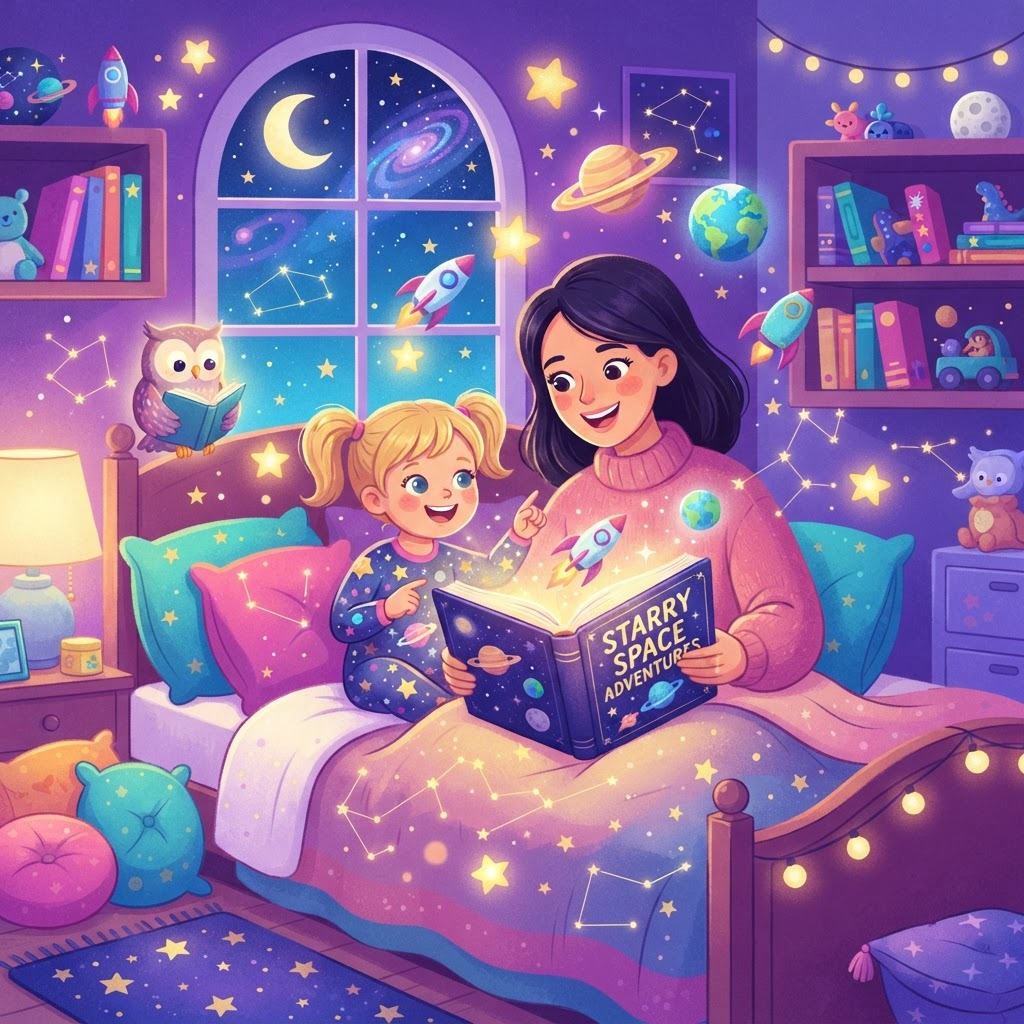
Choosing the best space stories for 3 year olds is less about finding the most detailed tale and more about matching your child’s stage of development. At age 3, children love wonder, repetition, and comforting endings, which makes space bedtime stories a lovely fit for the evening routine. When the moon, stars, and rockets are presented in a gentle, playful way, they can turn bedtime into a calm moment of curiosity instead of a struggle.
What developmental milestones matter when choosing space stories for a 3-year-old?
The most important milestones at age 3 are growing imagination, improving language, and a limited but expanding attention span. In practice, that means bedtime stories for 3 year olds work best when they are simple, repetitive, and emotionally reassuring.
According to the CDC’s developmental milestones for 3-year-olds, many children this age enjoy pretend play, can speak in short conversations, and can follow simple story sequences. They are also beginning to ask lots of “what” and “where” questions.
For story time, that usually means a 3-year-old can enjoy:
- One main character
- One clear goal
- A short beginning, middle, and end
- Repeated phrases or sounds
- Familiar emotions like excitement, shyness, or sleepiness
What they usually do not need is a complex plot or scientific explanation. If a story has too many characters, too much action, or abstract ideas about the universe, many preschoolers will lose the thread.
Why do space bedtime stories appeal so strongly to 3-year-olds?
Space bedtime stories appeal to 3-year-olds because they combine nighttime comfort with big imagination. The moon, stars, and rockets feel magical, but they are also simple enough for young children to picture.
For many preschoolers, space is not yet about astronomy facts. It is about glowing stars, a friendly moon, a rocket that zooms gently, or a sleepy alien who needs a bedtime hug. That blend of novelty and softness is exactly why kids space stories often work so well before sleep.
Space also fits naturally into a bedtime routine because children can look out the window and connect the story to the real night sky. That kind of real-world link helps young children understand and remember stories.
If your child already enjoys gentle nighttime tales, you may also like these bedtime stories for 3-year-olds for building a predictable evening routine.
How long should bedtime stories for 3 year olds be?
For most preschoolers, the ideal length is 5 to 8 minutes, or roughly 400 to 700 words. Shorter stories are easier to follow, easier to repeat, and far more likely to calm a tired child than a long, winding plot.
At age 3, attention can shift quickly, especially at the end of the day. A strong bedtime story usually has:
- A gentle opening
- One small problem or goal
- A soothing resolution
- A sleepy final line
You do not need a dramatic climax. In fact, many bedtime stories for 3 year olds are better when the “action” is tiny: finding the brightest star, tucking in a baby robot, or flying home before bedtime.
Shared reading itself supports language and bonding. The American Academy of Pediatrics has long emphasized the value of reading aloud for early development, especially when adults use warm, responsive conversation during the story.
Which space themes work best for 3-year-olds at bedtime?
The best themes are gentle, concrete, and easy to imagine. For space stories for 3 year olds, think less “survival in deep space” and more “the moon says goodnight.”
These themes are especially effective:
- Moon and stars: A child waves goodnight to the moon, counts stars, or helps a sleepy star shine softly.
- Friendly rockets: A small rocket takes a calm trip and always comes safely home.
- Planet colors and shapes: Round planets, glowing rings, and favorite colors give children something simple to picture.
- Space friendship: A shy alien, astronaut, or star needs a friend or kind helper.
- Bedtime routines in space: Brushing teeth on a spaceship, putting on pajamas, or tucking in a moon bear can mirror your child’s own routine.
Themes that connect back to home are especially calming. Even in imaginative kids space stories, 3-year-olds usually feel safest when the character ends the story in bed, with a parent, or under a familiar night sky.
If you have a younger sibling in the house, it can help to compare what works for different ages. This guide to space bedtime stories for 2-year-olds shows how stories often need to be even shorter and more repetitive for toddlers.
What should parents avoid in space bedtime stories for 3-year-olds?
Parents should avoid anything that makes space feel frightening, overstimulating, or confusing right before sleep. The goal at bedtime is comfort, not intensity.
Try to skip stories with:
- Characters lost alone in space for long stretches
- Loud battles, crashes, or emergencies
- Realistic dangers like black holes swallowing things
- Too many made-up names, planets, or side characters
- Fast scene changes that feel chaotic
- Endings that are unresolved or emotionally tense
You also want to be careful with tone. Some children laugh at silly aliens; others become worried by unfamiliar creatures. If your child is sensitive, keep new characters friendly, rounded, and clearly safe.
A useful rule from early childhood practice is simple: if a story is likely to lead to more questions than comfort, save it for daytime. For bedtime, predictability matters.
How can parents use personalized AI space stories in a safe and helpful way?
Personalized AI stories can be wonderful for preschoolers when parents guide the experience. The safest and most helpful approach is to keep the story age-appropriate, preview it first, and use it as a shared reading tool rather than passive screen time.
That is where InstaTales can be especially useful. You can create your own personalized bedtime story with your child’s name, favorite rocket color, or preferred bedtime routine, which often makes the story instantly more engaging. If you want a quicker start, the ready-made story templates can help you shape a gentle space adventure without overcomplicating the plot.
A few best practices:
- Preview the story before reading it aloud
- Keep the tone calm and reassuring
- Ask for one main character and one simple goal
- Include familiar comfort objects like a blanket or teddy
- Save successful stories in your story library for easy re-reading
Repetition is not a problem at this age; it is a benefit. Early childhood organizations such as ZERO TO THREE have consistently highlighted how responsive, repeated language experiences support learning and connection.
What are five great space bedtime story ideas for 3-year-olds?
The best story ideas are simple, soothing, and full of wonder. These five concepts work well because they match a 3-year-old’s love of repetition, gentle adventure, and happy endings.
1. The Sleepy Rocket’s Goodnight Tour
A tiny rocket flies past the moon, a star, and one colorful planet, saying goodnight to each one. At the end, the rocket comes back home, parks in its cloud garage, and falls asleep.
2. The Little Star Who Lost Its Twinkle
A small star feels sad because it cannot shine brightly. With help from a kind child and a soft moonbeam, it finds its twinkle again and glows gently over bedtime.
3. Pajamas on the Moon
A child visits the moon and discovers that even moon rabbits, aliens, and craters have bedtime routines. Everyone brushes teeth, puts on pajamas, and snuggles under silver blankets.
4. The Friendly Alien Who Needed a Hug
A shy alien lands nearby and feels nervous in a new place. A caring child shows the alien how bedtime works on Earth, from story time to cuddles, and the alien feels safe enough to sleep.
5. Counting Stars with Bear
A child and a teddy bear look out the window and imagine each star as a sleepy friend. They count a few stars, make one small wish, and drift off before reaching the biggest constellation.
These ideas can also mix beautifully with your child’s other interests. If they love animals as much as rockets, pairing space themes with soft creatures can make the story even more appealing.
How can parents make space stories more calming at bedtime?
Parents can make space bedtime stories more calming by slowing the pace, using repetition, and ending with emotional safety. A soothing delivery matters as much as the story itself.
Try these simple techniques:
- Read in a quiet, slower voice than usual
- Repeat comforting lines such as “The stars are shining softly”
- Use your child’s name in the story
- Pause to let your child point or respond
- End with sleep, home, cuddles, or a goodnight ritual
If your child loves movement during the day but needs gentler stories at night, it can help to separate “adventure reading” from “sleepy reading.” Save high-energy plots for daytime and keep bedtime focused on calm, predictable rhythms. For more themed ideas, browse the InstaTales blog when you want fresh prompts that still fit a peaceful evening routine.
Frequently Asked Questions
Are space stories too exciting for bedtime?
Not if they are written for preschoolers. The best space bedtime stories use soft imagery, simple plots, and reassuring endings rather than loud action or danger.
What makes a good space story for a 3-year-old?
A good story has one main character, one simple goal, and a calm ending. Repetition, familiar feelings, and concrete images like stars, moons, and rockets help 3-year-olds follow along.
Can 3-year-olds understand stories about planets and space?
Yes, in a simple way. Most 3-year-olds enjoy basic ideas like “the moon glows” or “a rocket zooms home,” even if they are not ready for detailed science.
How often is it okay to repeat the same bedtime story?
Very often. Repetition helps preschoolers feel secure, build language, and anticipate what comes next, which is one reason favorite bedtime stories get requested again and again.
Are personalized AI stories safe for young children?
They can be, especially when a parent previews the story and reads it aloud together. Keep the story short, age-appropriate, and emotionally gentle.
What if my child is scared of space or the dark?
Start with the most familiar parts of space, like the moon and stars seen from home. Gentle stories that end in a cozy bed can help make nighttime feel safe rather than mysterious.
Ready to Create a Personalized Bedtime Story?
Use our free AI bedtime story generator to create a personalized illustrated story for your child in 30 seconds — no credit card needed.
Popular story types:
Maya Rodriguez
Lead Content Editor & Early Literacy Specialist
Maya is a former early childhood educator and literacy specialist with over a decade of experience helping children develop a love of reading. She leads content at InstaTales, where she writes about the science of storytelling, child development, and how families can use personalized AI stories to build literacy and emotional resilience.
instatales.ai