Feelings Stories for Kids: A Parent’s Guide
Stories are a natural way to teach kids about emotions. Here's how to use them to build your child's emotional intelligence.
✦ Key Takeaways
- •Stories work well because they let children explore emotions at a safe distance.
- •Stories build feeling vocabulary by putting emotions into context.
- •The best way to discuss emotions in stories is to pause briefly, ask one simple question, and listen without rushing to correct.
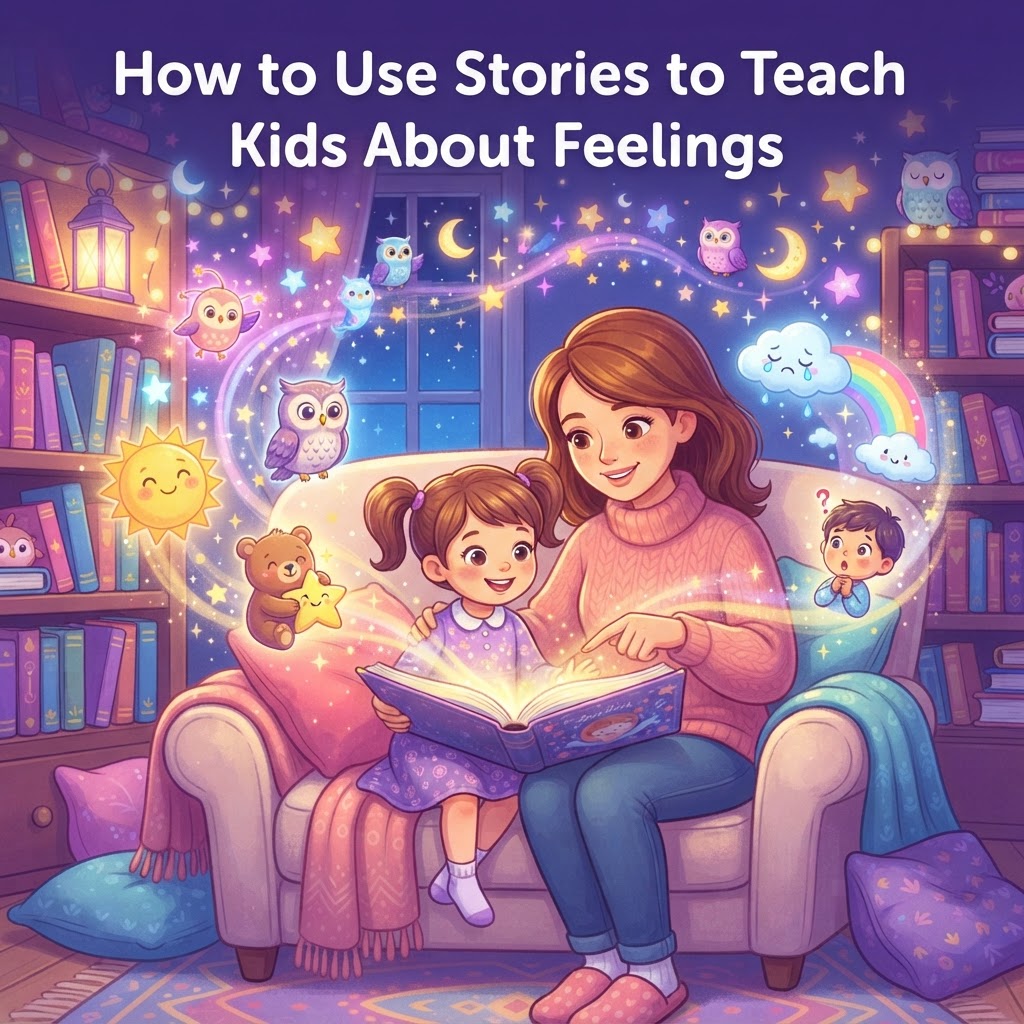
Stories give children a safe, natural way to learn about emotions. When kids hear about a worried bear, a jealous dragon, or a proud little inventor, they begin to notice feelings, name them, and understand what causes them. That is why feelings stories for kids are such a powerful tool for building emotional intelligence at home and in the classroom.
For parents and teachers, teaching emotions through stories does not need to feel formal or complicated. A short bedtime story, a picture book, or a personalized tale can help children practice empathy, grow their feeling vocabulary, and learn healthy ways to respond to big emotions. Research on social-emotional learning, including work from CASEL, shows that children benefit when adults intentionally support self-awareness, self-management, and relationship skills.
Why are stories such a powerful way to teach feelings?
Stories work well because they let children explore emotions at a safe distance. A child may not be ready to talk directly about their own anger or sadness, but they can often talk freely about how a story character feels.
This “one step removed” effect matters. Children can observe a character’s face, words, choices, and consequences without feeling judged. Over time, they learn that feelings have names, causes, and patterns.
Stories also support core social-emotional skills. According to Harvard’s Center on the Developing Child, early relationships and responsive interactions shape emotional development. Shared reading creates exactly that kind of back-and-forth moment: a trusted adult, a calm setting, and space to think together.
When you use emotional literacy stories, you help children:
- Recognize feelings in themselves and others
- Understand that all feelings are normal
- Learn words beyond “happy,” “sad,” and “mad”
- Practice empathy and perspective-taking
- Explore coping tools in a non-threatening way
This is one reason storytime can be more than entertainment. It can be a simple SEL practice built into daily life.
How do stories build a child’s feelings vocabulary?
Stories build feeling vocabulary by putting emotions into context. Instead of memorizing emotion words, children hear them connected to events, body signals, and relationships.
That context is what helps the words stick. A child is more likely to understand “frustrated” when a character keeps trying to stack blocks and they keep falling down. They are more likely to understand “disappointed” when a picnic gets rained out.
To build emotional vocabulary through stories, focus on three layers:
Name the feeling
Use clear, specific words as you read:
- happy
- lonely
- nervous
- proud
- frustrated
- disappointed
- excited
- embarrassed
- calm
- jealous
Notice the clues
Point out what shows the feeling:
- “Her shoulders dropped.”
- “He is hiding behind his dad.”
- “They are smiling and jumping.”
- “His hands are tight.”
Connect the feeling to the event
Help children see cause and effect:
- “She feels worried because it is her first day.”
- “He feels proud because he kept trying.”
- “They feel left out because the game already started.”
For younger children, keep it simple and repetitive. For older children, compare similar emotions like upset vs. disappointed, or nervous vs. excited. The more precise the language, the stronger their emotional understanding becomes.
How can you discuss emotions during storytime?
The best way to discuss emotions in stories is to pause briefly, ask one simple question, and listen without rushing to correct. Children learn emotional literacy best when the conversation feels warm and curious, not like a quiz.
You do not need to stop on every page. A few thoughtful moments are enough. In fact, too many questions can break the flow of the story.
Try prompts like these during reading:
- “How do you think she feels right now?”
- “What clues tell you that?”
- “Have you ever felt like that?”
- “What could help him feel better?”
- “What do you think will happen next?”
After reading, go one step deeper:
- “Which character felt the biggest emotion?”
- “Did anyone make a kind choice?”
- “What would you do in that situation?”
If your child gives an unexpected answer, stay open. A child who says, “He looks angry,” when you thought the character looked scared may be noticing a real overlap. You can respond with, “I can see why you thought that. I wonder if he might also feel scared.”
This style of conversation supports emotional growth better than giving the “right” answer right away. The National Association for the Education of Young Children emphasizes that children build social-emotional skills through responsive adult interactions, modeling, and guided practice.
If you want to make these chats easier, reading in a calm setup helps. A predictable routine and a cozy story space can make children more open to talking about feelings.
What are five simple feeling story prompts to try?
The easiest way to start is with short, emotionally clear story ideas. These prompts are designed to support feelings stories for kids across ages 1-10, with room to simplify or deepen depending on your child.
1. The nervous first-day adventure
A small animal is worried about trying something new, like school, swimming, or meeting new friends. Along the way, they notice their racing heart, get help from a trusted adult, and discover that bravery can exist alongside fear.
2. The stormy anger story
A character feels angry when a plan changes or a sibling breaks something important. The story explores what anger feels like in the body and introduces calming choices like breathing, taking space, or asking for help.
3. The left-out playground tale
A child sees others playing and feels left out. The story can show different paths: joining kindly, starting a new game, or finding one special friend.
4. The proud little helper story
A character works hard on a difficult task and finally succeeds. This is especially useful if you also enjoy confidence-building stories, because pride and perseverance often go together.
5. The rainy-day disappointment story
A long-awaited plan gets canceled. The character feels upset at first, then learns that disappointment can be real without ruining the whole day.
These kinds of emotional literacy stories work best when the resolution feels realistic. Not every character needs to become instantly cheerful. Sometimes the most useful ending is, “I still feel sad, but I know what helps.”
How can InstaTales help you create emotional literacy stories?
Personalized stories can make emotional learning more relevant because the child sees their own world reflected back to them. When a story includes your child’s name, favorite toy, school setting, or current challenge, the lesson often feels more meaningful and memorable.
With InstaTales, you can create your own personalized bedtime story around a specific emotion such as jealousy, worry, frustration, or excitement. That makes teaching emotions through stories much easier when your child is dealing with something real right now.
Here are a few practical ways to use it:
- Create a story about the exact feeling your child is having this week
- Add familiar people, pets, or routines for comfort
- Choose gentle resolutions that model coping skills
- Re-read helpful stories from your story library when the same feeling comes up again
- For schools or group settings, explore options through InstaTales for teachers
You can also personalize for age. For toddlers, use simple plots and repeated feeling words. For older children, include mixed emotions, friendship conflicts, or more thoughtful problem-solving.
If you want a quick start, it helps to think like an educator:
- What feeling do I want to explore?
- What situation usually triggers it?
- What coping tool do I want the story to model?
- What ending would feel honest and reassuring?
And if inspiration disappears at bedtime, it helps to know how to make up a bedtime story on the spot using a simple character-feeling-problem-solution structure.
How can you turn emotion stories into a regular habit?
Children learn emotional skills through repetition. One story helps, but a regular rhythm of story-and-conversation helps much more.
You do not need a long lesson plan. Try one of these simple routines:
- Read one feelings-based story at bedtime two or three nights a week
- Revisit the same story when the emotion comes up in real life
- Keep one “feeling of the week” in mind, such as patience or courage
- Ask one reflection question after reading
- Let your child retell the story in their own words
Consistency matters because emotional learning is gradual. Children need many chances to hear the words, notice the patterns, and practice using them.
It also helps to connect story lessons to daily life:
- “That looked frustrating, just like the bunny in our story.”
- “You seemed proud of yourself, like the little fox.”
- “Do you want to try the calming trick the character used?”
This is where stories become more than stories. They become a shared language for everyday emotions.
Frequently Asked Questions
At what age can children start learning about feelings through stories?
Children can begin learning about emotions through stories in infancy and toddlerhood. Very young children benefit from simple books with clear faces, repeated feeling words, and warm adult conversation.
What if my child cannot name the emotion correctly?
That is completely normal. Gently add language instead of correcting harshly: “You think he’s mad. I wonder if he might also feel disappointed.” Emotional literacy grows through practice.
Should I stop and ask questions on every page?
No. Too many interruptions can make reading feel like a test. Pause only at key moments and keep the conversation short, natural, and connected to the story.
Are personalized stories better for emotional learning?
They can be especially helpful because they feel relevant and familiar. When children see their own experiences reflected in a story, they often engage more deeply and remember the lesson better.
Can teachers use feeling stories in the classroom?
Yes. Stories fit naturally into SEL lessons, morning meetings, literacy blocks, and calm-down routines. They work especially well when paired with simple discussion prompts and follow-up activities like drawing or role-play.
Ready to Create a Personalized Bedtime Story?
Use our free AI bedtime story generator to create a personalized illustrated story for your child in 30 seconds — no credit card needed.
Popular story types:
Maya Rodriguez
Lead Content Editor & Early Literacy Specialist
Maya is a former early childhood educator and literacy specialist with over a decade of experience helping children develop a love of reading. She leads content at InstaTales, where she writes about the science of storytelling, child development, and how families can use personalized AI stories to build literacy and emotional resilience.
instatales.ai