Recycling Stories for Kids: Parent Guide
Teaching kids to care for the planet starts with stories. Here's how to use storytelling to teach them about recycling and environmental responsibility.
✦ Key Takeaways
- •Stories work because they turn an abstract topic into a human-sized experience.
- •Recycling stories build awareness by connecting everyday choices to bigger environmental outcomes.
- •A good recycling story is simple, hopeful, and action-focused.
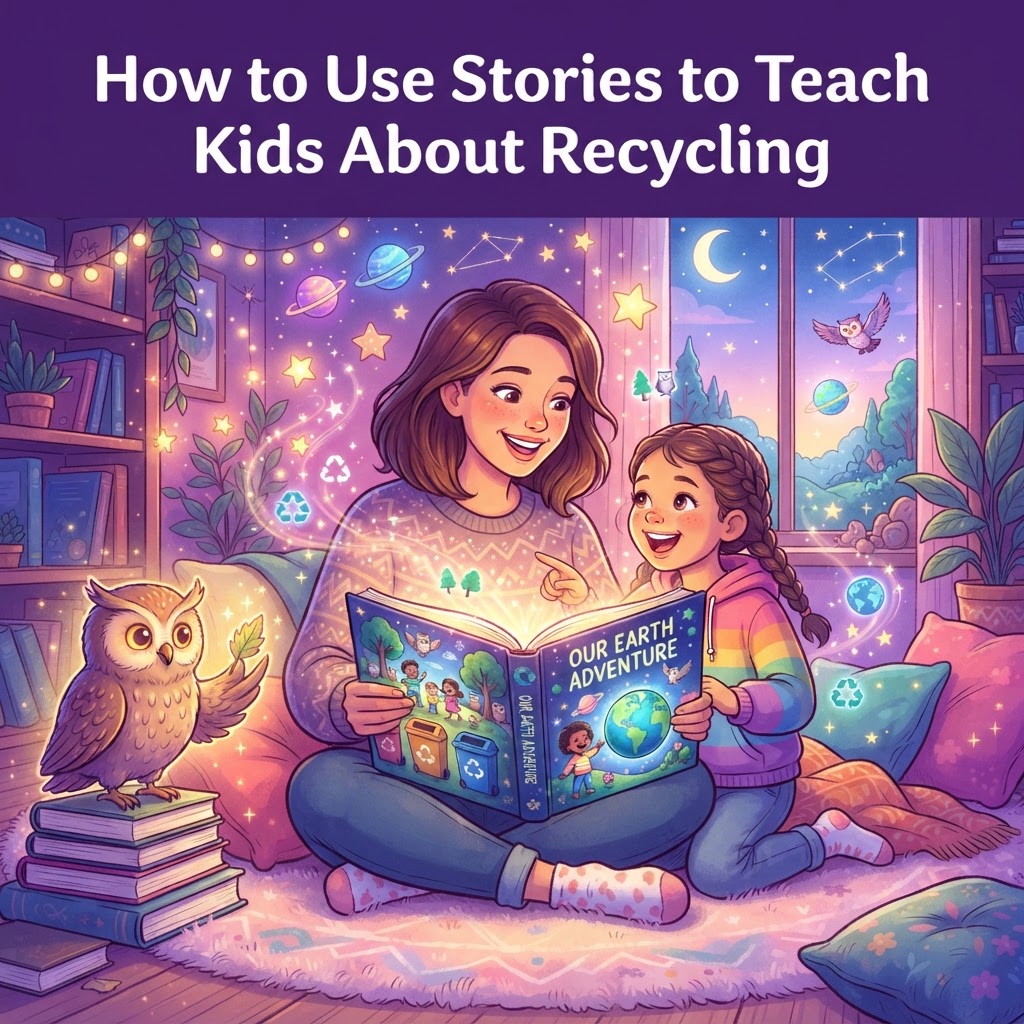
Children rarely care about a plastic bottle because an adult explains landfill statistics. They care when that bottle becomes a character who gets a second life. That is why recycling stories for kids can be such a powerful tool: stories make environmental ideas feel personal, memorable, and doable.
If you want to raise a child who notices waste, asks thoughtful questions, and takes small action, storytelling is a strong place to start. Below, you’ll learn why teaching recycling through stories works, how to create age-appropriate eco tales, and how to turn story time into real-life habits without fear or guilt.
Why are stories such an effective way to teach kids about recycling?
Stories work because they turn an abstract topic into a human-sized experience. Instead of hearing “recycling is important,” children see a character sort a juice box, rescue a park, or reuse a cardboard box for something new.
This matters developmentally. Young children learn best through repetition, emotion, and concrete examples. A story gives all three. It wraps a big concept like waste reduction inside a simple narrative arc: problem, choice, action, result.
Environmental education groups have long supported starting early. The North American Association for Environmental Education emphasizes that early experiences help children build awareness, empathy, and stewardship. Likewise, UNESCO’s work on education for sustainable development highlights that children need values and habits, not just facts.
Stories also help children feel capable. That is important. If a child only hears about pollution or climate problems, they may feel overwhelmed. But if they hear a story about a child who rinses a yogurt cup, sorts paper, and helps a friend recycle, they learn that small actions matter.
In practice, stories teach recycling well because they:
- make environmental responsibility feel relatable
- show cause and effect in a simple way
- build empathy for nature, animals, and community spaces
- repeat vocabulary like reuse, sort, reduce, and recycle
- encourage action instead of shame
How do recycling stories for kids build real environmental awareness?
Recycling stories build awareness by connecting everyday choices to bigger environmental outcomes. A child begins to understand that what happens at snack time, cleanup time, or bedtime can affect parks, oceans, animals, and neighborhoods.
That connection is the heart of environmental learning. Children do not need a lecture on systems thinking. They need stories that show how one banana peel, one bottle cap, or one overflowing bin fits into a larger world.
For example, a strong story might show:
- a squirrel whose park is cleaner when litter is picked up
- a toy robot built from cereal boxes and paper tubes
- a family that notices less trash after reusing containers
- a classroom that sorts materials and creates art from scraps
These narratives help children notice patterns. Over time, the message becomes: “I am part of my environment, and my choices affect it.”
This is especially effective when recycling is linked to topics children already understand. If your child enjoys nature books, you can connect eco lessons with season-based storytelling. If they are learning perseverance, pair sustainability with growth mindset stories so they see that trying again matters for habits too.
What makes a good recycling story for children?
A good recycling story is simple, hopeful, and action-focused. The best environment stories for children do not preach. They show one clear problem, one meaningful choice, and one satisfying outcome.
For ages 1-4, keep the plot short and repetitive. A toddler-friendly story might repeat a line like, “Paper goes here, plastic goes there,” while a familiar character sorts objects into colorful bins. At this age, rhythm and routine matter more than detailed explanation.
For ages 5-7, add a little problem-solving. A lost bottle, a messy playground, or a full trash can gives children a story reason to care. They can follow a character’s decision and understand why it helps.
For ages 8-10, you can introduce bigger ideas such as waste reduction, reusing materials, or community action. Older children often enjoy stories where they solve a challenge with friends, build something from recyclables, or lead a class project.
The strongest recycling stories usually include:
- A relatable main character: a child, animal, or toy with familiar feelings
- A visible eco problem: litter, mixed-up bins, wasted paper
- A simple action step: sort, rinse, reuse, repair, or collect
- A positive result: cleaner space, proud feeling, helpful change
- A hopeful ending: children should feel empowered, not blamed
You can also borrow techniques from other learning stories. Repetition, predictable structure, and gentle problem-solving all help children remember what to do.
What are 5 recycling story prompts parents and teachers can use tonight?
The easiest way to start is with a prompt that gives your child a clear character, problem, and recycling action. These five ideas work well for bedtime, classroom read-alouds, or creative writing.
1. The Bottle That Wanted Another Life
A plastic bottle worries it will be forgotten in the trash. A child notices it, rinses it, places it in the right bin, and imagines what it might become next.
2. The Mixed-Up Bin Mystery
At school, the recycling bin is full of the wrong items. Two friends become “recycling detectives” and solve the mystery by teaching their class what belongs where.
3. The Cardboard Castle Rescue
A family is about to throw away a big pile of boxes. Instead, a child turns them into a castle, spaceship, or animal home and learns that reusing is part of caring for the planet too.
4. The Park Picnic Cleanup Crew
After a windy picnic, wrappers blow across the grass. A group of children works together to sort the mess, protect the ducks, and leave the park better than they found it.
5. The Little Robot Made From Scraps
A child builds a friendly robot from cans, tubes, and paper. The robot teaches that old materials can become something useful, creative, and fun.
To make any prompt stronger, add:
- your child’s name
- a favorite animal or toy
- a familiar place, like home, school, or the local park
- one repeated phrase they can join in with
How can you use InstaTales to create eco-themed stories that feel personal?
Personalized stories are especially effective because children pay more attention when they are part of the adventure. When a story includes their name, favorite objects, and familiar routines, the lesson feels real rather than generic.
With InstaTales, you can create your own personalized bedtime story around a simple recycling challenge in just a few minutes. That makes it easier to match the story to your child’s age, attention span, and current interests.
Try using prompts like these:
- “Create a gentle bedtime story about Maya learning to sort paper and plastic.”
- “Write a funny story about Leo and a talking recycling bin who clean up the playground.”
- “Make a story for a 4-year-old with repetition about reusing boxes to build a rocket.”
A few practical tips make the story even better:
- ask for one clear recycling behavior
- keep the tone warm and hopeful
- request repetition for younger children
- include 1-2 discussion questions at the end
- use familiar settings like home, preschool, or grandma’s house
If you want to reread favorite stories, save them in your story library. And if you are planning eco literacy in a classroom, InstaTales for teachers can support group reading, writing prompts, and themed activities across a week or unit.
How can parents and teachers turn story time into recycling habits?
Story time changes behavior best when it leads to one small real-world action. After the story ends, give children a chance to do the same thing the character did.
This does not need to be complicated. In fact, simple follow-through works best. A two-minute sorting game after a bedtime story can be more effective than a long lecture.
Try these easy extensions:
- set out two or three bins and sort a few safe household items
- ask, “What would our story character do with this?”
- go on a mini “recycle or trash?” scavenger hunt
- make a reuse box for art supplies and cardboard scraps
- let children decorate recycling labels for home or class
The U.S. Environmental Protection Agency’s recycling basics can help adults check local guidelines, since rules vary by area. That matters because children learn best when the story lesson matches what happens in real life.
You can also build an eco-story routine across the year. Pair recycling stories with books about weather, seasons, gardens, and community helpers. If you want more ideas, browse the InstaTales blog for connected literacy themes that make environmental learning feel natural rather than forced.
Frequently Asked Questions
What age should I start teaching recycling through stories?
You can start as early as toddlerhood with simple language and repetition. Young children may not understand systems yet, but they can learn basic habits like putting paper in the right bin.
How long should a recycling story be for kids?
For toddlers and preschoolers, keep it to 3-5 minutes with repeated lines. For older children, 5-10 minutes works well if the story includes a problem to solve.
Should recycling stories focus on facts or feelings?
They should use both, but feelings come first for most young children. When a child cares about a character, they are more likely to remember the fact and copy the action.
What if my child becomes anxious about pollution or waste?
Keep the tone hopeful and action-based. Focus on what children can do—sort, reuse, clean up, and help—rather than on scary global problems they cannot control.
Can teachers use personalized recycling stories in class?
Yes, as long as the stories are age-appropriate and tied to clear learning goals. Personalized or class-themed stories can boost engagement during science, literacy, or social-emotional learning blocks.
How often should we read recycling stories?
A few times a week is enough to build familiarity. Re-reading the same story, then practicing one matching habit, is often more effective than constantly introducing new lessons.
Ready to Create a Personalized Bedtime Story?
Use our free AI bedtime story generator to create a personalized illustrated story for your child in 30 seconds — no credit card needed.
Popular story types:
Maya Rodriguez
Lead Content Editor & Early Literacy Specialist
Maya is a former early childhood educator and literacy specialist with over a decade of experience helping children develop a love of reading. She leads content at InstaTales, where she writes about the science of storytelling, child development, and how families can use personalized AI stories to build literacy and emotional resilience.
instatales.ai