Photosynthesis for Kids: 5 Curious Stories
Feed your child's curiosity with these photosynthesis stories that combine imagination with real science and discovery.
✦ Key Takeaways
- •Photosynthesis stories help children remember science because they turn abstract ideas into vivid mental pictures.
- •Photosynthesis is the way plants make their own food using sunlight, water, and carbon dioxide from the air.
- •The best photosynthesis adventures for children combine one memorable character with one clear science idea.
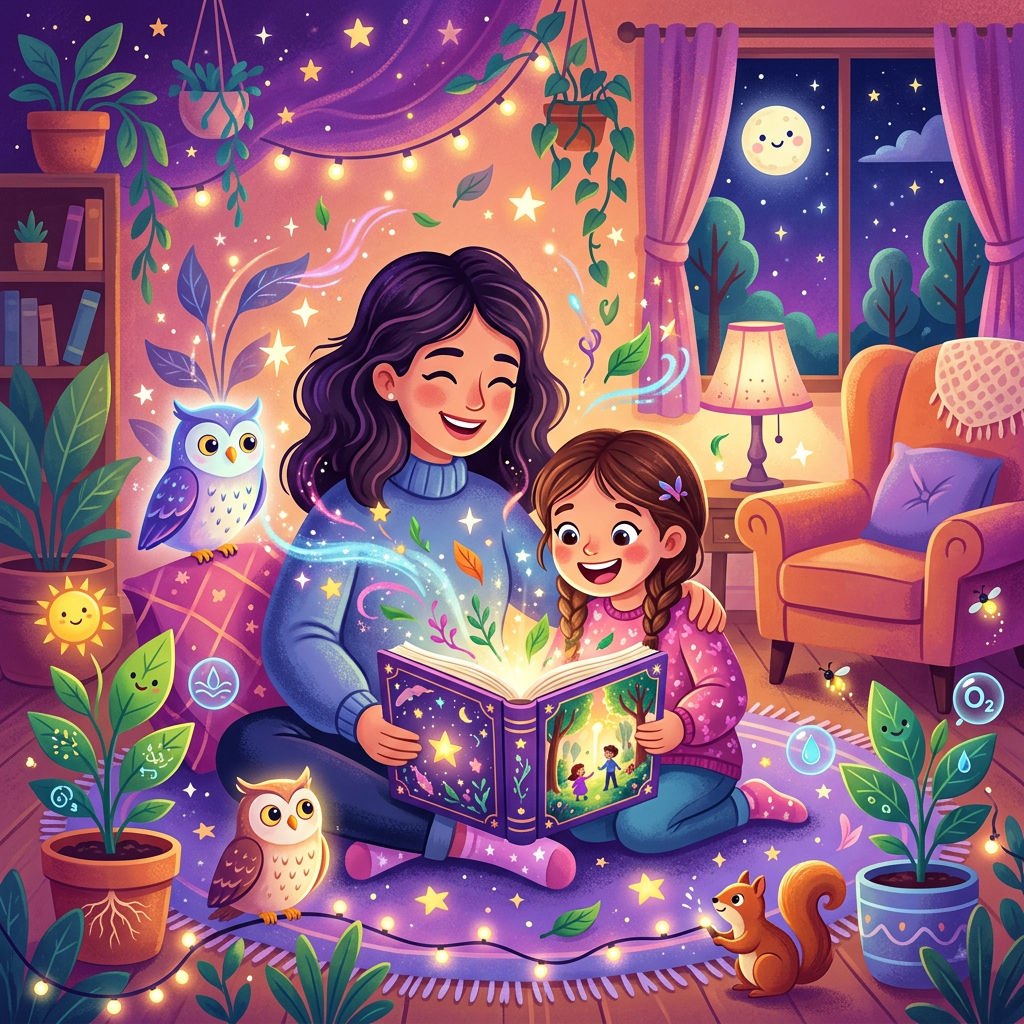
If your child asks, “How do plants eat sunlight?” they are ready for photosynthesis for kids in the best possible form: a story. Facts matter, but stories help children see invisible science happening inside a leaf, a tree, or a tiny sprout on the windowsill.
That is why photosynthesis stories work so well for bedtime, classrooms, and family reading. They mix wonder with accurate science, giving children a gentle way to understand how plants use sunlight, water, and air to make food. If you want more plant-themed reading ideas, these stories that make plant science fun are a great next step.
Why do photosynthesis stories help curious kids remember science?
Photosynthesis stories help children remember science because they turn abstract ideas into vivid mental pictures. When a leaf becomes a helper, sunlight becomes energy, and roots become delivery tubes, children can follow the process like a mini adventure.
This matters for learning. Research from the Harvard Center on the Developing Child shows that young children learn best through rich language, warm interaction, and meaningful back-and-forth experiences. A story creates exactly that. It gives parents and teachers natural chances to pause, ask questions, and connect ideas to the real world.
Stories also support memory because they provide:
- Sequence: first sunlight, then water, then plant food
- Emotion: children care more when a character has a goal
- Repetition: key science words can appear again and again
- Context: facts feel useful, not random
For curious kids photosynthesis becomes much less intimidating when it sounds like a journey instead of a textbook definition.
What is photosynthesis for kids in simple words?
Photosynthesis is the way plants make their own food using sunlight, water, and carbon dioxide from the air. In simple terms, a plant uses light energy to turn these ingredients into sugar, which helps it grow, while also releasing oxygen.
A child-friendly version might sound like this: Plants are tiny food makers. They catch sunlight in their leaves, drink water through their roots, take in air, and make plant sugar.
These are the key facts to keep accurate in any story:
- Sunlight gives the plant energy
- Roots take in water from the soil
- Leaves take in carbon dioxide from the air
- Chlorophyll helps plants capture light energy
- The plant makes glucose, a kind of sugar
- The plant releases oxygen
NASA’s kid-friendly explainer on photosynthesis is especially useful if you want a clear visual for older children. For a hands-on science education resource, the American Chemical Society also offers child-friendly materials that support early plant science learning.
Which photosynthesis stories can turn science into an adventure?
The best photosynthesis adventures for children combine one memorable character with one clear science idea. You do not need a long plot; you just need a simple problem, a little wonder, and a few accurate facts.
1. The leaf who learned to catch sunlight
A little leaf worries it is “just green” until it discovers that green leaves contain chlorophyll, the pigment that helps plants capture light energy. The twist: the leaf learns that it looks green because chlorophyll reflects green light while absorbing other colors more strongly.
Science facts to include:
- Chlorophyll helps plants use sunlight
- Most photosynthesis happens in leaves
- Leaves are like solar panels for plants
2. The roots’ secret delivery mission
In this story, the roots are busy messengers carrying water up to the leaves. Along the way, the child meets the idea that roots absorb water from the soil, and the plant transports it upward through special tubes.
Science facts to include:
- Roots absorb water
- Water travels up through the plant
- Water is one ingredient plants need to make food
This story works especially well for children who like “inside the plant” adventures.
3. The little tree with an air-door
A young tree discovers tiny openings on its leaves that act like tiny doors. These openings, called stomata, let carbon dioxide enter so the plant can use it in photosynthesis.
Science facts to include:
- Plants take in carbon dioxide from the air
- Stomata are tiny openings, often on leaves
- Plants use carbon dioxide along with water and sunlight
For many children, this is the moment when photosynthesis for kids suddenly clicks: plants are not just sitting still; they are constantly interacting with their environment.
4. The sugar factory in the sunny garden
A sunflower imagines its leaf as a tiny kitchen or factory where ingredients become sugar. That sugar, called glucose, helps the plant grow taller, make seeds, and store energy.
Science facts to include:
- Photosynthesis makes glucose
- Plants use sugar for growth and repair
- Some extra sugar can be stored for later
This is one of the strongest photosynthesis stories for connecting science with everyday foods children already know, like fruits, seeds, and vegetables.
5. The sleepy plant and the daytime puzzle
A child wonders whether plants make food all night long. The story reveals that photosynthesis needs light, so it mainly happens during the day, even though plants keep living and using energy all the time.
Science facts to include:
- Photosynthesis needs light
- Plants do not photosynthesize the same way in the dark
- Plants also use energy to stay alive day and night
This idea can lead naturally into connected science topics like weather and water movement. If your child enjoys linking big systems together, try these water cycle stories next.
How can you prompt InstaTales for science-rich photosynthesis stories?
A strong prompt gives the story a child-friendly plot while protecting the science facts. The easiest way to do this is to name the child’s age, the main character, the setting, and 2-4 facts you want included.
When you create your own personalized bedtime story, try this simple formula:
- Child’s age or reading level
- Main character or favorite animal
- A plant setting, like a garden, jungle, or greenhouse
- The science facts to include
- The tone: cozy, funny, adventurous, gentle
- A closing question to encourage discussion
Here are three prompt examples:
- “Write a bedtime story for a 5-year-old about a brave leaf who learns photosynthesis. Include sunlight, water, carbon dioxide, chlorophyll, and oxygen. Keep it warm and easy to understand.”
- “Create a science story for a 7-year-old about a tree detective solving the mystery of how plants make food. Use accurate facts about roots, stomata, and glucose.”
- “Write a classroom-friendly story for ages 6-8 about a sunflower teaching children photosynthesis. End with three simple discussion questions.”
If you want a faster start, browse the built-in story templates and adapt one for plant science. Once you find a favorite, save it in your story library so children can revisit the same science idea through repetition, which is especially helpful for younger learners.
What can parents and teachers do after the story ends?
The learning deepens when the story leads to one simple conversation or activity. You do not need a full lesson plan; one small follow-up is enough to help children connect the narrative to real plants.
Try one of these easy extensions:
- Ask, “What were the three things the plant needed?”
- Look at a houseplant and find roots, stem, and leaves
- Draw the journey of water from soil to leaf
- Act out the process: sunlight, water, air, sugar
- Compare plant science stories with other curiosity-led topics on the InstaTales blog
For classrooms, short science stories can also support read-alouds, writing prompts, and cross-curricular learning. NAEYC and other early childhood organizations consistently support inquiry-based, language-rich science experiences because young children learn best when they can talk, imagine, observe, and revisit ideas.
The goal is not to make bedtime feel like a quiz. The goal is to help photosynthesis adventures children actually enjoy, remember, and want to explore again.
Frequently Asked Questions
What is the easiest way to explain photosynthesis to a child?
Say that plants make their own food using sunlight, water, and air. Then add that this process helps plants grow and gives off oxygen for living things to breathe.
At what age can children start learning about photosynthesis?
Many children can begin understanding basic plant ideas around ages 4-6 if the language is simple and concrete. Older children, usually 7-10, are often ready for words like chlorophyll, carbon dioxide, and glucose.
Why are stories better than simple definitions for science learning?
Stories make invisible processes easier to picture and remember. They also create emotional engagement, which helps children stay interested and ask better questions.
How accurate should photosynthesis stories be?
They should be imaginative but scientifically correct at the core. Keep the main facts true: plants use sunlight, water, and carbon dioxide to make sugar and release oxygen.
Can photosynthesis stories be used in the classroom?
Yes, they work well for read-alouds, science centers, and writing extensions. Teachers can also use them to introduce vocabulary before hands-on observation or plant experiments.
How can I make a personalized photosynthesis story for my child?
Start with a familiar character, a favorite setting, and two or three plant facts you want included. Then use InstaTales to build a cozy, age-appropriate story that matches your child’s interests and curiosity.
Ready to Create a Personalized Bedtime Story?
Use our free AI bedtime story generator to create a personalized illustrated story for your child in 30 seconds — no credit card needed.
Popular story types:
Maya Rodriguez
Lead Content Editor & Early Literacy Specialist
Maya is a former early childhood educator and literacy specialist with over a decade of experience helping children develop a love of reading. She leads content at InstaTales, where she writes about the science of storytelling, child development, and how families can use personalized AI stories to build literacy and emotional resilience.
instatales.ai