Realistic vs Fantasy Stories for Kids: Which Helps?
Should kids read realistic stories or fantasy? Both have developmental benefits. Here's how to choose and balance them.
✦ Key Takeaways
- •Neither is “better” for every child or every moment.
- •Realistic stories help children understand themselves and the world they actually move through each day.
- •Fantasy stories support development by growing imagination, creativity, and emotional flexibility.
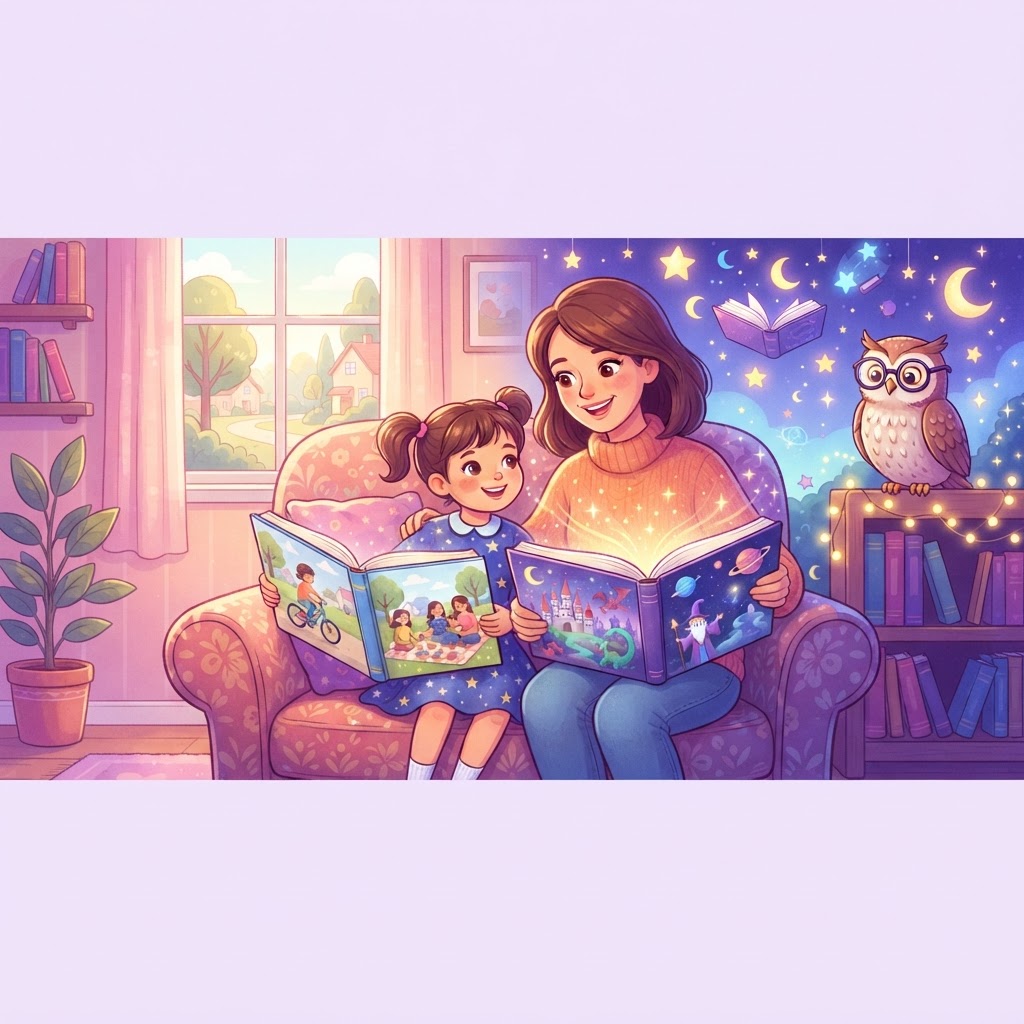
When parents search realistic vs fantasy stories for kids, they’re often really asking a bigger question: What kind of story helps my child grow best? The short answer is that both matter. Realistic stories help children make sense of everyday life, while fantasy stories stretch imagination and give kids a safe way to explore big feelings, brave choices, and new possibilities.
Are realistic or fantasy stories better for kids?
Neither is “better” for every child or every moment. The best story types for children depend on age, temperament, and what a child is working through right now.
A child starting preschool may benefit from realistic stories about friendships, routines, and separation. A child who loves dragons, magical forests, and talking animals may be building creativity, flexible thinking, and emotional resilience through fantasy. In practice, the strongest reading diet usually includes both.
Think of it this way:
- Realistic stories build connection to the child’s real world
- Fantasy stories expand the child’s inner world
- Together, they support language, empathy, and thinking skills
This is one reason educators often recommend a varied reading life, much like the balance discussed in this guide to fiction and nonfiction choices for kids.
What do realistic stories help children learn?
Realistic stories help children understand themselves and the world they actually move through each day. They are especially useful for social learning, emotional regulation, and practical problem-solving.
In realistic fiction vs fantasy children often respond differently because realistic stories mirror familiar experiences. A story about losing a toy, meeting a new teacher, welcoming a sibling, or feeling left out at play gives children language for situations they may not yet know how to explain.
Key benefits of realistic stories include:
- Relatability: Children see characters who feel like them
- Problem-solving: They watch how everyday conflicts get resolved
- Social learning: They notice sharing, cooperation, apology, and kindness
- Emotional validation: They realize, “Other kids feel this way too”
- Vocabulary growth: They hear words tied to real routines and experiences
This matters developmentally. The American Academy of Pediatrics has long emphasized that shared reading supports language, relationships, and early literacy. Realistic stories are especially powerful when adults pause to ask questions like, “What would you do?” or “How do you think that character felt?”
In my experience as an education-focused writer, realistic stories are often the best choice when a child is:
- Starting daycare or school
- Learning bedtime or toileting routines
- Navigating friendship problems
- Adjusting to change at home
- Feeling worried about something specific
For many children, these stories don’t just entertain. They rehearse life.
How do fantasy stories support healthy development?
Fantasy stories support development by growing imagination, creativity, and emotional flexibility. They let children explore the impossible in a way that can feel exciting, playful, and surprisingly safe.
A magical story may look “less practical” than a realistic one, but fantasy often does important cognitive and emotional work. When children imagine flying, transforming, meeting mythical creatures, or solving problems in enchanted worlds, they practice symbolic thinking. That skill is closely tied to creativity, storytelling, and flexible reasoning.
Fantasy stories often help children:
- Imagine alternatives: “What else could happen?”
- Practice creativity: They connect ideas in new ways
- Explore fears safely: Monsters and magic can stand in for real worries
- Build courage: Heroes face danger, uncertainty, and setbacks
- Strengthen narrative thinking: Children follow complex “what if” scenarios
Organizations like NAEYC have long highlighted the developmental value of imaginative play, and fantasy stories work in a similar way. They invite children to try on possibilities before they can live them.
There is also research linking fiction to social understanding. Work by psychologist Raymond Mar and colleagues has found that engagement with stories can support perspective-taking and empathy. Fantasy can do this especially well because it asks children to enter worlds unlike their own.
If a child loves adventure, fantasy may also keep reading joyful. And joy matters. Motivation is one of the strongest predictors of reading growth, as literacy experts at Reading Rockets frequently note.
How should story choices change by age?
Story balance should change as children grow. Younger children usually need more concrete, familiar stories, while older children can benefit from a richer blend of realism and fantasy.
Here is a practical age-by-age guide:
Ages 1-3: Start with familiar life, add gentle magic
Toddlers learn best from repetition and everyday routines. Books about bedtime, eating, families, pets, and feelings are highly useful because they connect directly to lived experience.
Fantasy can still work well at this age, but it should usually be simple and reassuring. Think friendly animals, mild wonder, and predictable patterns rather than complex world-building.
Ages 4-6: Mix everyday problem-solving with make-believe
Preschoolers and kindergartners are in a sweet spot for both realism and fantasy. They are learning social rules and emotional control, but they also thrive on pretend play and imagination.
This is often the best age to pair a realistic story about friendship with a fantasy story about bravery. Children can move between the two easily and learn from both.
Ages 7-10: Use both for deeper thinking
Older children can handle more layered plots, symbolism, and moral complexity. Realistic fiction can help them think through school pressure, fairness, identity, and friendships. Fantasy can help them grapple with power, responsibility, difference, and courage.
This is also when format matters more. If your child is moving from picture books to chapter books, both realistic and fantasy stories can make that transition easier, depending on interest.
How can parents balance realistic and fantasy stories at home?
The easiest way to balance both is to match the story to the child’s current need. You do not need a perfect ratio; you need a responsive mix.
A simple weekly pattern might look like this:
- Choose realistic stories when your child is facing a real-life challenge
- Choose fantasy stories when your child wants wonder, adventure, or emotional distance
- Re-read favorites, because repetition deepens learning
- Let your child help choose, so reading stays motivating
A few practical examples:
- If your child is nervous about school, pick a realistic story about first-day feelings
- If your child seems mentally tired, pick a light fantasy story that feels playful
- If your child is working through conflict, use realistic fiction to model repair
- If your child needs confidence, use fantasy to explore bravery and heroism
Timing can help, too. Some children settle best with calm realistic stories at night, while others find gentle fantasy soothing and comforting. If you’re deciding when each type works best, this guide to the best time for kids’ stories can help.
You can also personalize the mix. With InstaTales, families can create your own personalized bedtime story based on a child’s age, mood, interests, or current challenge, then save favorites in your story library for easy re-reading. That makes it easier to offer a realistic story one night and a fantasy story the next.
When should you choose realistic stories, and when should you choose fantasy stories?
Choose realistic stories when a child needs clarity, and choose fantasy stories when a child needs possibility. Both can comfort, teach, and inspire; the difference is usually the path they take.
Choose realistic stories when your child needs:
- Help understanding a daily routine
- Support with friendship or family changes
- Language for a real emotion
- Examples of everyday problem-solving
Choose fantasy stories when your child needs:
- A spark for imagination
- Safe distance from fear or stress
- Encouragement to think creatively
- A sense of adventure, wonder, or empowerment
If you’re unsure, offer both and watch your child’s response. Children often tell us what they need by the stories they ask for again and again.
Frequently Asked Questions
Are realistic stories better for toddlers?
Realistic stories are often especially helpful for toddlers because they connect to routines, feelings, and familiar people. Gentle fantasy can still be wonderful, but most children ages 1-3 benefit from stories rooted in everyday life.
Do fantasy stories confuse young children?
Usually, no. Most young children can enjoy fantasy while still learning the difference between pretend and real, especially when adults talk with them during reading. The key is choosing age-appropriate fantasy that feels playful rather than overwhelming.
How much fantasy is too much for kids?
There is no fixed limit. Fantasy becomes less helpful only if it fully replaces other valuable story experiences, including realistic fiction, nonfiction, and conversation about real life.
Can realistic fiction teach empathy?
Yes. Realistic fiction can be excellent for empathy because children recognize the characters’ problems, feelings, and social situations. That familiarity makes it easier to connect story events to real behavior.
Should siblings read the same story types?
Not necessarily. Children in the same family can have very different developmental needs, reading levels, and preferences. A balanced home reading life can include shared family stories plus individual choices.
What is the best mix of story types for children?
A good mix includes both realistic and fantasy stories across the week. If you follow your child’s age, interests, and current challenges, you’ll usually find the right balance naturally.
Ready to Create a Personalized Bedtime Story?
Use our free AI bedtime story generator to create a personalized illustrated story for your child in 30 seconds — no credit card needed.
Popular story types:
Maya Rodriguez
Lead Content Editor & Early Literacy Specialist
Maya is a former early childhood educator and literacy specialist with over a decade of experience helping children develop a love of reading. She leads content at InstaTales, where she writes about the science of storytelling, child development, and how families can use personalized AI stories to build literacy and emotional resilience.
instatales.ai