7 Story-Based History Activities for Kids
Combine storytelling with history activities — fun, educational activities that extend the story experience and build skills.
✦ Key Takeaways
- •Yes—stories make history easier for children to understand because narratives give facts a human shape.
- •Start simple: choose one historical setting, generate one short story, and build one activity from it.
- •The best history activities are clear, concrete, and easy to repeat.
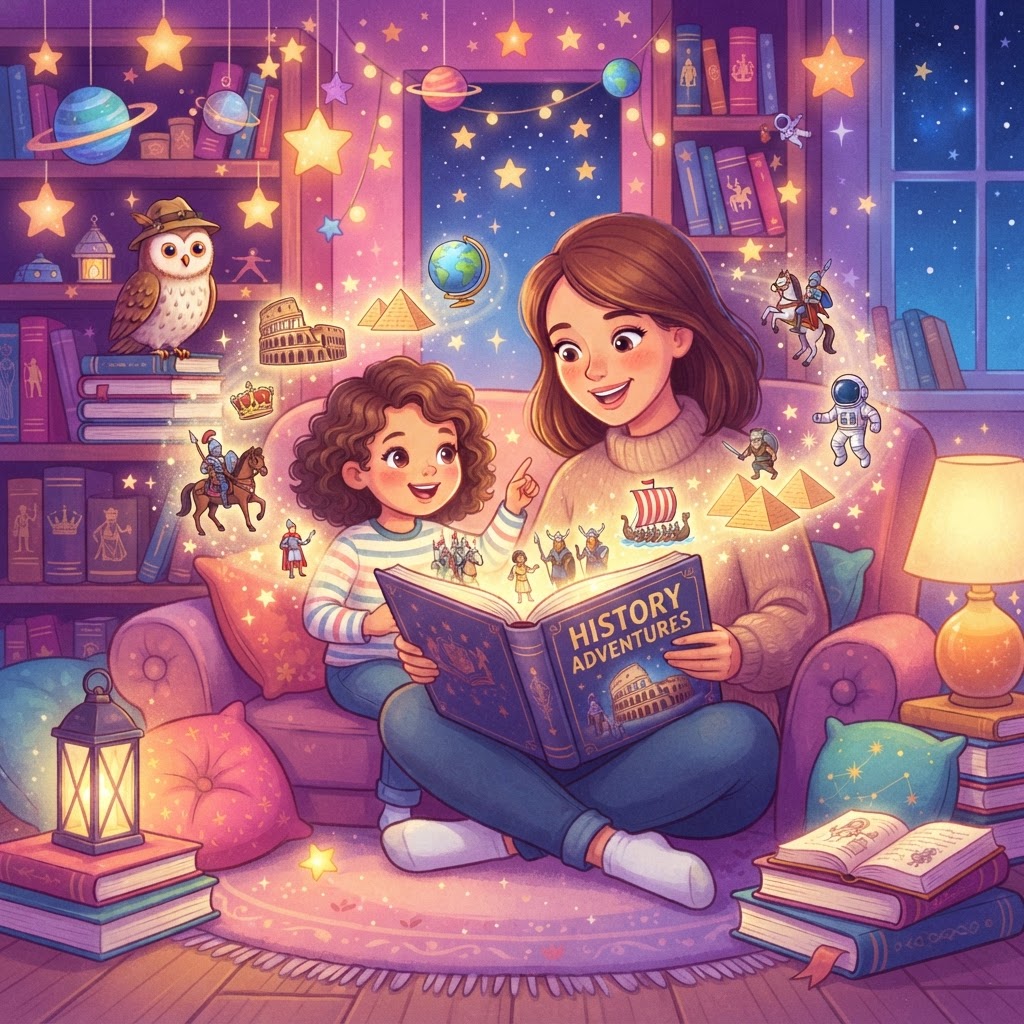
History feels real to children when it arrives through a character, a problem, and a place they can imagine. That is why story-based history activities for kids work so well: a bedtime story about a child in ancient Egypt or on the Oregon Trail gives parents and teachers a simple starting point for hands-on learning.
With InstaTales, you can create your own personalized bedtime story around a historical setting, then turn that story into play, art, writing, and discussion the next day. If you have been searching for history-activities activities children can do without dry worksheets, this guide gives you practical, low-prep ideas that build curiosity, memory, and language skills.
Why do story-based history activities work so well for kids?
Yes—stories make history easier for children to understand because narratives give facts a human shape. Instead of memorizing dates, children follow a person, sequence events, and ask, “What happened next?”
This matters because young children learn best through play, repetition, and meaningful context. The National Association for the Education of Young Children has long highlighted how pretend play strengthens language, self-regulation, and flexible thinking. Historical storytelling also supports early historical thinking: children compare “then” and “now,” notice tools and clothing, and begin to understand that people lived differently in the past.
For older children, story-based history activities also build empathy. A child who imagines carrying water in a Roman town or writing a letter during the Civil Rights Movement is doing more than playing—they are practicing perspective-taking, a key part of social and cognitive development.
How can parents and teachers set up a story-based history lesson?
Start simple: choose one historical setting, generate one short story, and build one activity from it. You do not need a full unit plan for story-based history-activities to be effective.
A good setup looks like this:
- Pick an age-appropriate topic: castles, ancient Egypt, inventors, pioneers, the first moon landing, or a family history story
- Use story templates or write a prompt in InstaTales with your child as the main character
- Read the story once for enjoyment, then read it again to notice details
- Ask 2-3 questions: Who was there? What objects did they use? What was different from today?
- Save strong stories in your story library so children can revisit favorites and extend them later
For classroom use, InstaTales for teachers can help you organize themes by week, reading level, or grade. If you want to add more literacy after the activity, these story-based journaling ideas pair especially well with history lessons.
What story-based history activities for kids can you try today?
The best history activities are clear, concrete, and easy to repeat. Below are seven history activities for kids that begin with an InstaTales story and turn reading into active learning.
1. Can children pack a time-travel suitcase?
Yes—this activity helps children think about daily life in another time period. It works especially well for ages 4-8.
- Story prompt: Create an InstaTales story about your child traveling to ancient Egypt, a medieval castle, or a pioneer town for one day.
- Materials needed: Small bag or box, paper, crayons, child-safe household objects
- Instructions:
- After reading, ask: “What would you need to bring if you were really going there?”
- Have children choose or draw 5 items for their suitcase.
- For each item, ask them to explain why it matters in that historical setting.
- Compare which items would help then versus now.
This activity teaches historical context, problem-solving, and oral language.
2. How can kids build a living timeline?
A living timeline helps children understand sequence, which is one of the first big history skills. It is especially good for ages 5-10.
- Story prompt: Generate a story with 4-6 clear events, such as a day in the life of a child in ancient Rome or during the moon landing era.
- Materials needed: String or ribbon, clothespins or tape, index cards, markers
- Instructions:
- Write or draw one event from the story on each card.
- Stretch the string across a wall or floor.
- Ask your child to place the cards in order from first to last.
- Retell the story together using sequencing words: first, next, then, finally.
To extend learning, add one modern event card and discuss how life has changed.
3. What can kids learn by making a then-and-now museum?
Children quickly grasp history when they compare everyday objects across time. This activity works from preschool through elementary.
- Story prompt: Create a story about your child visiting a home, school, or marketplace from long ago.
- Materials needed: Paper, shoebox or table space, printed pictures or simple object drawings
- Instructions:
- Choose 3-5 items from the story, such as a candle, quill, clay pot, washboard, or old toy.
- Pair each with a modern version: flashlight, pen, mug, washing machine, or tablet.
- Set up a mini museum with labels: “Then” and “Now.”
- Invite children to explain what changed and what stayed the same.
This is a strong way to build observation skills. The Smithsonian Learning Lab offers excellent age-appropriate images if you want real object examples.
4. Can a story turn into a historical diary entry?
Yes—a diary entry is one of the easiest ways to deepen comprehension and empathy. It is ideal for ages 6-10.
- Story prompt: Ask InstaTales to tell a story from the point of view of a child living in a specific time period.
- Materials needed: Notebook or paper, pencils, optional tea-stained paper for fun
- Instructions:
- After reading, say: “Now let’s write what this child would say at the end of the day.”
- Use sentence starters: “Today I…,” “I felt…,” “I noticed…,” “Tomorrow I hope…”
- Encourage children to include one historical detail from the story, such as clothing, food, jobs, or transportation.
- Younger children can dictate while an adult writes.
This blends history with literacy and emotional expression.
5. How does role-play help children understand people from the past?
Role-play helps children remember details because they act them out with their bodies and voices. It is excellent for mixed ages and group settings.
- Story prompt: Generate a story in which your child meets a historical figure, craftsperson, explorer, inventor, or community helper from the past.
- Materials needed: Simple costume pieces, scarf, hat, cardboard props
- Instructions:
- Assign roles: narrator, child traveler, historical character
- Reread key parts of the story and pause to act them out
- Add an interview: “What is your job?” “What tools do you use?” “What is hard about life here?”
- Let children switch roles and answer in character
For families, this pairs nicely with reflective conversation after the activity. These story-based family discussion starters can help.
6. What is a family history map, and why is it powerful?
A family history map connects personal identity to the idea that history is made of real people and places. It is one of the most meaningful story-based history activities for kids.
- Story prompt: Create a story about a grandparent, parent, or ancestor as a child, using real details if possible.
- Materials needed: Paper map, printed map, stickers, crayons, family photos if available
- Instructions:
- Mark where the story takes place
- Add symbols for home, school, work, or a journey the person took
- Talk about what life might have looked like there at that time
- Invite children to compare that place with where they live now
This activity also supports geography skills. If your child enjoys maps, try these story-led geography activities next.
7. Can kids build a historical landmark from the story?
Yes—building makes history tactile and memorable. It is a great choice for ages 4-10.
- Story prompt: Generate a story set near a pyramid, castle, longhouse, lighthouse, fort, or early village.
- Materials needed: Blocks, cardboard, recycled materials, tape, crayons
- Instructions:
- Ask children to name the important building from the story
- Look back at the story for clues about shape, size, or purpose
- Build a model together
- When finished, ask: “Who used this place, and what happened here?”
This activity encourages close listening, engineering thinking, and creative recall.
How can you adapt story-based history activities for different ages?
Yes—you can scale these activities up or down by adjusting language, time, and output. The same story can work for a toddler, a first grader, and a fourth grader with small changes.
- Ages 1-3: Focus on pictures, textures, simple objects, and naming. Keep activities short and sensory.
- Ages 4-6: Use drawing, pretend play, sequencing, and “then vs. now” comparisons.
- Ages 7-10: Add diary writing, map work, interviews, timelines, and perspective questions.
A helpful rule is this: younger children need concrete experiences, while older children can handle more abstraction. The Library of Congress teaching resources are useful for adults who want to bring in photos, posters, or artifacts as children grow.
How can you keep history learning accurate and age-appropriate?
Yes—you can make history engaging without making it confusing or frightening. The key is to simplify carefully, not distort.
Choose one clear theme at a time, such as homes, transport, food, inventions, or daily routines. For younger children, avoid graphic or overwhelming details and focus on how people lived. For older children, you can gently introduce harder topics by naming unfairness, struggle, and change in honest but calm language.
It also helps to say, “This story is inspired by history,” then check one or two real facts together. That small habit teaches children that stories spark curiosity, and research deepens understanding.
Frequently Asked Questions
What age are history activities for kids best for?
Story-based history activities can work from toddlerhood through age 10. Younger children do best with sensory play and simple comparisons, while older children can write, map, and discuss point of view.
How long should a story-based history activity take?
Most activities work well in 10-30 minutes. Short sessions are often more effective because children can return to the same story over several days.
What kinds of historical topics are best for young children?
Daily life topics are usually best: homes, clothes, food, transport, tools, and celebrations. These are easier for children to picture than complex political events.
Can teachers use InstaTales for classroom history lessons?
Yes. Teachers can generate stories for a unit theme, small groups, or independent centers, then reuse them for timelines, writing, and role-play activities.
Do story-based history activities replace real history sources?
No. Stories are a starting point, not the whole lesson. They help children care first, then adults can add photos, artifacts, maps, and simple factual resources to deepen learning.
Ready to Create a Personalized Bedtime Story?
Use our free AI bedtime story generator to create a personalized illustrated story for your child in 30 seconds — no credit card needed.
Popular story types:
Maya Rodriguez
Lead Content Editor & Early Literacy Specialist
Maya is a former early childhood educator and literacy specialist with over a decade of experience helping children develop a love of reading. She leads content at InstaTales, where she writes about the science of storytelling, child development, and how families can use personalized AI stories to build literacy and emotional resilience.
instatales.ai