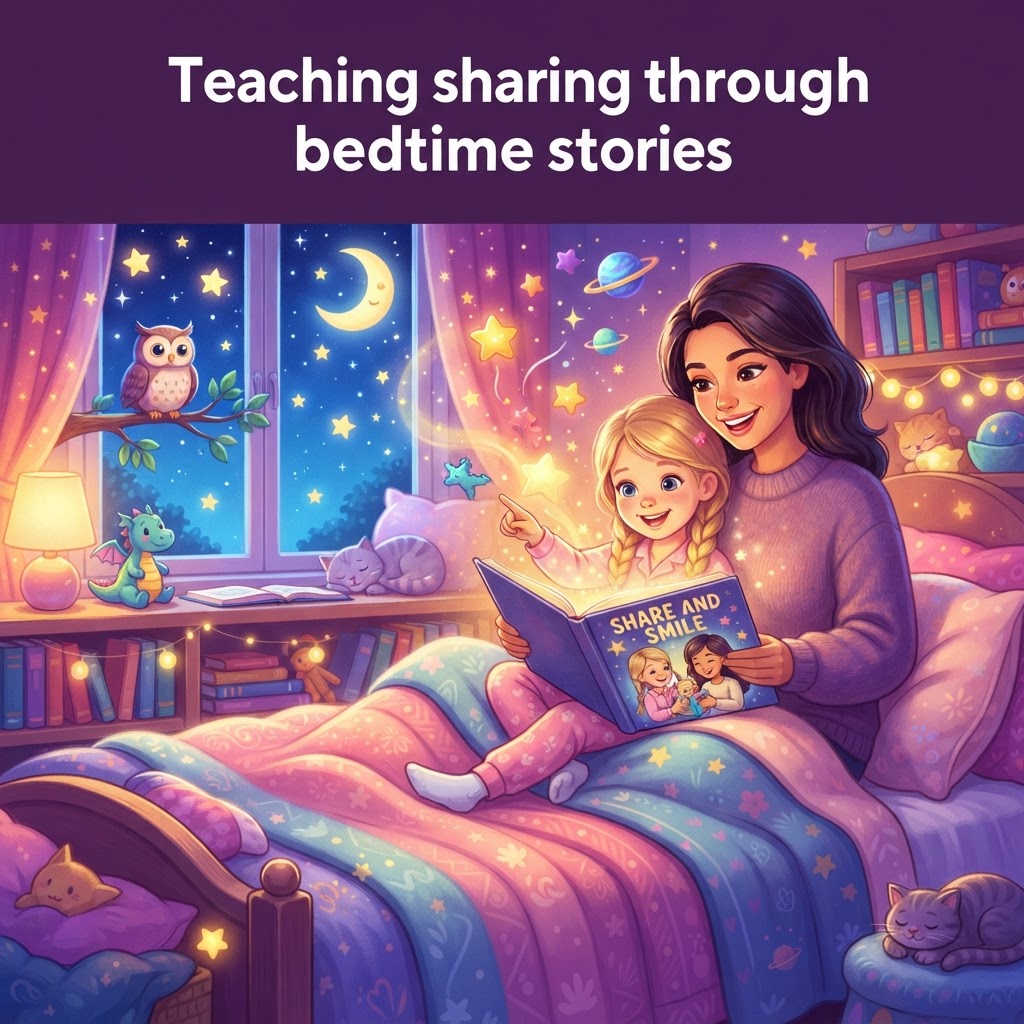
Teaching sharing through bedtime stories
Bedtime stories are the perfect time to teach sharing. Here's how to weave moral lessons into your child's nightly reading routine.
✦ Key Takeaways
- •Bedtime is a strong time to teach sharing because children feel safe, connected, and less defensive.
- •The best stories for teaching sharing show realistic emotions, simple consequences, and a satisfying resolution.
- •The best post-story conversations are short, curious, and specific.
If your child struggles to share toys, turns, or attention, bedtime can become one of your best teaching moments. In those calm, connected minutes before sleep, bedtime stories about sharing feel less like correction and more like comfort. That is why teaching sharing at bedtime works so well: children are relaxed, receptive, and ready to imagine what kindness looks like in real life.
Parents often ask whether moral stories for kids really make a difference. The short answer is yes—when the story is gentle, age-appropriate, and followed by a simple conversation. Decades of child development research show that children learn prosocial behavior through modeling, repetition, and warm adult guidance, not lectures. Organizations like the Center on the Developing Child at Harvard University and the American Academy of Pediatrics consistently highlight the power of responsive relationships and back-and-forth conversations in building social-emotional skills.
Why is bedtime such a good moment to teach sharing?
Bedtime is a strong time to teach sharing because children feel safe, connected, and less defensive. A calm nervous system makes it easier for a child to absorb new ideas and imagine better choices.
During the day, sharing can be loaded with emotion. A child may be tired, possessive, or frustrated, especially when siblings or friends are involved. At bedtime, you can revisit those same situations from a distance, through a story, when there is no toy to fight over and no pressure to perform.
This matters because young children do not learn values from instructions alone. They learn from stories, repetition, and emotional connection. Sharing bedtime stories give children a chance to see a character struggle, make a mistake, repair it, and feel good about being generous.
A bedtime story also lowers resistance. Instead of saying, “You need to share better tomorrow,” you can say, “That fox felt nervous about sharing his shiny red wagon. Have you ever felt that way?” That small shift invites reflection rather than shame.
How do you choose bedtime stories about sharing that actually help?
The best stories for teaching sharing show realistic emotions, simple consequences, and a satisfying resolution. Children learn more from a character who hesitates and grows than from one who is perfectly generous from page one.
When choosing bedtime stories about sharing, look for stories that include:
- A relatable conflict, such as sharing toys, snacks, space, or attention
- A character who feels something real: worry, jealousy, pride, or fear
- A clear moment of empathy, where the character notices another person’s feelings
- A positive outcome of sharing, such as friendship, teamwork, or relief
- A gentle tone, not a punishing or preachy message
Try to avoid stories where sharing is forced in a harsh way. In real life, children need help understanding why sharing matters and when it makes sense. They do better with stories that model turn-taking, cooperation, and generosity than with stories that simply say, “Good children share.”
If you want more examples, explore these stories that teach sharing to kids. You can also pair sharing themes with related values like kindness in bedtime stories, because empathy often comes before generosity.
How can you talk about sharing without turning story time into a lecture?
The best post-story conversations are short, curious, and specific. One or two thoughtful questions work better than a long moral speech.
After reading, try a simple rhythm:
- Name the moment: “That was the hard part for the bunny.”
- Ask one feeling question: “Why do you think she did not want to share?”
- Connect gently: “Have you ever felt like that?”
- End with encouragement: “Tomorrow you can try one small sharing moment too.”
This approach works because children need emotional language before behavior change. The National Association for the Education of Young Children emphasizes that empathy and self-regulation grow through relationships and conversation, not just rules.
A few good questions for moral stories for kids include:
- “What made sharing hard in this story?”
- “How did the other character feel before and after?”
- “What was one kind choice the character made?”
- “What could we try tomorrow if sharing feels tricky?”
Keep the tone warm. If your child had a hard sharing day, bedtime is not the time to correct every detail. The goal is to plant a seed, not win an argument.
What does teaching sharing at bedtime look like at different ages?
Teaching sharing at bedtime should match your child’s developmental stage. A toddler needs simple examples and repetition, while an older child can handle fairness, perspective-taking, and more nuanced social situations.
Ages 1-3: Keep it concrete and repetitive
Toddlers are only beginning to understand ownership, waiting, and other people’s feelings. Use very short stories with familiar objects like blocks, snacks, crayons, or stuffed animals.
Focus on phrases such as:
- “We take turns.”
- “There is enough for both.”
- “He felt happy when she shared.”
- “First me, then you.”
At this age, success may look like offering one toy for five seconds. That counts.
Ages 4-6: Build empathy and simple problem-solving
Preschoolers and kindergarteners can start to understand how their choices affect others. Stories can include small conflicts, mistakes, apologies, and try-again moments.
At this age, ask:
- “What was the fair thing to do?”
- “How did the friend feel?”
- “What could the character say next time?”
This is a great age for repeated themes. Reading several sharing bedtime stories over a few weeks helps the message stick.
Ages 7-10: Explore fairness, generosity, and social confidence
Older children can think beyond toys. Sharing may involve time, attention, leadership, ideas, or including someone new in a game.
Stories for this age can cover:
- Sharing credit on a school project
- Letting a sibling choose first
- Including a child who feels left out
- Balancing personal boundaries with generosity
If you are looking for age-specific ideas, these picks for older children learning to share can help. You can also connect sharing with truthfulness and responsibility through stories about honesty at bedtime.
How can personalized stories make sharing lessons feel more real?
Personalized stories often work better because children see themselves inside the lesson. When the main character has your child’s name, favorite animal, or common struggle, the message feels relevant instead of abstract.
That is one reason many families like to create your own personalized bedtime story. With InstaTales, parents can choose a moral story focus and a kind tone, which is especially useful for sensitive topics like sharing. A gentle voice helps children feel guided, not judged.
For example, a story about “Mia and the Moonlight Markers” can mirror a real challenge your child has with sharing art supplies. Because the story is one step removed from real life, children often engage more openly. They can reflect on the character’s choices without feeling called out.
Personalized stories also make repetition easier. If one story works, save it in your story library and revisit it over several nights. Re-reading is not a bad thing. In fact, repetition is one of the fastest ways to help children internalize social lessons.
What sharing bedtime stories can you try tonight?
The easiest way to start is with one simple prompt that matches your child’s age and current challenge. These story ideas are designed to support teaching sharing at bedtime without sounding heavy-handed.
Prompt 1: The toy-sharing story for ages 2-5
“Create a gentle bedtime story about a little bear who does not want to share a shiny toy truck at first, but learns that taking turns makes play more fun. Use simple language, a calm ending, and a warm lesson about friendship.”
This prompt works well for toddlers and preschoolers because it stays concrete and reassuring.
Prompt 2: The sibling-sharing story for ages 4-7
“Write a bedtime story about two siblings who both want the same blanket fort. They feel upset, then work together to make a bigger fort they can share. Include kind dialogue and a cozy bedtime ending.”
This helps children imagine cooperation instead of competition.
Prompt 3: The classroom-sharing story for ages 7-10
“Write a story about a child who is nervous about sharing art supplies and ideas during a school project. Show how sharing helps the whole group succeed, while also respecting the child’s feelings and boundaries.”
This prompt supports older children who are learning that sharing is not just about objects. It is also about collaboration, fairness, and confidence.
The goal is not to create a perfect moral every night. The goal is to give your child repeated, low-pressure practice seeing generosity in action. Over time, those small story moments become everyday habits.
Frequently Asked Questions
Can bedtime stories really help children learn to share?
Yes. Stories help children rehearse social situations in a calm, safe way. When you add a short follow-up conversation, the lesson becomes even more meaningful.
What if my child resists stories with obvious morals?
Choose stories with humor, warmth, and realistic feelings rather than heavy lessons. A child is more likely to connect with a character’s struggle than with a message that feels preachy.
How often should I read bedtime stories about sharing?
Two or three times a week is enough to build consistency without making the theme feel forced. You can rotate sharing stories with books about kindness, honesty, courage, and friendship.
Should I talk about my child’s behavior after the story?
Yes, but keep it gentle and brief. One simple connection like “That reminded me of today at the playground” is often more effective than a long correction.
Are personalized stories better than traditional books?
They can be, especially when your child is working on a specific skill. Personalized stories let you match the child’s age, challenge, and emotional sensitivity while keeping the experience warm and engaging.
Ready to Create a Personalized Bedtime Story?
Use our free AI bedtime story generator to create a personalized illustrated story for your child in 30 seconds — no credit card needed.
Popular story types:
Maya Rodriguez
Lead Content Editor & Early Literacy Specialist
Maya is a former early childhood educator and literacy specialist with over a decade of experience helping children develop a love of reading. She leads content at InstaTales, where she writes about the science of storytelling, child development, and how families can use personalized AI stories to build literacy and emotional resilience.
instatales.ai