Benefits of Fantasy Stories for Child Development
Fantasy stories do more than entertain — they build imagination, creativity, and cognitive flexibility. Here's what the research says.
✦ Key Takeaways
- •Fantasy stories support child development by helping children practice imagination, creativity, emotional understanding, and cognitive flexibility.
- •Fantasy strengthens imagination because it asks children to create mental pictures of things they cannot see in everyday life.
- •Fantasy stories build creativity by showing children that problems can have more than one answer.
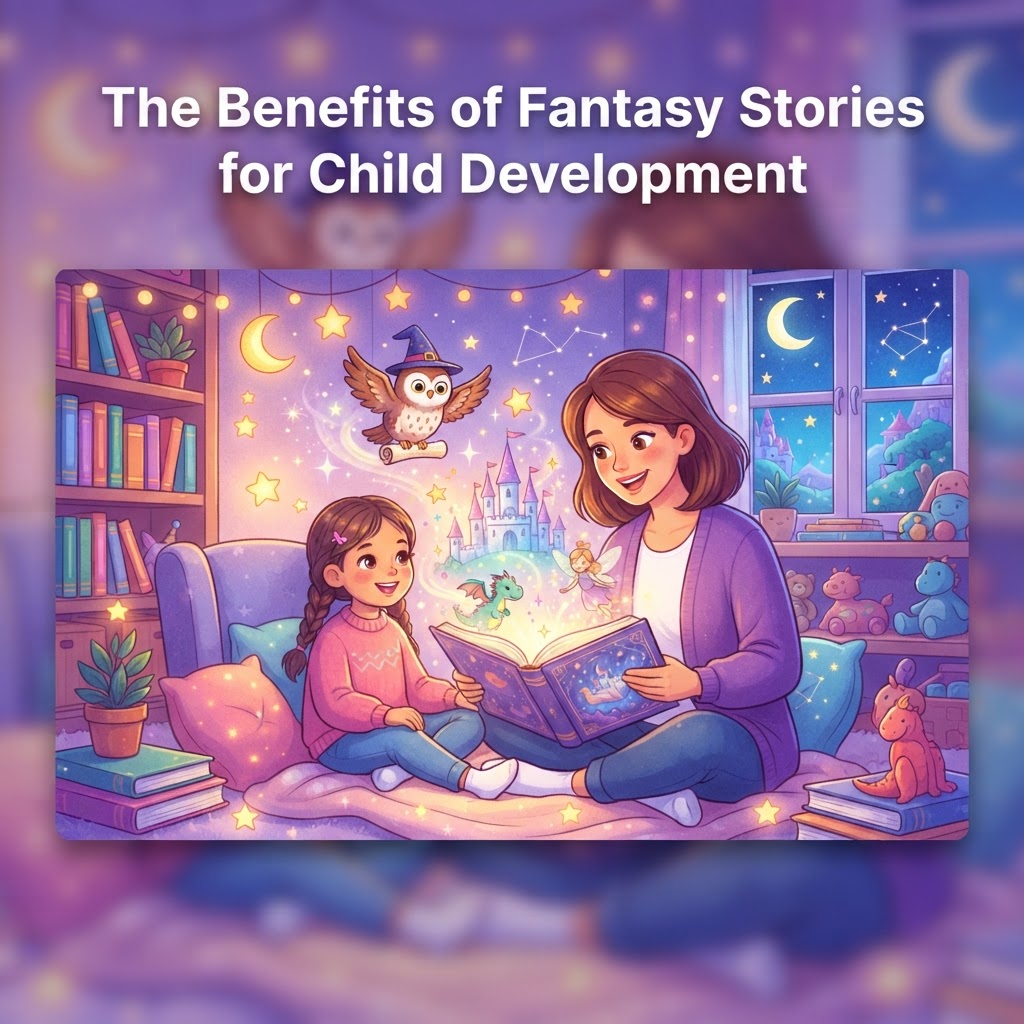
Fantasy stories do far more than entertain children before bed. Research on fantasy and child development suggests that magical narratives can strengthen imagination, support creativity, build flexible thinking, and give children a safe space to explore big feelings. For parents, teachers, and caregivers, that means dragons, talking animals, and enchanted forests are not just fun—they are powerful tools for learning.
This matters because childhood development is not only about memorizing facts. Children also need chances to wonder, pretend, problem-solve, and make sense of emotions. That is where the benefits of fantasy stories become especially clear.
How do fantasy stories support child development?
Fantasy stories support child development by helping children practice imagination, creativity, emotional understanding, and cognitive flexibility. In simple terms, they invite children to think beyond the obvious while still making meaning from what they hear.
When a child follows a hero through a magical world, they are doing real mental work. They picture scenes, predict what might happen next, and connect symbolic events to real-life feelings. Developmental theorist Lev Vygotsky famously argued that imagination is not separate from learning; it helps children build symbolic thought and self-regulation.
Fantasy stories also encourage children to hold two ideas at once: “This is pretend” and “This matters.” That ability supports later skills in reading comprehension, problem-solving, and social understanding.
Why does fantasy strengthen imagination?
Fantasy strengthens imagination because it asks children to create mental pictures of things they cannot see in everyday life. That practice builds the brain’s ability to form images, symbols, and possibilities.
A realistic story may show a child a familiar world. A fantasy story goes further. It asks, “What if animals could speak?” “What if the moon had feelings?” or “What if courage looked like a glowing key?” These ideas stretch thinking in healthy ways.
Researchers such as Dorothy and Jerome Singer, known for their work on imaginative play, found that make-believe experiences are linked to richer storytelling, language growth, and original thinking. Organizations like the National Association for the Education of Young Children also emphasize that imaginative play supports learning across many domains.
This is one reason fantasy overlaps so naturally with fairy tales and classic magical storytelling. Both genres help children practice symbolic thinking, which is a foundation for reading, writing, and abstract thought later on.
How do fantasy stories build creativity and problem-solving?
Fantasy stories build creativity by showing children that problems can have more than one answer. They also strengthen problem-solving because characters often face unusual challenges that require inventive thinking.
In fantasy, the solution is rarely simple. A child may hear about a giant who can only be calmed with music, or a lost star that must be returned through kindness instead of force. These plots model divergent thinking—the ability to generate many possible ideas.
That matters in everyday life. Creative thinking helps children:
- come up with new ways to solve conflicts
- experiment with language and storytelling
- adapt when plans change
- express themselves through art, play, and conversation
This is where imagination stories research becomes especially useful. Research reviews in the National Library of Medicine note that pretend play and imaginative activity are closely connected with narrative ability, symbolism, and social thinking. While no single story “causes” creativity overnight, regular exposure to imaginative narratives gives children repeated practice in flexible, original thought.
At home, this can be as simple as asking, “What would you do if you found a hidden door in the garden?” If you want to make that even more personal, you can create your own personalized bedtime story built around your child’s favorite magical themes.
Can magical stories improve cognitive flexibility?
Yes, magical stories can improve cognitive flexibility by helping children shift between perspectives, rules, and possibilities. Cognitive flexibility is the mental skill that lets a child adjust their thinking when the situation changes.
Fantasy stories are full of mental shifts. A broom can become transportation. A scary creature can turn out to be lonely. A problem that seems impossible can be solved through empathy rather than strength. Each of these moments asks the child to rethink what they assumed.
This kind of thinking supports executive function, the set of brain-based skills involved in attention, planning, and self-control. The Harvard Center on the Developing Child explains that flexible thinking is a core part of executive function development. Fantasy narratives naturally exercise that skill because they challenge children to update their predictions and understand changing rules.
For educators, fantasy can be especially useful in discussion. Teachers might ask:
- “Why did the character change their mind?”
- “What else could the magic object mean?”
- “How would the story change if the dragon were the narrator?”
That kind of talk turns story time into higher-order thinking. In classroom settings, this can work well alongside InstaTales for teachers, where educators can tailor stories to themes, vocabulary, or social-emotional goals.
How do fantasy stories help children explore emotions safely?
Fantasy stories help children explore emotions safely by placing difficult feelings inside symbolic, manageable situations. A child can face fear, jealousy, loneliness, or anger through a story character before naming those feelings in themselves.
That distance is powerful. A monster under the bed may represent fear. A storm that follows a character might reflect anger or sadness. Because the feeling is wrapped in story, children can approach it without becoming overwhelmed.
This is one reason fantasy can be deeply comforting at bedtime. It gives children a way to rehearse bravery, hope, and reassurance. For some children, magical stories work especially well when paired with soothing plots and gentle resolutions, much like calming bedtime stories for anxious kids.
Psychologist Marjorie Taylor, known for her research on children’s fantasy lives and imaginary companions, has shown that children’s imaginative worlds often reflect advanced social understanding rather than confusion. In other words, children often use fantasy to work through reality—not avoid it.
What does imagination stories research say about fantasy and learning?
Imagination stories research suggests that fantasy supports learning by strengthening language, symbolism, memory, and perspective-taking. It does not pull children away from reality; done well, it helps them interpret reality more deeply.
When children listen to fantasy, they must track plot, understand motives, remember details, and infer meaning. Those are all important literacy skills. They also learn that stories can operate on more than one level: a wand can be a wand, but it can also symbolize power, responsibility, or hope.
Research and child development organizations consistently point to the value of imaginative play and storytelling for healthy growth. The key takeaway is not that every fantasy story is automatically educational. Rather, fantasy and child development connect most strongly when adults read with warmth, ask open-ended questions, and let children respond creatively.
Practical ways to support this include:
- rereading favorite stories so children can deepen understanding
- asking “what if” questions after reading
- inviting drawing, pretend play, or retelling
- choosing stories with emotional clarity and age-appropriate themes
If your child loves returning to the same magical world, saving favorites in your story library can make re-reading easier and more meaningful.
How can parents choose and use fantasy stories wisely?
Parents can use fantasy stories wisely by matching the story to the child’s age, sensitivity, and interests. The best fantasy story is not the most elaborate one; it is the one the child can enjoy, understand, and emotionally handle.
For toddlers, keep fantasy simple and soothing. Think friendly animals, soft magic, and clear endings. For older children, longer plots and more layered conflicts can support deeper thinking.
A few practical guidelines help:
- Choose stories with hope, not just danger.
- Look for clear emotional arcs children can follow.
- Pause to explain confusing parts if needed.
- Let children ask questions about what is real and pretend.
- Follow the child’s lead if a story feels too intense.
Fantasy also works well when mixed with other genres. Some children love magical quests with action, similar to adventure stories for kids, while others prefer gentle, whimsical tales. The goal is not one perfect genre. It is giving children rich story experiences that stretch the mind and support the heart.
In the end, the benefits of fantasy stories are both joyful and practical. They help children imagine boldly, think flexibly, and explore emotions with safety and wonder. That is not escapism. That is development.
Frequently Asked Questions
At what age do fantasy stories start helping children?
Fantasy stories can help children from toddlerhood onward, though the type of fantasy should match the child’s age. Younger children often do best with simple, comforting magical elements, while older children can handle more complex plots and symbolism.
Can fantasy stories confuse children about what is real?
Usually, no. Most children gradually learn to separate pretend from real life, and fantasy can actually help them practice that distinction when adults talk with them about the story.
Are fantasy stories good for anxious children?
They can be, especially when the stories include safety, comfort, and positive resolution. Fantasy lets children approach fear symbolically, which can feel less overwhelming than direct discussion.
How often should parents read fantasy stories?
Regular reading matters more than perfection. Even a few fantasy stories each week can support imagination, language, and emotional connection when shared in a calm, responsive way.
What makes a good fantasy story for child development?
A good fantasy story is engaging, age-appropriate, emotionally clear, and rich in imagination. Stories are most helpful when they invite curiosity, problem-solving, and discussion rather than only fast-paced excitement.
Ready to Create a Personalized Bedtime Story?
Use our free AI bedtime story generator to create a personalized illustrated story for your child in 30 seconds — no credit card needed.
Popular story types:
Maya Rodriguez
Lead Content Editor & Early Literacy Specialist
Maya is a former early childhood educator and literacy specialist with over a decade of experience helping children develop a love of reading. She leads content at InstaTales, where she writes about the science of storytelling, child development, and how families can use personalized AI stories to build literacy and emotional resilience.
instatales.ai