The Benefits of Adventure Stories for Kids
Adventure stories aren't just exciting — they build courage, problem-solving, and resilience. Here's why they matter for child development.
✦ Key Takeaways
- •Adventure stories matter because they help children practice emotional, cognitive, and social skills in a safe and engaging format.
- •Kids love adventure because it gives them safe excitement.
- •Adventure stories build courage by showing children that fear can be managed, not avoided.
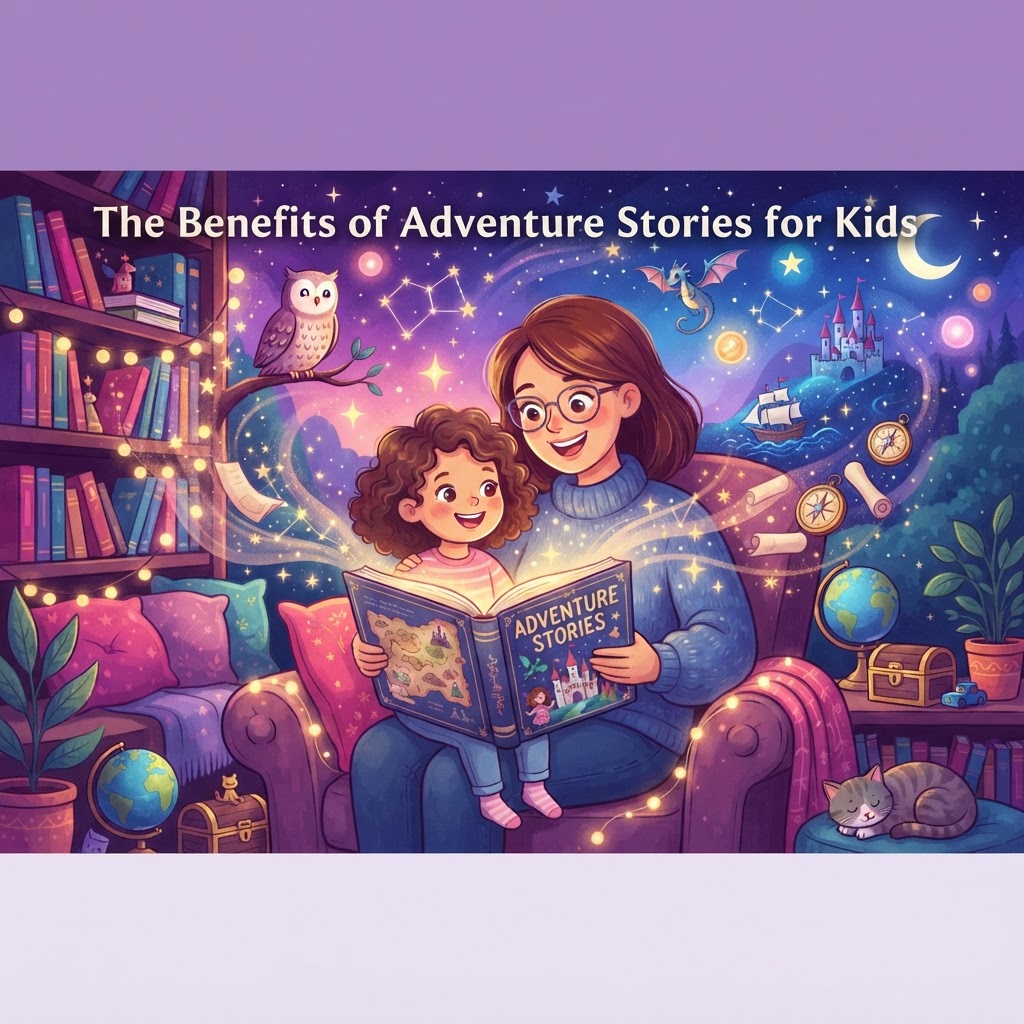
Adventure stories are more than exciting tales about quests, treasure maps, or brave children in faraway places. They give kids a safe way to explore fear, risk, curiosity, and success. When children listen to or read these stories, they practice important life skills in their minds long before they face them in real life. That is why the benefits of adventure stories go far beyond entertainment.
For parents and educators, the link between adventure stories child development is especially important. A well-told adventure can help children build courage, think through problems, bounce back from setbacks, and stretch their imagination. It can also make reading feel joyful, which matters for lifelong learning.
Why do adventure stories matter for child development?
Adventure stories matter because they help children practice emotional, cognitive, and social skills in a safe and engaging format. A child can feel suspense, face uncertainty, and watch a character solve a problem, all while sitting securely beside a trusted adult.
From a developmental perspective, stories support much more than literacy. The Harvard Center on the Developing Child explains that executive function includes working memory, flexible thinking, and self-control. Adventure plots naturally exercise those skills because children track events, predict outcomes, and revise their thinking as the story unfolds.
Research-backed early childhood organizations also connect storytelling and play. The National Association for the Education of Young Children notes that imaginative play supports planning, perspective-taking, and problem-solving. Adventure stories often work like guided pretend play, especially during shared reading and discussion.
That is one reason adventure stories pair so well with the benefits of reading aloud. When adults pause, ask questions, and respond to a child’s ideas, the story becomes a tool for development, not just a bedtime routine.
Why do kids love adventure?
Kids love adventure because it gives them safe excitement. They get to explore danger, mystery, and discovery without being truly unsafe, which satisfies curiosity and supports emotional growth.
Part of why kids love adventure is that these stories match how children naturally learn. Young children are driven to explore. They want to know what is behind the door, over the hill, or inside the cave. Adventure stories turn that instinct into narrative form.
They also offer something children deeply enjoy: movement and progress. The characters do not stay still. They search, try, fail, learn, and continue. That forward motion keeps attention strong, especially for children who struggle with slower, more reflective stories.
Adventure stories also let children imagine themselves as capable. Even when the hero is scared, small, or unsure, they keep going. That combination of vulnerability and bravery helps kids connect to the character and think, “Maybe I could do that too.”
How do adventure stories build courage?
Adventure stories build courage by showing children that fear can be managed, not avoided. Kids learn that bravery does not mean feeling no fear; it means acting with care even when something feels uncertain.
This matters because many children experience everyday fears: darkness, separation, making mistakes, new places, or trying something hard. In an adventure story, those fears are often symbolized by storms, forests, puzzles, or unknown creatures. The child listener can face those symbols from a safe distance.
When adults talk through the story, the impact grows. You might ask:
- “Was the character scared?”
- “What helped them keep going?”
- “What would you do next?”
- “Have you ever felt like that?”
These simple questions help children name feelings and connect story events to real life. That is also why adventure tales work well alongside stories that support emotional intelligence through storytelling.
The American Academy of Pediatrics has long emphasized the value of shared reading for language and relationships. Adventure stories are especially powerful in this setting because children borrow calm and confidence from the adult reading with them.
How do adventure stories strengthen problem-solving skills?
Adventure stories strengthen problem-solving because they are built around obstacles, choices, and consequences. Every challenge in the plot invites children to think: What is the problem? What are the options? What might happen next?
That makes adventure a natural training ground for flexible thinking. A hero may need to cross a river, solve a riddle, find a hidden clue, or work with a friend. As children follow those moments, they practice:
- predicting outcomes
- noticing cause and effect
- comparing choices
- remembering key details
- adjusting when plans fail
These are core thinking skills for school and daily life. In story time, you can strengthen them by pausing before the solution appears and asking your child to guess what the character should do.
Adventure stories are especially helpful for children who learn best through action. Instead of teaching problem-solving as a lecture, the story lets them feel the stakes and think alongside the character.
How do adventure stories teach resilience?
Adventure stories teach resilience by showing that setbacks are part of the journey. Children see characters get lost, make mistakes, feel discouraged, and try again.
This is one of the most important benefits of adventure stories for growing minds. Real resilience is not about winning easily. It is about recovering after disappointment, learning from difficulty, and continuing with hope.
Good adventure stories model that process clearly. The hero may need help. They may change their plan. They may discover that kindness, patience, or teamwork matters just as much as strength. These are powerful messages for children who are learning how to cope when things do not go their way.
Parents can reinforce resilience by highlighting effort rather than outcome. Try saying, “I noticed the character kept trying,” or “They solved that because they did not give up.” This connects well with stories that teach values, including moral stories for kids, but adventure adds the extra layer of action and challenge that many children find especially motivating.
How do adventure stories spark imagination and creativity?
Adventure stories spark imagination because they invite children to picture new worlds, unusual problems, and surprising possibilities. The more vividly a child imagines, the more they practice mental flexibility and creative thinking.
A child listening to an adventure might imagine:
- a hidden jungle path
- a moonlit boat ride
- a talking animal guide
- a secret map under the bed
- a mission to help a friend
These imaginative leaps matter for development. Creative thinking supports language growth, pretend play, storytelling, and even later writing skills. Children who hear rich, image-filled stories often begin creating their own plots, characters, and endings.
This is one reason personalized stories can be so effective. When the hero has your child’s name, favorite animal, or dream destination, engagement rises quickly. If you want to create your own personalized bedtime story, adventure themes can be a wonderful starting point because they naturally combine excitement, emotion, and imagination.
How can parents and teachers use adventure stories intentionally?
Parents and teachers can use adventure stories intentionally by choosing age-appropriate challenges and talking about the child’s thinking and feelings during the story. The goal is not just to entertain, but to help children reflect, imagine, and grow.
A few practical ways to do this:
- Choose the right level of suspense. Toddlers and preschoolers often do best with gentle adventure. Older children usually enjoy higher stakes and longer quests.
- Pause for prediction. Ask what might happen next before the story reveals the answer.
- Talk about feelings. Name fear, excitement, frustration, relief, and pride.
- Connect to real life. Link the character’s challenge to something familiar, like trying a new activity or solving a friendship problem.
- Invite retelling. When children retell the adventure, they strengthen memory, sequencing, and language.
In classrooms, adventure stories can also support group discussion, creative writing, and role-play. Educators looking for story-based learning ideas may find InstaTales for teachers helpful for literacy centers, prompt-based writing, or themed reading activities.
For families who want more story ideas, the InstaTales blog can also be a useful place to explore related topics and reading strategies.
Frequently Asked Questions
Are adventure stories good for young children?
Yes, as long as the story matches the child’s age and temperament. Younger children usually do best with gentle adventures that include safety, reassurance, and a happy resolution.
What age are adventure stories best for?
Adventure stories can work from toddlerhood through the primary school years. The key is to adjust the complexity, length, and intensity to fit the child’s developmental stage.
Can adventure stories help anxious children?
They can, especially when read with a calm adult who pauses to talk about feelings. Stories let children explore fear from a safe distance and see that difficult moments can be managed.
Do adventure stories improve problem-solving?
Yes, because children follow characters through obstacles, choices, and consequences. This supports prediction, flexible thinking, and understanding cause and effect.
What makes a good adventure story for kids?
A good adventure story has a clear goal, manageable suspense, a relatable hero, and a satisfying resolution. The best ones also include emotional warmth, not just action.
How can I make adventure stories more engaging at bedtime?
Use expressive voices, pause for simple questions, and connect the story to your child’s interests. Personalized adventures often work especially well because children feel like active participants in the journey.
Ready to Create a Personalized Bedtime Story?
Use our free AI bedtime story generator to create a personalized illustrated story for your child in 30 seconds — no credit card needed.
Popular story types:
Maya Rodriguez
Lead Content Editor & Early Literacy Specialist
Maya is a former early childhood educator and literacy specialist with over a decade of experience helping children develop a love of reading. She leads content at InstaTales, where she writes about the science of storytelling, child development, and how families can use personalized AI stories to build literacy and emotional resilience.
instatales.ai