Storytelling and Emotional Intelligence: Key Benefits
Stories are one of the most effective tools for building emotional intelligence in children. Here's what the research shows.
✦ Key Takeaways
- •Storytelling matters because it helps children practice emotional skills in a low-pressure way.
- •Stories build empathy by helping children step into someone else’s experience.
- •Stories grow emotional vocabulary by giving children words for inner experiences.
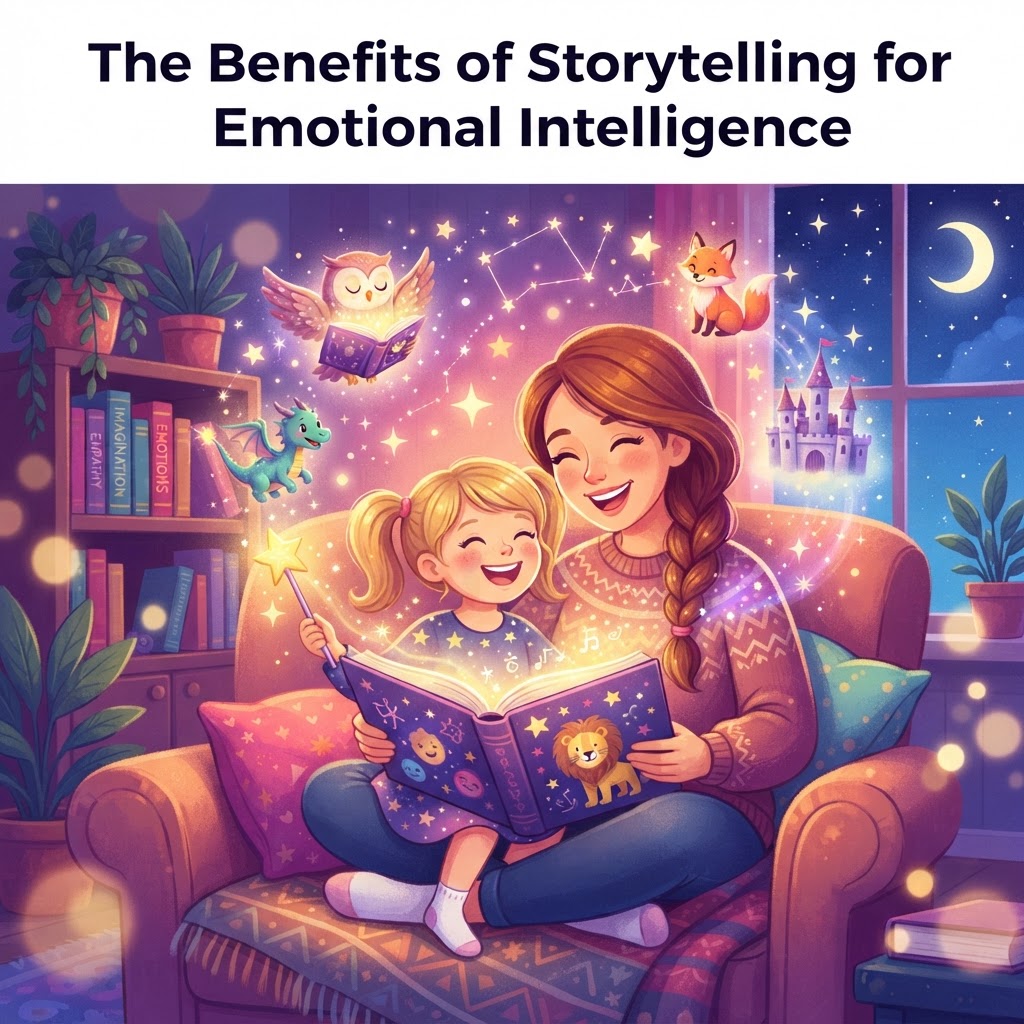
Stories do more than entertain children before bed. They give children a safe, repeatable way to notice feelings, name them, and practice what to do next. That is why storytelling and emotional intelligence are so closely connected: when children hear stories, discuss characters, and imagine different outcomes, they build the foundations of empathy, self-awareness, and healthy relationships.
Research in child development supports this idea. Shared reading and storytelling expose children to emotional situations they may not face every day, while still keeping them emotionally safe. Organizations like CASEL and the Harvard Center on the Developing Child emphasize that social-emotional learning grows through warm relationships, language-rich interactions, and repeated practice. Stories naturally bring all three together.
If you already use bedtime stories at home, you may also enjoy these related ideas on the benefits of bedtime stories and the benefits of reading aloud.
Why does storytelling matter for emotional intelligence?
Storytelling matters because it helps children practice emotional skills in a low-pressure way. A story lets a child explore fear, jealousy, kindness, frustration, and repair without being overwhelmed by real-life consequences.
Emotional intelligence, often called EQ, includes skills like recognizing feelings, understanding other people’s perspectives, managing reactions, and making thoughtful choices. In children, these skills do not appear all at once. They develop through repeated experiences with language, relationships, and reflection.
Stories support that process because they slow life down. A child can pause at the moment a character feels left out, confused, or proud. That pause is powerful. It creates room for conversation, prediction, and meaning-making.
This is one reason stories and EQ fit so well together. Books and oral stories help children rehearse emotional situations long before they can fully handle them independently.
How do stories build empathy in children?
Stories build empathy by helping children step into someone else’s experience. When a child listens to a character’s problem, they practice perspective-taking: “How does this person feel?” and “Why did they act that way?”
Developmental research has long linked story exposure with stronger perspective-taking and social understanding. Through fiction, children meet characters with different fears, families, needs, and strengths. That widens their emotional world.
Empathy grows especially well when adults ask simple, open questions during or after a story, such as:
- “Why do you think she felt nervous?”
- “What do you think he needed in that moment?”
- “Have you ever felt like that?”
- “What could a friend do to help?”
These conversations teach children that feelings make sense, even when behavior needs guidance. That distinction is central to emotional intelligence.
Personalized stories can deepen this effect because children often connect more strongly when the hero feels familiar. If you want to create your own personalized bedtime story, you can tailor situations around friendship, new siblings, school worries, or big feelings in a way that feels relevant and comforting.
How do stories expand a child’s emotional vocabulary?
Stories grow emotional vocabulary by giving children words for inner experiences. The more accurately a child can name a feeling, the more likely they are to understand it and communicate it.
Many young children know basic emotion words like happy, sad, and mad. But emotional development through stories often happens in the next layer of language: disappointed, worried, embarrassed, frustrated, relieved, proud, lonely, calm. These words help children move from reacting to reflecting.
Reading aloud is especially helpful because adults can pause and label what is happening. For example:
- “He isn’t just angry. He might be frustrated because the tower fell.”
- “She looks disappointed, not mad.”
- “That face tells me he feels nervous and excited at the same time.”
This kind of emotion coaching is supported by pediatric and literacy experts, including the American Academy of Pediatrics, which highlights shared reading as a rich context for language and relationship-building.
If you are choosing books or digital stories for this purpose, look for stories that include:
- Clear emotional moments
- Everyday social challenges
- Character dialogue
- Gentle repetition of feeling words
- Opportunities to pause and talk
These are also some of the reasons personalized stories for kids can feel so emotionally effective.
How can storytelling strengthen self-awareness and self-regulation?
Storytelling strengthens self-awareness by helping children notice feelings, triggers, and patterns. It also supports self-regulation because stories model coping strategies children can try in real life.
Self-awareness begins when a child can say, “I feel upset because my turn ended,” instead of simply melting down. Stories make that insight easier because children often understand a character before they can understand themselves.
When a character takes deep breaths, asks for help, waits patiently, or repairs a mistake, children see self-management in action. These moments can be more memorable than direct lectures because they are attached to a narrative.
You can make this learning stick by adding one short reflection after the story:
- “What feeling did the character have first?”
- “What helped them calm down?”
- “What could you try next time you feel that way?”
This approach aligns closely with the CASEL competencies of self-awareness and self-management. It also works well at bedtime, when children are naturally shifting into a reflective state. Re-reading favorite stories helps too, because repetition gives children more chances to notice emotional details they missed the first time.
How do stories support social skills through the CASEL framework?
Stories support social skills by giving children examples of cooperation, conflict, repair, and responsible choices. Through the CASEL framework, storytelling can strengthen all five core areas of social-emotional learning.
CASEL identifies these five competencies:
- Self-awareness: recognizing emotions, strengths, and values
- Self-management: managing emotions and behavior
- Social awareness: showing empathy and understanding others
- Relationship skills: communicating, listening, cooperating, resolving conflict
- Responsible decision-making: making caring and constructive choices
Stories are a natural fit for each one. A child watching a character apologize learns relationship skills. A child noticing that one action hurts a friend learns responsible decision-making. A child hearing how a shy character feels in a new classroom builds social awareness.
This is one reason storytelling works well in both homes and classrooms. Teachers can use story discussions to explore friendship, inclusion, and problem-solving in a structured way. For school settings, InstaTales for teachers can help educators build prompts around emotions, community, and SEL themes.
The key is discussion. Simply hearing a story is valuable, but talking about motives, consequences, and alternatives is what turns a story into social-emotional practice.
What practical storytelling strategies help children build EQ?
The best storytelling strategies are simple, consistent, and interactive. Children build EQ most effectively when adults read with them, not just to them.
Here are practical ways to use emotional development through stories at home or in class:
- Choose stories with relatable conflicts. Friendship problems, waiting, sharing, fear of the dark, mistakes, and new experiences all create rich emotional learning.
- Pause for feeling words. Stop briefly and name emotions as they appear.
- Ask “why” and “what next” questions. These build perspective-taking and decision-making.
- Connect the story to real life. “Remember when you felt nervous on your first day too?”
- Model nonjudgmental language. Say, “He felt angry and needed help calming down,” instead of “He was bad.”
- Re-read favorites. Repetition helps children internalize emotional patterns and coping tools.
- Invite children to change the ending. This encourages problem-solving and flexible thinking.
- Use personalized storytelling for specific needs. If a child is struggling with bedtime fears or sibling conflict, creating a tailored story can make the lesson feel safer and more engaging.
For families, it can help to save stories children return to often in your story library, especially when those stories support a current emotional challenge. You can also find more family literacy ideas on the InstaTales blog.
A final tip: keep the tone curious, not corrective. The goal is not to quiz children on the “right” answer. The goal is to help them notice emotions, understand people, and practice kinder, calmer responses over time.
Frequently Asked Questions
At what age does storytelling start helping emotional intelligence?
Storytelling supports emotional growth from the toddler years onward. Even very young children benefit from hearing feeling words, noticing facial expressions, and listening to simple stories about everyday experiences.
What kinds of stories are best for building empathy?
Stories with clear characters, relatable emotions, and gentle conflict are often best. Children learn a lot from stories about friendship, sharing, mistakes, courage, and understanding differences.
Can personalized stories improve emotional learning?
Yes, personalized stories can make emotional lessons feel more relevant and memorable. When children see themselves in the story, they often engage more deeply with the feelings and solutions.
How can parents talk about emotions during story time?
Keep it simple and natural. Pause to name feelings, ask what a character might be thinking, and connect the moment to your child’s own experiences when appropriate.
Does storytelling help with behavior too?
Often, yes. Stories can improve behavior indirectly by building self-awareness, emotional vocabulary, and coping strategies, which makes it easier for children to express needs and manage big feelings.
How often should families use stories for social-emotional learning?
A little consistency matters more than long sessions. Even 10 minutes of shared storytelling a few times a week can create meaningful practice in empathy, reflection, and emotional language.
Ready to Create a Personalized Bedtime Story?
Use our free AI bedtime story generator to create a personalized illustrated story for your child in 30 seconds — no credit card needed.
Popular story types:
Maya Rodriguez
Lead Content Editor & Early Literacy Specialist
Maya is a former early childhood educator and literacy specialist with over a decade of experience helping children develop a love of reading. She leads content at InstaTales, where she writes about the science of storytelling, child development, and how families can use personalized AI stories to build literacy and emotional resilience.
instatales.ai