Benefits of Fairy Tales for Child Development
Fairy tales have endured for centuries because they're developmentally powerful. Here's why they matter for child development.
✦ Key Takeaways
- •Fairy tales strengthen imagination because they invite children to think beyond the literal world.
- •Fairy tales support moral reasoning by making right and wrong visible in ways children can understand.
- •Fairy tales can build emotional resilience because they let children face fear in a safe, structured way.
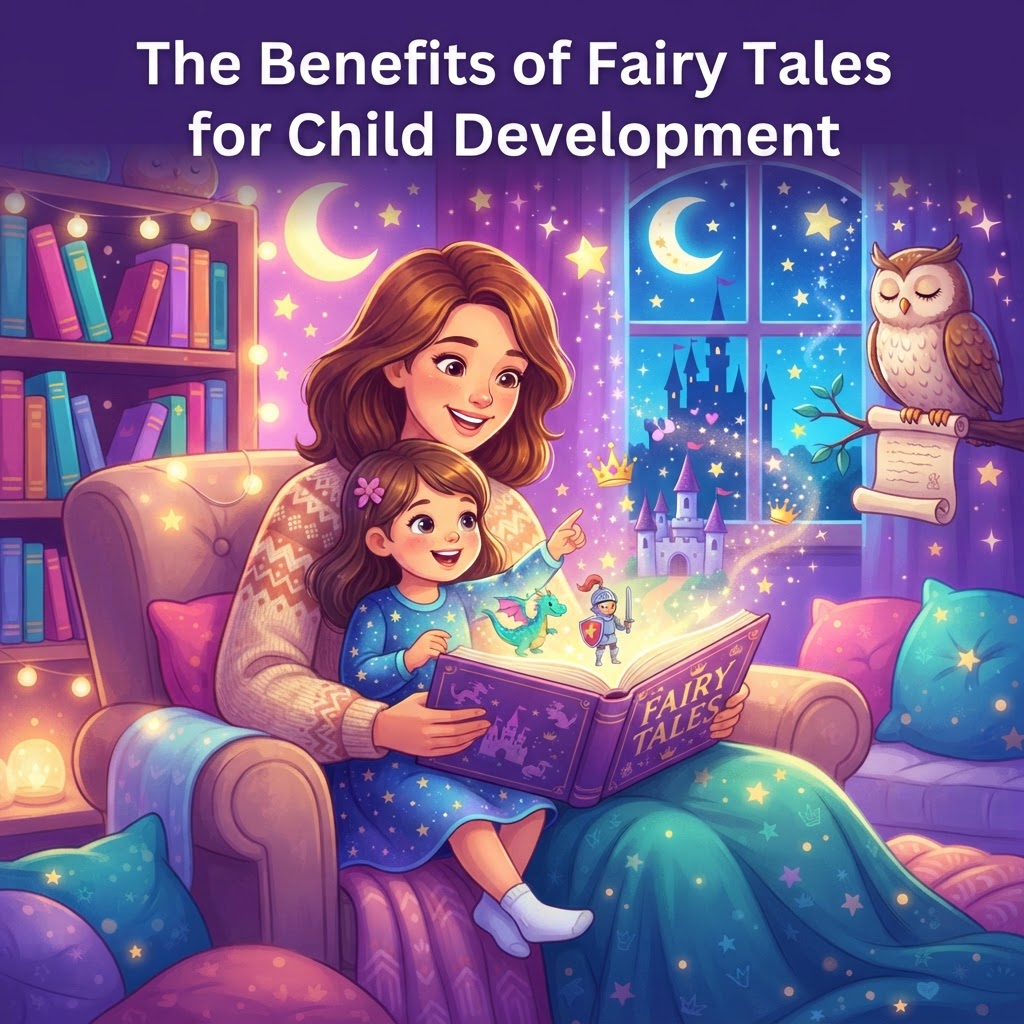
Fairy tales have lasted for centuries because they do more than entertain. They give children a safe, symbolic way to explore big feelings, tricky choices, and unfamiliar ideas. From a developmental perspective, the benefits of fairy tales are wide-ranging: they support imagination, language, emotional growth, moral thinking, and a child’s sense of culture and belonging.
This is also why fairy tales child development is such an important topic for parents and educators. Long before screens, adults used stories about forests, helpers, monsters, and brave children to help young listeners make sense of the world. When we ask why fairy tales matter, the answer is simple: they help children practice being human.
Why do fairy tales strengthen imagination?
Fairy tales strengthen imagination because they invite children to think beyond the literal world. A talking wolf, a magic bean, or a hidden kingdom asks the brain to build images, predict outcomes, and hold multiple possibilities at once.
That kind of mental play matters. In child development, imagination supports symbolic thinking, language growth, and flexible problem-solving. When children picture a castle in the clouds or a key that opens a secret door, they are practicing the same cognitive skills used later in writing, planning, and creative thinking.
Fairy tales are especially powerful because they use simple patterns with surprising twists. Children learn that:
- ordinary objects can carry meaning
- small characters can solve big problems
- one choice can change the whole story
Those patterns help children become active meaning-makers, not passive listeners. Research from the Harvard Center on the Developing Child consistently highlights how play, language, and responsive interaction build the foundations for learning.
This is one reason reading fairy tales aloud is so effective. If you want to extend that benefit, pairing fairy tales with the habits in reading aloud to children can deepen attention, vocabulary, and comprehension.
How do fairy tales support moral reasoning?
Fairy tales support moral reasoning by making right and wrong visible in ways children can understand. They show consequences clearly: kindness often brings help, greed causes trouble, and courage grows through action.
Young children do not learn values best from lectures alone. They learn through stories, repetition, and examples. Fairy tales give them memorable situations where characters face jealousy, dishonesty, fairness, loyalty, and responsibility.
Bruno Bettelheim, in The Uses of Enchantment, argued that fairy tales speak to children’s inner conflicts in symbolic form. While some of his ideas are debated today, his central point still resonates: children use stories to work through moral and emotional questions at a level they can manage.
What makes fairy tales useful is not that they offer perfect lessons. It is that they create space for discussion. After a story, adults can ask:
- Why do you think the character made that choice?
- Was that fair?
- What else could they have done?
- How did the ending change because of that decision?
These conversations build early ethical thinking. They also support perspective-taking, which is closely tied to empathy and social understanding. For families who want to connect story time with feelings and relationships, this is where storytelling helps emotional intelligence.
Why can fairy tales build emotional resilience?
Fairy tales can build emotional resilience because they let children face fear in a safe, structured way. The danger is symbolic, the struggle is contained, and the ending often restores order and hope.
Children naturally have worries about separation, anger, jealousy, power, and safety. Fairy tales externalize those feelings. Instead of talking directly about anxiety or helplessness, the story may show a dark forest, a giant, or a storm. This makes hard emotions feel less overwhelming and more manageable.
That emotional distance is useful. A child can listen, imagine, and process without feeling exposed. In many classic tales, the main character is small, underestimated, or vulnerable at first. Yet they persist, get help, make wise choices, and grow stronger.
This pattern teaches an important developmental message: scary feelings can be survived. That does not mean every fairy tale fits every child. Age, temperament, and sensitivity matter. Parents can soften details, skip parts, or choose gentler retellings for younger children.
The American Academy of Pediatrics emphasizes that shared reading supports language, connection, and emotional security. When fairy tales are read in a warm, responsive setting, children benefit not only from the story itself, but from the adult who helps them make sense of it.
That is also why bedtime stories support child development so powerfully. The story becomes a bridge between stimulation and calm, helping children process the day and settle into rest.
How do fairy tales help children understand culture and identity?
Fairy tales help children understand culture and identity by passing on shared symbols, values, and story patterns. They connect children to the language, humor, fears, and hopes of different communities.
A child who hears fairy tales from many traditions learns that every culture has meaningful stories. There are clever tricksters in West African tales, magical transformations in European tales, wisdom-rich folk heroines in Asian stories, and powerful nature imagery in Indigenous storytelling traditions. The details differ, but the human questions are often similar.
This builds cultural literacy. Children begin to recognize references, archetypes, and motifs that appear later in books, films, art, and conversation. Just as importantly, diverse fairy tales can help children see both themselves and others with more respect.
For identity development, representation matters. Children benefit from hearing stories where the heroes look like them, sound like them, or share family values they recognize. They also benefit from stories that gently widen their world.
The National Association for the Education of Young Children has long emphasized the importance of culturally responsive literacy experiences. In practice, that means balancing beloved classics with inclusive retellings and stories from many backgrounds.
This is one reason many families now mix traditional tales with personalized stories for kids. A familiar fairy-tale structure paired with a child’s own name, interests, or culture can make the developmental benefits feel even more immediate.
How can parents and teachers use fairy tales in healthy, practical ways?
Parents and teachers can use fairy tales well by choosing age-appropriate versions, talking about the story, and connecting themes to real life. The goal is not to “teach a lesson” too heavily, but to help children think, feel, and imagine.
For toddlers and preschoolers, simple retellings work best. Keep the language rhythmic, the plot clear, and the emotional intensity manageable. For older children, you can compare different versions, discuss character motives, and explore how the story would change with a different ending.
A few practical ways to use fairy tales well:
- Read interactively. Pause to ask what the child notices, predicts, or feels.
- Name emotions. “That character looks worried.” “He seems proud.” “She felt left out.”
- Invite play. Act out scenes with puppets, blocks, or dress-up clothes.
- Compare cultures. Read similar tales from different parts of the world.
- Revisit favorites. Repetition helps children feel mastery and notice deeper meaning.
Re-reading matters more than many adults realize. The comfort and learning children get from familiar tales is similar to the value of repetition in children’s stories.
Teachers can also use fairy tales to support writing prompts, social-emotional lessons, and creative projects. If you want to adapt a tale to a child’s age, interests, or classroom theme, you can create your own personalized bedtime story and make the language or message fit the moment without losing the magic.
Frequently Asked Questions
Are fairy tales good for child development?
Yes. Fairy tales support imagination, language, moral reasoning, and emotional resilience. When shared in an age-appropriate way, they give children safe practice with big ideas and feelings.
Why do children enjoy fairy tales so much?
Children enjoy fairy tales because the stories are vivid, rhythmic, and full of clear patterns. Repetition, suspense, and magical elements make them memorable and emotionally satisfying.
Can fairy tales be too scary for young children?
Sometimes. Some children are sensitive to danger, loss, or dark imagery, so it is important to choose versions that match the child’s age and temperament and to stay available for questions and comfort.
What did Bruno Bettelheim say about fairy tales?
Bruno Bettelheim believed fairy tales help children work through inner conflicts using symbols and imagination. While not all of his theories are accepted in the same way today, his work helped highlight the deep psychological role stories can play in childhood.
How can I make fairy tales more relevant to my child?
You can connect the story to your child’s experiences, ask open-ended questions, and choose retellings that reflect their interests or background. Personalized and culturally inclusive stories often make the lessons feel more meaningful.
Do fairy tales still matter in the age of AI and digital media?
Yes. The format may change, but the developmental value remains. Whether told aloud, read from a book, or adapted through digital storytelling, fairy tales still help children imagine, feel, and understand the world.
Ready to Create a Personalized Bedtime Story?
Use our free AI bedtime story generator to create a personalized illustrated story for your child in 30 seconds — no credit card needed.
Popular story types:
Maya Rodriguez
Lead Content Editor & Early Literacy Specialist
Maya is a former early childhood educator and literacy specialist with over a decade of experience helping children develop a love of reading. She leads content at InstaTales, where she writes about the science of storytelling, child development, and how families can use personalized AI stories to build literacy and emotional resilience.
instatales.ai