Benefits of Repetition in Stories for Kids
If your child demands the same story every night, that's a good thing! Here's why repetition is so beneficial for child development.
✦ Key Takeaways
- •Children love repetition because it helps them make sense of the world.
- •Repetition helps build neural pathways by strengthening the brain connections used for memory, language, and self-regulation.
- •Repeated stories support language development by giving children many chances to hear, understand, and use the same words in meaningful context.
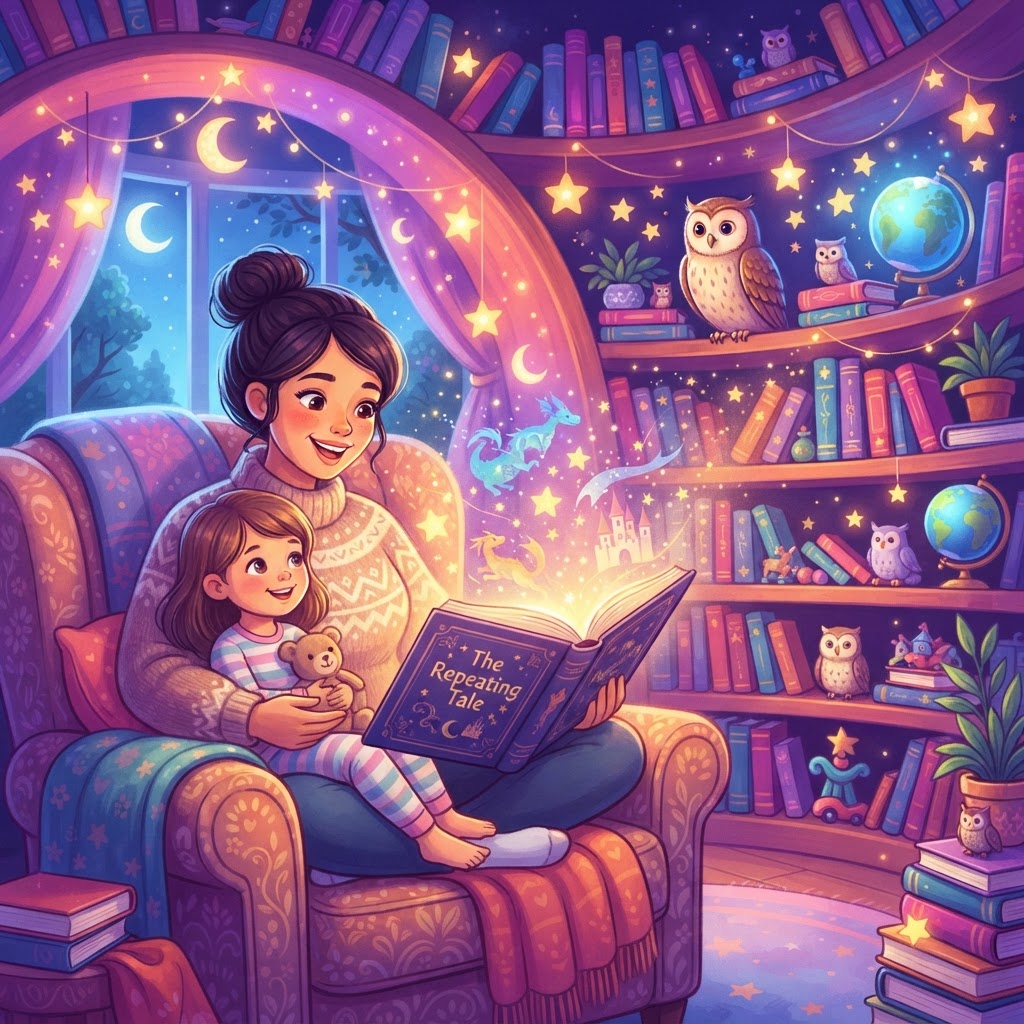
If your child asks for the same story again and again, that is not a reading rut. It is often a sign that something important is happening in their brain. The benefits of repetition in stories are well supported by child development research, and they touch nearly every area of early learning: language, memory, emotional regulation, and confidence.
For adults, repetition can feel boring. For children, it feels productive. Young children learn through patterns, predictability, and practice, which is exactly why kids love repetition so much. When you reread a favorite bedtime book or retell a familiar story, you are not “just” repeating yourself. You are helping build the foundation for repetition and child development in a very real, brain-based way.
Why do kids love repetition?
Children love repetition because it helps them make sense of the world. A familiar story gives them a pattern they can predict, enjoy, and eventually master.
Young children live in a world that often feels new and complex. The same story, told in the same order with the same words, gives them a reassuring structure. They know what is coming next, and that predictability feels good.
There is also a cognitive reason behind this. When children already know the plot, they can pay less attention to “what happens” and more attention to details like new vocabulary, facial expressions, humor, or cause and effect. In other words, familiarity frees up mental energy for deeper learning.
This is one reason repeated reading is so powerful. Research on shared reading, including guidance from the American Academy of Pediatrics, shows that reading aloud supports language and relationship-building from the earliest years. Repetition strengthens those benefits.
If your child wants the same bedtime book every night, they are not being stubborn. They are practicing.
How does repetition build neural pathways?
Repetition helps build neural pathways by strengthening the brain connections used for memory, language, and self-regulation. The more a skill or pattern is used, the more efficient those brain circuits become.
Early childhood is a period of rapid brain development. Neural connections form through repeated experiences, especially warm, responsive interactions with caregivers. The Harvard Center on the Developing Child explains that children’s brains are built over time through repeated, back-and-forth experiences.
Stories are full of those experiences. When a child hears the same phrases, sound patterns, and plot sequence repeatedly, the brain begins to encode them more deeply. That helps with:
- Memory formation
- Attention and sequencing
- Understanding cause and effect
- Recognizing patterns in language
Think of repetition as “brain rehearsal.” Each rereading makes the pathway a little stronger. That is why children often begin to recite parts of the story before they can fully read it themselves.
How do repeated stories support language development?
Repeated stories support language development by giving children many chances to hear, understand, and use the same words in meaningful context. This repeated exposure is one of the best ways to grow vocabulary and comprehension.
A child usually does not learn a new word the first time they hear it. They need multiple exposures, and those exposures work best when the word appears in a familiar, emotionally engaging setting. Story repetition naturally provides that.
Researchers such as Monique Sénéchal and later Jessica Horst and colleagues have found that repeated storybook readings can improve children’s word learning. When the story stays the same, children are more likely to notice and remember the language inside it.
Repeated reading helps children learn:
- New vocabulary
- Sentence structure
- Story sequence
- Rhythm, rhyme, and sound patterns
- Conversation skills through repeated dialogue
This is one reason reading aloud to children is so effective. The child is not just listening passively. They are storing patterns, anticipating phrases, and gradually joining in.
If you have ever heard your child “read” a memorized book back to you, you have seen repetition turn into early literacy.
Why does hearing the same story create emotional safety?
Hearing the same story creates emotional safety because predictability helps children feel calm, secure, and in control. Familiar stories can act like a soothing routine for the nervous system.
Children often return to favorite books during times of change, stress, or big feelings. A repeated story offers a known beginning, middle, and end. That matters because young children are still learning how to regulate emotions, and predictable routines help.
This is especially true at bedtime. A familiar story can become a cue that says, “You are safe. The day is winding down now.” That is part of why bedtime stories support child development so well.
There is also an emotional processing benefit. Children may revisit stories with themes of fear, separation, kindness, or bravery because they are working through those ideas. A child who asks for the same story about being scared of the dark may be using repetition to practice coping in a safe setting.
Storytelling also helps children understand feelings in themselves and others, which is one reason stories build emotional intelligence. Repetition deepens that effect because each rereading gives the child another chance to notice emotions and outcomes.
How does repetition help children feel capable and independent?
Repetition helps children feel capable because it leads to mastery. When children know a story well, they experience the confidence that comes from “I know this” and eventually “I can do this.”
Mastery is a major developmental need in early childhood. Children want to predict, participate, and succeed. A repeated story gives them all three.
You may notice your child:
- Finishing sentences
- Correcting skipped words
- Turning pages at the right moment
- Retelling the plot in their own words
- Acting out scenes during play
These are not small moments. They show growing memory, comprehension, and expressive language. They also build self-esteem.
This is one reason repetition and child development are so closely linked. Repetition turns passive listening into active participation. Over time, the child moves from listener to storyteller.
How can parents use repetition in healthy and helpful ways?
Parents can use repetition well by following the child’s interest, keeping reading interactive, and gently adding small variations over time. Repetition works best when it feels comforting, not forced.
If your child wants the same story every night, you do not need to fight it. Instead, make the most of it with simple strategies:
- Pause for participation. Let your child fill in familiar words or phrases.
- Ask easy prediction questions. “What happens next?”
- Name feelings. “How do you think the bear feels here?”
- Add one small new idea. Point out a detail in the picture or define one new word.
- Connect it to real life. “That was brave, like when you tried swim class.”
It is also fine to balance repetition with novelty. A good rhythm is “same favorite, plus one new story.” That gives children the security of the familiar and the growth of the new.
If your child responds especially well to stories that reflect their own interests, personalized stories can increase engagement. For some families, it helps to create your own personalized bedtime story with familiar characters, routines, or challenges, so the child gets both repetition and relevance.
The key is not endless variety. The key is meaningful repetition with connection.
Can personalized stories make repetition even more effective?
Yes, personalized stories can make repetition even more effective because children pay closer attention when the story feels personally relevant. Familiar structure plus personal meaning can boost engagement, language, and emotional connection.
A story about “a child just like me” often lands differently. When children hear their own name, favorite animal, school theme, or bedtime routine in a story, they are more likely to listen closely and ask for it again. That repeated return is exactly where learning deepens.
This can be especially useful for:
- Preparing for new experiences, like starting school
- Practicing social skills
- Reinforcing bedtime routines
- Revisiting a comforting theme in a fresh way
For parents and educators, the goal is not to replace classic books. It is to use story repetition thoughtfully. A familiar personalized story can become part of a strong home or classroom literacy routine, much like any other beloved reread.
Frequently Asked Questions
Is it normal for toddlers to want the same book every day?
Yes, it is completely normal. Toddlers use repetition to build memory, language, and emotional security, so asking for the same book is usually a healthy developmental sign.
Does repeating stories help speech and vocabulary?
Yes, repeated stories can support speech and vocabulary growth. Children learn words best when they hear them many times in meaningful context, especially during warm, interactive reading.
Can too much repetition be a problem?
Usually, no. Most children naturally balance favorite stories with interest in new ones over time, though parents can gently introduce variety alongside familiar books.
Why do repeated bedtime stories calm children down?
Repeated bedtime stories are calming because they are predictable. Familiar words, rhythms, and routines help children feel safe and prepare their bodies and minds for sleep.
Should I still ask questions if my child knows the story by heart?
Yes, but keep them simple and enjoyable. Familiar stories are a great time to ask prediction, feeling, or memory questions because your child already has the confidence of knowing the plot.
Are personalized stories good for repetition too?
Yes, personalized stories can work very well for repetition. When a story reflects a child’s own world, they often engage more deeply and return to it more often, which strengthens learning.
Ready to Create a Personalized Bedtime Story?
Use our free AI bedtime story generator to create a personalized illustrated story for your child in 30 seconds — no credit card needed.
Popular story types:
Maya Rodriguez
Lead Content Editor & Early Literacy Specialist
Maya is a former early childhood educator and literacy specialist with over a decade of experience helping children develop a love of reading. She leads content at InstaTales, where she writes about the science of storytelling, child development, and how families can use personalized AI stories to build literacy and emotional resilience.
instatales.ai