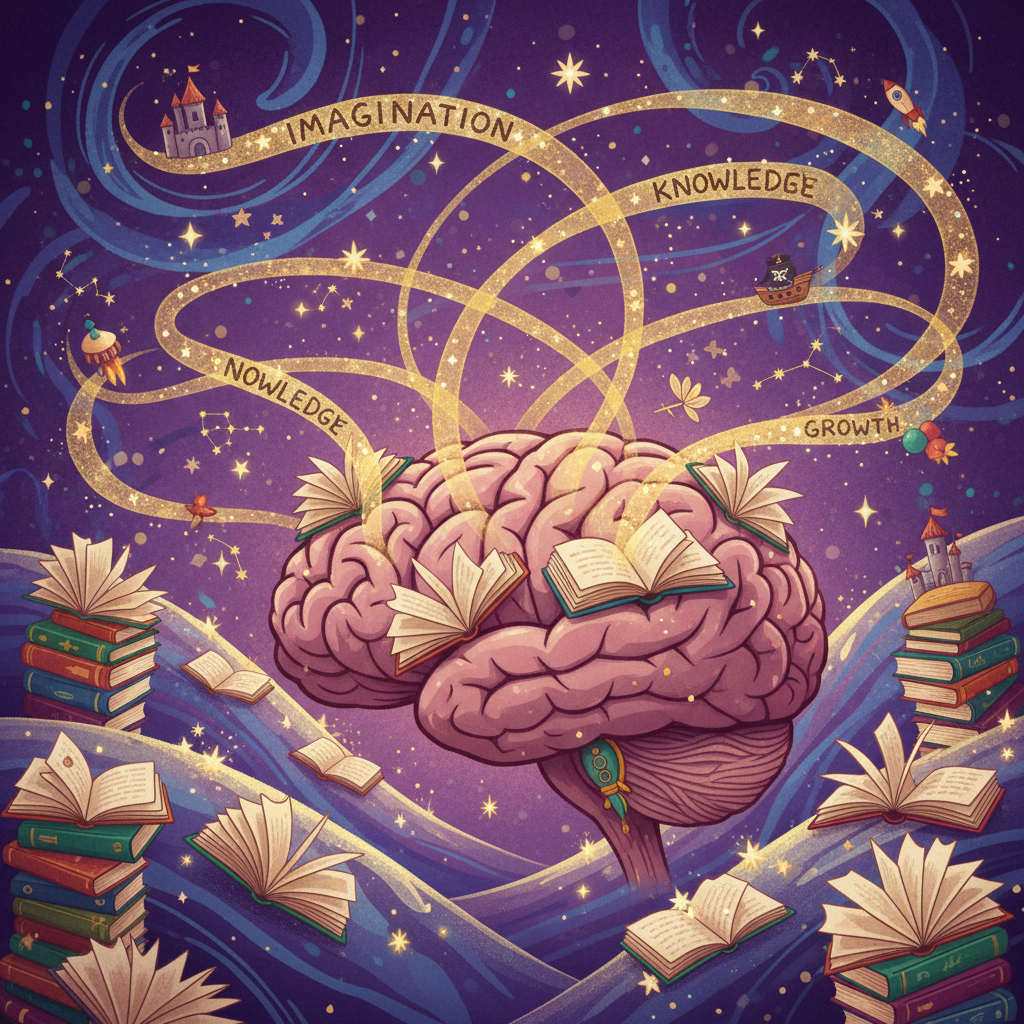
Storytelling and Creativity: How Kids Build Big Ideas
Stories are fuel for creativity. Here's how storytelling builds imagination, divergent thinking, and creative confidence in kids.
✦ Key Takeaways
- •Storytelling is powerful because it gives children both raw material and freedom.
- •Stories build imagination by asking children to create pictures in their minds.
- •Storytelling strengthens divergent thinking because stories rarely have only one possible path.
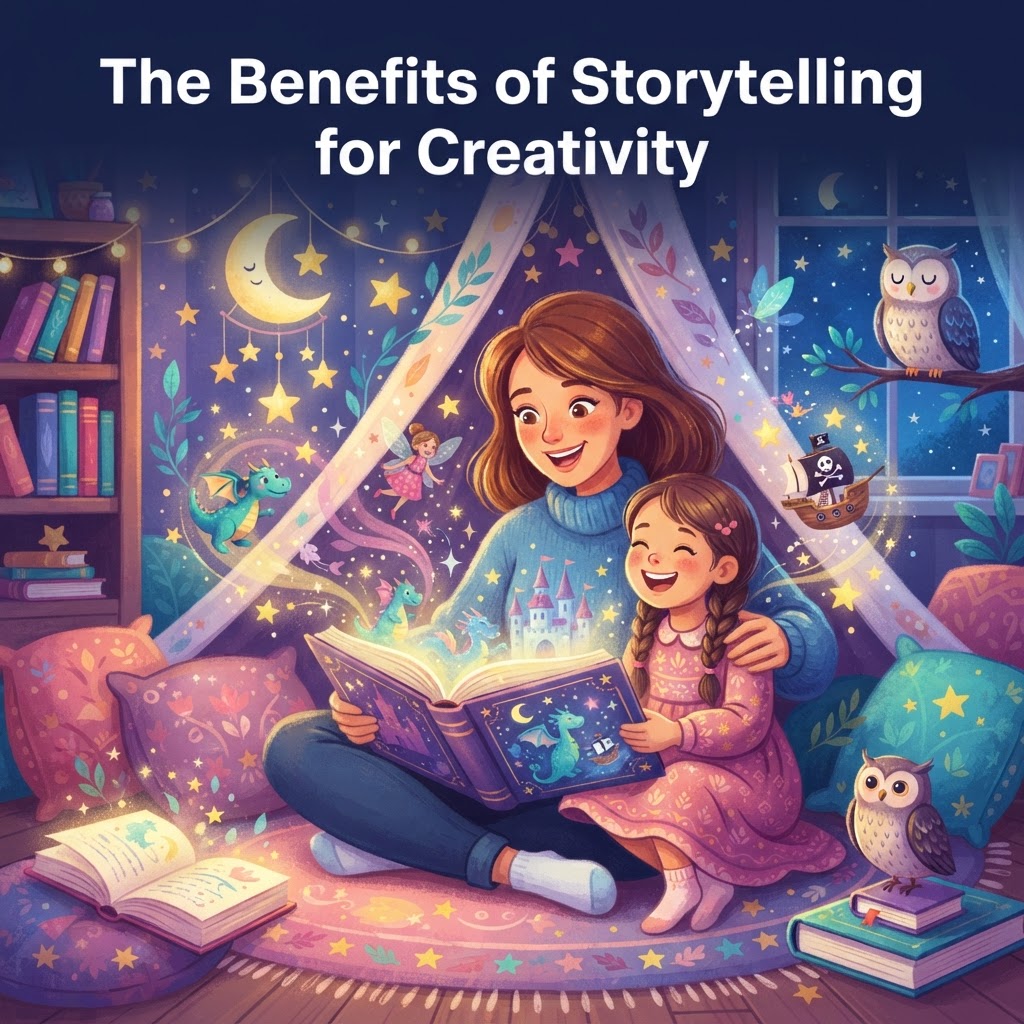
Stories do more than entertain children before bed. They give young minds practice in imagining, experimenting, and making meaning. That is why storytelling and creativity are so closely linked: every story invites a child to picture new worlds, test new ideas, and believe that their own thoughts matter.
For children ages 1-10, stories are a powerful tool for creative development through stories because they build imagination, flexible thinking, and creative confidence at the same time. Research in child development, literacy, and creativity all point in the same direction: when children hear, discuss, retell, and invent stories, they are not just learning language. They are learning how to think.
Why is storytelling so powerful for creativity?
Storytelling is powerful because it gives children both raw material and freedom. A story offers characters, settings, emotions, and problems, then invites a child to connect them in new ways.
Psychologist Lev Vygotsky argued that imagination grows from real experiences that children recombine into something new. That idea fits storytelling perfectly. When a child hears about a dragon in a library or a rabbit who solves a problem, they are storing pieces they can later remix in play, drawing, writing, and conversation.
Shared reading also supports the brain systems creativity depends on. The American Academy of Pediatrics recommends reading aloud from infancy because it supports language, relationships, and early brain development.
Storytelling activates several creativity skills at once:
- Mental imagery: picturing people, places, and actions
- Symbolic thinking: understanding that one thing can stand for another
- Perspective-taking: seeing through someone else’s eyes
- Cause-and-effect thinking: asking what happens next, and why
- Idea combination: blending familiar details into fresh ideas
This is why stories and imagination grow together. The more stories children hear and tell, the more material they have for original thinking.
How do stories build imagination in children?
Stories build imagination by asking children to create pictures in their minds. Even when a book has illustrations, children still imagine voices, movement, feelings, and details beyond the page.
That mental simulation matters. When a child listens to “a bear tiptoeing through a moonlit garden,” they are doing imaginative work: building a scene, filling gaps, and making the story real in their own way. This is one of the clearest ways storytelling supports creative thinking.
The effect changes a little by age and format. For toddlers and preschoolers, pictures can help them follow the plot and name what they see. In fact, illustrations can support meaning-making, especially for younger children who are still building vocabulary. As children grow, stories with fewer visuals can invite even more internal image-making.
Imagination also grows when children meet unusual worlds and possibilities. That is one reason fantasy stories support child development. A child who hears about talking animals, floating cities, or time-traveling siblings is practicing “what if?” thinking, which sits at the heart of creativity.
You can strengthen imagination during story time by asking simple questions like:
- What do you think this place looks like?
- How is the character feeling right now?
- What might be behind that door?
- If you were in the story, what would you do?
These questions slow the story down just enough for the child to become an active creator, not only a listener.
How does storytelling strengthen divergent thinking?
Storytelling strengthens divergent thinking because stories rarely have only one possible path. Children can imagine different endings, different motives, and different solutions, which is exactly how divergent thinking works.
Creativity researcher E. Paul Torrance helped popularize the idea that creative thinking involves fluency (many ideas), flexibility (different kinds of ideas), and originality (unusual ideas). Storytelling naturally exercises all three. When you ask, “What else could happen?” you are inviting fluency. When you ask, “How else could the hero solve the problem?” you are inviting flexibility. When a child invents a surprising twist, you are seeing originality.
Story talk also supports cognitive flexibility, a core part of executive function. Harvard’s Center on the Developing Child explains that executive function includes working memory, self-control, and mental flexibility. These skills help children hold story details in mind, shift perspectives, and generate alternatives.
Try these prompts to build divergent thinking during or after reading:
- Tell me three different endings.
- What is another way this character could solve the problem?
- What if the story took place underwater? In space? In our house?
- Which side character deserves their own story?
- Can you mix this story with another favorite book?
This is where creative development through stories becomes very practical. A child does not need formal creativity lessons to practice original thinking. They can do it while cuddled up with a book.
How do stories help children feel creatively confident?
Stories help children feel creatively confident because they offer a safe place to try ideas without fear of being wrong. In a story, there is room for guesses, twists, silly details, and revision.
That matters because creativity is not only about skill. It is also about confidence. Children create more freely when adults respond with curiosity instead of correction. If a child says, “The fox flies to school in a bubble,” the best response is often, “Tell me more,” not “That doesn’t make sense.”
Storytelling also gives children small, manageable ways to contribute. A child can:
- choose a character name
- invent one problem
- suggest a setting
- change the ending
- retell the story in their own words
These tiny choices build a powerful message: your ideas are worth hearing.
Personalized storytelling can make that message even stronger. When children help create your own personalized bedtime story, they often become more invested because the story reflects their interests, fears, and favorite themes. Saving those stories in your story library also makes it easy to revisit them later and notice growth over time.
And yes, repetition helps. Rereading a favorite story gives children mastery over plot, language, and structure. Once they know the story well, they are more likely to play with it, change it, and build on it creatively.
What does research say about creative development through stories?
Research suggests that stories support many of the building blocks creativity needs. They strengthen language, symbolic thought, social understanding, memory, and flexible thinking.
Vygotsky’s work on imagination showed that children create by recombining what they know. Narrative experiences give them more to recombine. Researchers studying storytelling and pretend play, including scholars such as Ageliki Nicolopoulou, have also shown that narrative activity supports language growth, social understanding, and meaning-making.
Child development organizations make similar points from a practical angle. The National Association for the Education of Young Children emphasizes that rich play and language experiences help children plan, pretend, communicate, and solve problems. Those are creativity skills.
The research does not mean every story session produces a burst of genius. It means regular story experiences create the conditions in which creativity grows. In simple terms, stories help children:
- build a larger “idea bank” of words, images, and experiences
- practice pretending and symbolic transformation
- explore multiple viewpoints
- experiment with solutions before acting on them
- connect emotion, memory, and imagination
That is why storytelling and creativity should not be treated as separate topics. For young children, storytelling is one of the most natural daily routes into creative thinking.
How can parents and teachers use storytelling to spark more creativity?
Parents and teachers can spark more creativity by making story time interactive, open-ended, and low-pressure. You do not need to be a performer. A few simple habits are enough.
Here are practical ways to help children get more creative from stories:
Ask open questions
Swap quiz-style questions for creative ones. Instead of “What color was the hat?” try “Why do you think the character chose that hat?”
Pause before the ending
Stop one page early and ask the child to predict or invent an ending. This builds anticipation and idea generation.
Invite children to change one element
Change the setting, the problem, or the helper. Small changes are often less intimidating than “make up a whole story.”
Use play after reading
Act the story out with toys, pillows, puppets, or drawings. Retelling through play deepens memory and imagination.
Mix familiar and new
Children often create best when one part feels safe and one part feels fresh. A familiar bedtime routine plus a new twist works well.
Let children revisit favorites
Repetition is not the opposite of creativity. Mastery often comes first, then variation.
Keep the tone warm
Praise effort, detail, and originality. Comments like “I love that idea” or “That is such an interesting ending” help children keep creating.
For classrooms, these same strategies work well in read-alouds, writing centers, and group storytelling. The key is simple: make story time a conversation, not a performance.
Frequently Asked Questions
At what age does storytelling start helping creativity?
Storytelling helps creativity from the earliest years. Even babies and toddlers begin building mental images, listening patterns, and symbolic understanding long before they can tell stories back.
Is reading aloud better than telling stories from memory?
Both are valuable. Reading aloud gives children rich language and structure, while oral storytelling often invites more back-and-forth and imagination.
Do pictures reduce imagination?
Not necessarily. Pictures can support understanding, especially for younger children, while still leaving room for children to imagine voices, feelings, and what happens beyond the page.
Can the same story still support creativity?
Yes. Repeated stories build familiarity and confidence, and that often leads children to change details, retell events, and invent new versions.
What kinds of stories are best for creative development?
A mix works best. Everyday stories, fantasy, humorous tales, and child-led personalized stories all give children different material for imagination and divergent thinking.
How can I encourage a child who says, “I don’t know”?
Make the task smaller. Offer two choices, suggest one silly possibility, or invite the child to change just one detail instead of inventing everything from scratch.
Ready to Create a Personalized Bedtime Story?
Use our free AI bedtime story generator to create a personalized illustrated story for your child in 30 seconds — no credit card needed.
Popular story types:
Maya Rodriguez
Lead Content Editor & Early Literacy Specialist
Maya is a former early childhood educator and literacy specialist with over a decade of experience helping children develop a love of reading. She leads content at InstaTales, where she writes about the science of storytelling, child development, and how families can use personalized AI stories to build literacy and emotional resilience.
instatales.ai