First Grade Music Stories That Teach Through Play
Make music engaging for first grade students with stories. Practical strategies, story ideas, and classroom activities for teachers.
✦ Key Takeaways
- •Stories work well in first grade music because they give abstract musical ideas a concrete, memorable context.
- •Children can learn most core first grade music skills through stories, especially when the story includes repetition, movement, and clear sound cues.
- •The best story-based first grade music activities are short, repetitive, and easy to lead with or without many materials.
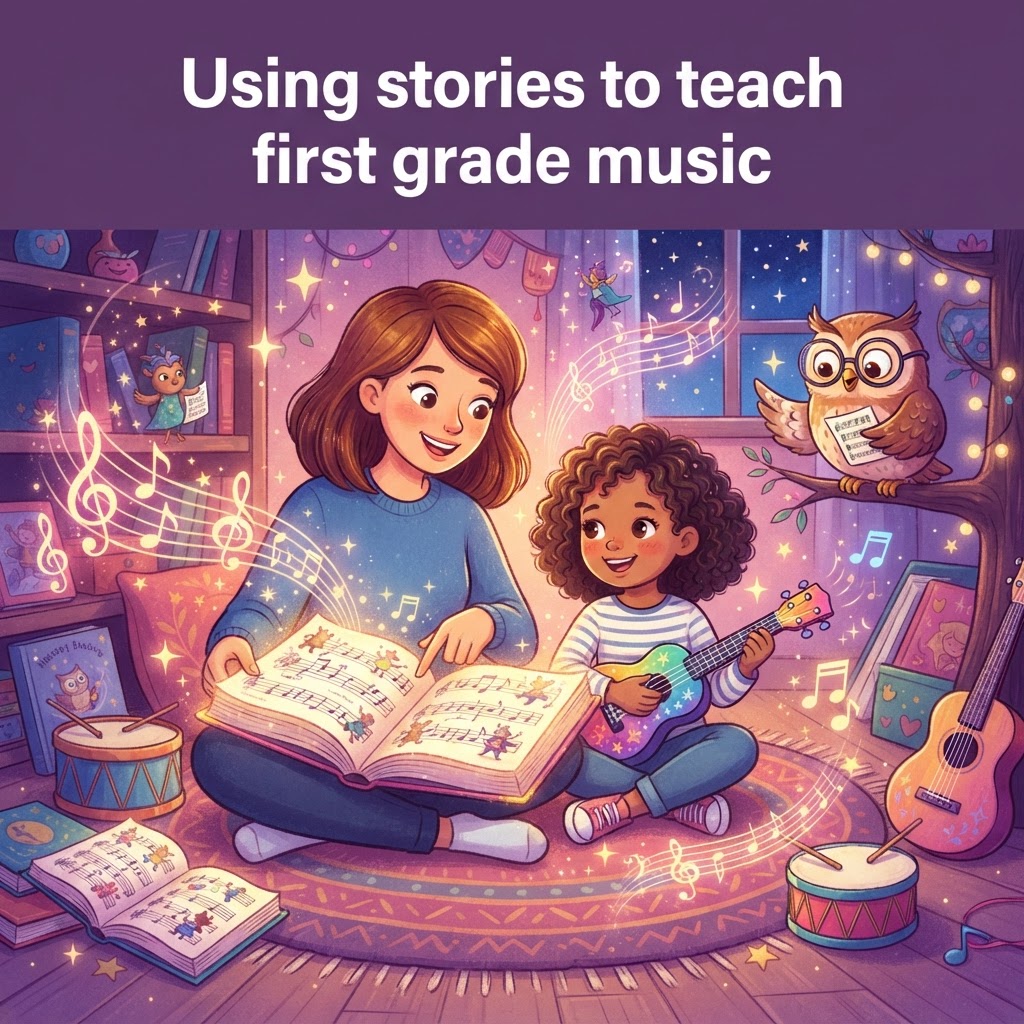
When music lessons feel playful, first graders learn faster and participate more confidently. That is why first grade music stories can be such a powerful teaching tool: they turn beat, rhythm, pitch, and listening into something children can picture, move through, and remember.
For busy teachers, teaching music with stories also makes planning easier. A simple narrative can anchor your warm-up, movement break, instrument work, and reflection all in one lesson. If you already use stories in literacy, you will find that music stories for first grade fit naturally alongside reading instruction through stories and story-based writing lessons.
Why do stories work so well in first grade music?
Stories work well in first grade music because they give abstract musical ideas a concrete, memorable context. When children imagine a giant stomping a steady beat or a bird singing a high pitch, the concept becomes easier to understand and recall.
This approach is supported by child development research. The Harvard Center on the Developing Child emphasizes that young children learn best through meaningful, engaging experiences and back-and-forth interaction. Story-based lessons do exactly that: they connect emotion, language, movement, and sound.
Narrative also supports memory. Jerome Bruner’s work on narrative thinking and Allan Paivio’s dual coding theory both help explain why children remember information better when words are paired with vivid mental images. In music, that means a story can help students hold onto patterns like:
- Steady beat
- Loud and soft
- Fast and slow
- High and low
- Musical sequence and form
The National Association for the Education of Young Children also highlights the value of play, movement, and integrated learning in early childhood. For first graders, a story is not an “extra.” It is often the bridge that makes the lesson click.
What music skills can first graders learn through stories?
Children can learn most core first grade music skills through stories, especially when the story includes repetition, movement, and clear sound cues. Stories are especially effective for foundational concepts that need practice over time.
With well-designed music stories for first grade, teachers can target:
- Steady beat through walking, tapping, or passing motions
- Rhythm patterns through repeated words and phrases
- Pitch awareness with character voices or melodic contours
- Tempo and dynamics through action scenes and mood changes
- Listening skills by identifying sound cues and contrasts
- Creative expression through improvised sound effects and endings
This matches what the National Association for Music Education promotes in elementary music: active, responsive music-making rather than passive listening alone. In other words, first grade music activities work best when children sing, move, speak, and create.
Which story-based first grade music activities work best?
The best story-based first grade music activities are short, repetitive, and easy to lead with or without many materials. The five activities below help children build real music skills while staying fully engaged.
1. Beat walk adventure
Tell a simple story about a character traveling through a forest, city, or jungle. Students keep a steady beat by patting, stepping, or tapping as the character moves.
Change the movement to match the setting, but keep the pulse steady. This helps children feel beat in their bodies, which is often easier than explaining it verbally.
2. Rhythm word story
Choose a story with repeated words like “clip-clop,” “tiptoe,” or “boom-boom.” Assign each word a rhythm pattern, then have students echo or perform it when the word appears.
This is an easy way to teach rhythm without formal notation. It also supports language development, which is one reason story-based music pairs well with other classroom subjects.
3. Pitch path with characters
Create two or three characters with different vocal ranges, such as a low-voiced bear, a middle-voiced child, and a high-voiced bird. As you tell the story, students sing or gesture the pitch level for each character.
This makes high and low pitch visible and playful. You can extend the lesson by drawing the pitch path on the board as the story unfolds.
4. Classroom sound-effect orchestra
Read or tell a short story and assign instruments or body percussion to different events. Rain might be finger taps, wind might be scarves swishing, and footsteps might be drums or knees.
This activity strengthens listening, timing, and ensemble awareness. It is also excellent for students who are not ready to sing independently but still want to participate meaningfully.
5. Compose the ending
Pause before the end of a musical story and ask students to create the final soundscape, rhythm, or short melody. They might decide whether the ending should sound sleepy, exciting, spooky, or joyful.
This gives first graders ownership while keeping the task manageable. It is a strong bridge into early composition and works especially well after students are already familiar with a story structure.
How can teachers differentiate music stories for first grade?
Teachers can differentiate story-based music lessons by adjusting language, response options, and complexity while keeping the same core story. The goal is not to give every child a different lesson, but to give every child a way in.
For students who need more support:
- Use shorter stories with clear repetition
- Add picture cards for characters and sound cues
- Let students echo instead of invent
- Offer two choices instead of open-ended responses
For students ready for more challenge:
- Ask them to lead a repeated rhythm
- Invite them to create a new ending
- Add simple icons or notation
- Let them conduct tempo or dynamics changes
For multilingual learners and neurodiverse students, predictable refrains and movement cues can be especially helpful. Many children understand the music concept first through gesture, sound, and repetition before they can explain it in words.
A practical rule: simplify the task, not the musical experience. Students can all enjoy the same rich story world, even if their responses look different.
How can InstaTales support first grade music lessons?
InstaTales can support first grade music by helping teachers create custom stories that match a specific musical goal, theme, or student interest. Instead of searching for the “perfect” book, you can build a story around the exact concept you are teaching.
For example, you might create a story about:
- an animal learning a steady beat
- a rainy-day adventure focused on dynamics
- a space trip that explores high and low pitch
- a class hero who solves problems through rhythm patterns
If you want classroom-friendly tools, InstaTales for teachers is the best place to start. Teachers can also use story templates to save planning time and organize finished lesson texts in your story library for re-use across centers, small groups, or future classes.
This is especially useful for differentiation. You can quickly adjust a story’s length, vocabulary, or theme without rebuilding the whole lesson. That flexibility makes teaching music with stories much more realistic during a busy school week.
InstaTales also works well for cross-curricular planning. A rhythm story can connect with seasonal themes, science units, or social-emotional learning, just as story-based lessons can in other subject areas.
What should teachers remember when using stories in first grade music?
Teachers should remember that the story is a vehicle for the music goal, not a distraction from it. Keep one clear target in mind, use repetition generously, and make sure students respond with sound, movement, or singing throughout the lesson.
The strongest first grade music stories are usually simple. A clear character, a repeated phrase, and one musical focus are often more effective than a complicated plot.
Frequently Asked Questions
What is the best length for music stories for first grade?
Short is usually better. Aim for 3-7 minutes of storytelling within the lesson, with active participation built in so students are moving, echoing, or playing as they listen.
Do I need instruments for story-based music lessons?
No. Many effective first grade music activities use body percussion, voices, movement, and classroom objects before adding instruments.
Can story-based music lessons still meet standards?
Yes. Stories are simply a teaching format, and they can directly support standards related to rhythm, pitch, expression, listening, movement, and creating.
How often should I use first grade music stories?
Many teachers use them once or twice a week, but even a short story-based warm-up can be effective. Consistency matters more than length.
Are AI-generated stories appropriate for elementary music class?
They can be, as long as the teacher reviews them first and aligns them to the lesson goal. AI works best as a planning partner, not a replacement for teacher judgment.
How can I connect music stories to other subjects?
You can pair them with literacy, science, writing, or social studies themes so students revisit vocabulary and ideas across the day. This kind of integration helps first graders make stronger, more meaningful connections.
Ready to Create a Personalized Bedtime Story?
Use our free AI bedtime story generator to create a personalized illustrated story for your child in 30 seconds — no credit card needed.
Popular story types:
Maya Rodriguez
Lead Content Editor & Early Literacy Specialist
Maya is a former early childhood educator and literacy specialist with over a decade of experience helping children develop a love of reading. She leads content at InstaTales, where she writes about the science of storytelling, child development, and how families can use personalized AI stories to build literacy and emotional resilience.
instatales.ai