Classic Fairy Tales vs Modern Stories for Kids
Should you read classic fairy tales or modern stories to your child? Both have value. Here's how to balance the old and the new.
✦ Key Takeaways
- •Classic fairy tales still matter because they give children shared cultural references, clear story structure, and powerful imaginative symbols.
- •Modern stories offer children relevance, representation, and emotional vocabulary.
- •Some classic fairy tales are too intense in their original form for some children, but that does not mean you need to avoid them completely.
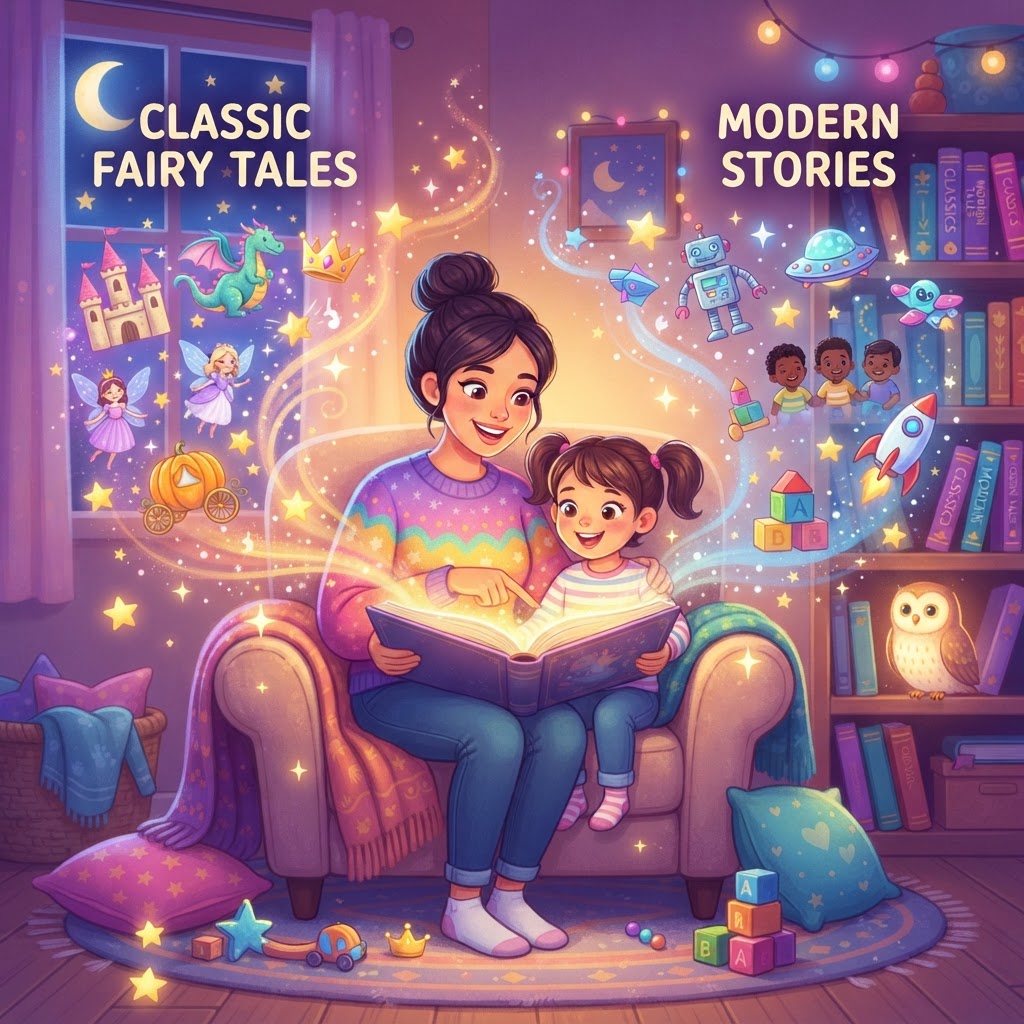
When parents ask about classic fairy tales vs modern stories, the best answer is usually: both. Children benefit from the deep patterns of traditional tales and the fresh perspectives of contemporary books. A balanced reading life gives kids cultural roots, emotional tools, and room to imagine themselves in the story.
This isn’t really a battle of traditional vs contemporary children's stories. It’s more like building a rich bookshelf. Some nights, a child needs the wonder of a forest, a giant, or a talking wolf. Other nights, they need a story about starting school, naming feelings, or seeing a family that looks like their own.
Why do classic fairy tales still matter?
Classic fairy tales still matter because they give children shared cultural references, clear story structure, and powerful imaginative symbols. Even very old stories can help young listeners make sense of fear, courage, justice, and hope.
Fairy tales endure because they are simple, memorable, and emotionally bold. A child quickly understands the pattern: there is a problem, a challenge, a helper, and a resolution. That structure supports early narrative thinking, which later helps with reading comprehension and storytelling.
Classic tales also build cultural literacy. Stories like Cinderella, Little Red Riding Hood, and Jack and the Beanstalk appear again and again in books, films, school discussions, and everyday language. Knowing these stories helps children understand references they will meet later.
Just as important, fairy tales feed imagination. Children do not need stories to be realistic in order to learn from them. In fact, fantasy often creates safe distance. A dragon or witch can stand in for big feelings that are harder to discuss directly.
Benefits of classic fairy tales include:
- Strong moral structure with clear consequences
- Repeated patterns that support memory and prediction
- Rich symbolism that encourages imaginative thinking
- Cultural continuity across generations
Shared reading itself also matters. The American Academy of Pediatrics has emphasized that reading aloud supports language development, early literacy, and parent-child connection. Classic tales can be one meaningful part of that experience.
What do modern stories offer children today?
Modern stories offer children relevance, representation, and emotional vocabulary. They often reflect the real world children live in now, including different family structures, cultures, abilities, and everyday challenges.
Contemporary children’s books tend to shine where older tales may be limited. Many modern stories show characters solving problems through cooperation, self-awareness, and communication rather than only through luck, magic, or punishment. That gives children useful models for real life.
Modern stories can also support diversity and belonging. When children see themselves in books, they feel recognized. When they see people different from themselves, they build empathy. Both outcomes matter for healthy social development.
This is one reason many educators encourage a wide reading diet. The National Association for the Education of Young Children, or NAEYC, highlights the value of reading aloud to support language, relationships, and meaningful conversations. Modern stories are especially strong conversation starters because they connect so easily to a child’s daily life.
Today’s stories often help children practice:
- Naming feelings like jealousy, worry, pride, or disappointment
- Understanding friendships and boundaries
- Seeing many kinds of families and communities
- Exploring identity in age-appropriate ways
If you are also thinking about reading variety more broadly, this guide on why fiction and non-fiction both matter can help round out your child’s book choices.
Are classic fairy tales too scary or outdated?
Some classic fairy tales are too intense in their original form for some children, but that does not mean you need to avoid them completely. The key is to choose age-appropriate versions and read with guidance.
Many traditional tales were first told in times with different social norms. Some include harsh punishments, passive female characters, or frightening imagery. Those elements can feel outdated, and in some cases they are. But not every old story needs to be thrown out. Instead, parents can adapt.
A practical approach is to treat fairy tales as tools, not rules. Choose retellings with gentler language. Skip details your child is not ready for. Pause to talk about what feels unfair, strange, or scary.
This kind of conversation is actually valuable. Children learn critical thinking when adults say, “That part is old-fashioned,” or “How else could the character solve this?” You are not just reading a story. You are teaching your child how to interpret stories.
Watch your child’s cues. If they are highly sensitive, nightmares are frequent, or they seem distressed, save darker tales for later. If they enjoy a little suspense and want to talk it through, classic stories can be a safe way to explore fear.
How can parents balance traditional and contemporary children's stories?
Parents can balance traditional and contemporary children's stories by treating both as essential, not competing, parts of reading. A simple mix across the week often works better than choosing one camp.
Think of your child’s reading life like nutrition. You do not want only familiar comfort books, and you do not want only issue-driven books either. Children thrive on variety.
A practical balance might look like this:
- Read a classic fairy tale once or twice a week for rhythm, symbolism, and cultural literacy
- Read modern stories several times a week for relevance, diversity, and emotional learning
- Repeat favorites because repetition strengthens language and confidence
- Talk after reading with one or two simple questions
- Match the story to the moment: calming books at bedtime, lively books earlier in the day
Timing matters too. Some families find that reflective, comforting stories work best at night, while more stimulating tales fit better earlier in the day. If you want help deciding, this article on the best time to read is a useful next step.
You can also balance story types by format. Younger children may engage with fairy tales best in picture-book retellings, while older children may enjoy richer language and longer plots. This guide on moving from picture books to chapter books can help you match the format to your child’s stage.
Most of all, let your child’s interests guide the ratio. A dragon-loving child may happily move between folklore and modern fantasy. A child processing a life event may need more contemporary, realistic stories for a while.
Which stories are best at different ages?
The best stories depend on a child’s developmental stage, not just their age. In general, younger children do best with gentler retellings and clear emotional safety, while older children can handle more complexity.
For ages 1-3:
- Choose simple, soothing stories with repetition
- Use soft fairy tale adaptations rather than dark originals
- Focus on rhythm, pictures, and familiar patterns
For ages 4-6:
- Introduce classic tales with light suspense and happy resolution
- Add modern stories about friendships, feelings, and everyday challenges
- Ask simple questions like, “How do you think she felt?”
For ages 7-10:
- Explore fuller versions of fairy tales and more layered modern books
- Compare stories across time
- Talk about character choices, fairness, and different perspectives
Research from the Harvard Center on the Developing Child also reminds us that back-and-forth conversation helps build learning and connection. In other words, the discussion around the story matters as much as the story itself.
How can personalized stories bring the best of both worlds?
Personalized stories can combine the timeless structure of fairy tales with the relevance of modern storytelling. They work especially well when a child loves traditional story patterns but engages more deeply when the details feel personal.
For example, a child might enjoy a story with classic elements like a quest, a magical helper, or a forest path, but feel even more connected when the main character shares their name, feelings, or favorite animal. That is one reason many families like to create your own personalized bedtime story when they want both familiarity and freshness.
Personalized stories can also help with re-reading. When a child returns to a story again and again, they build confidence, memory, and language. Saving favorites in your story library makes that easier, especially if you want to revisit a classic-style adventure one night and a modern feelings-based story the next.
For more ideas on building a thoughtful reading routine, you can also browse the InstaTales blog.
Frequently Asked Questions
Should I stop reading fairy tales if my child gets scared?
Not necessarily. Try gentler retellings, shorten tense scenes, and talk through the story together. If your child stays distressed, pause darker tales for now and return to them later.
Are modern stories better for teaching emotional intelligence?
Modern stories often do this very well because they name feelings and model everyday problem-solving. Still, classic tales can also support emotional growth when adults help children talk about characters and choices.
Why are classic fairy tales important for cultural literacy?
Classic tales give children common references they will meet in school, media, and later reading. Knowing these stories helps them understand symbols, themes, and repeated story patterns across many texts.
How often should I read classic fairy tales vs modern stories?
There is no perfect ratio, but many families do well with a mix across the week. Aim for variety, repeat favorites, and adjust based on your child’s age, sensitivity, and interests.
Can personalized stories replace traditional books?
No. Personalized stories work best as one part of a healthy reading life. Children still benefit from published classics, modern picture books, nonfiction, and shared library reading.
What if my child only wants the same type of story every night?
That is very common. Start with the kind they love, then gently pair it with something nearby in theme, tone, or character type so their reading world expands without feeling forced.
Ready to Create a Personalized Bedtime Story?
Use our free AI bedtime story generator to create a personalized illustrated story for your child in 30 seconds — no credit card needed.
Popular story types:
Maya Rodriguez
Lead Content Editor & Early Literacy Specialist
Maya is a former early childhood educator and literacy specialist with over a decade of experience helping children develop a love of reading. She leads content at InstaTales, where she writes about the science of storytelling, child development, and how families can use personalized AI stories to build literacy and emotional resilience.
instatales.ai