Co-Creating Stories With Kids: Step-by-Step
How to co-create stories with your child — a step-by-step guide to involving kids in choosing characters, settings, and plot twists with free AI story tools.
✦ Key Takeaways
- •**Co-creating stories with kids supports language and thinking skills** because children practice sequencing, prediction, and expressive vocabulary while helping build a plot.
- •**The best child story creation starts small**: let younger children choose one or two elements, such as a character or setting, and give older children more control over problems, motives, and plot twists.
- •**Interactive story making with kids works best when adults scaffold the process**, offering limited choices, repeating ideas back, and helping organize the beginning, middle, and end.
- •**AI tools can make collaborative storytelling with children easier** by offering quick character options, second-character pairings, and editable story paths that keep the child involved.
- •**Shared story making can also support emotional learning** when children explore themes like teamwork, patience, responsibility, and inclusion through characters they helped create.
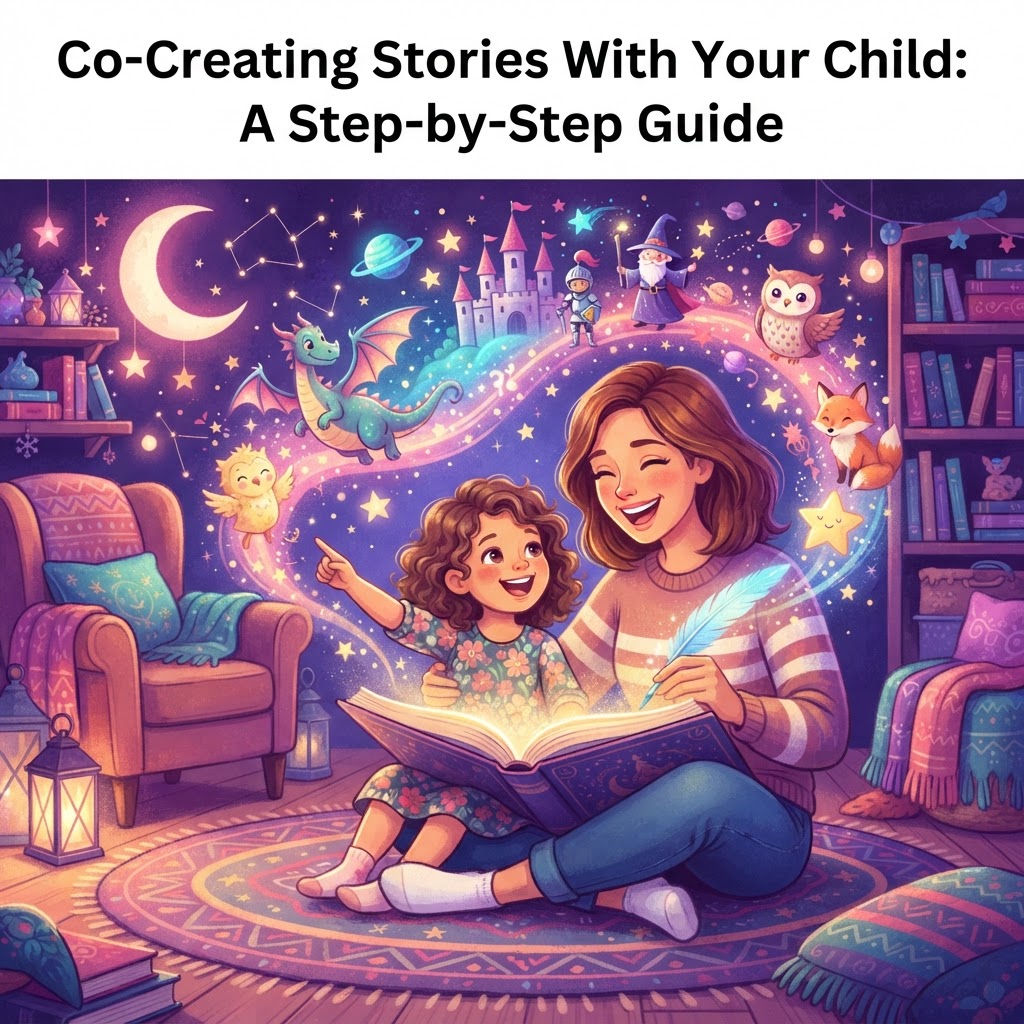
Co-creating stories with kids turns story time into a conversation, not a performance. When children help choose the hero, setting, and surprise twist, they practice imagination, language, problem-solving, and confidence all at once. This step-by-step guide will show you how to make collaborative storytelling with children simple, fun, and age-appropriate, whether you are making up a story out loud or using an AI bedtime story generator like InstaTales.
People Also Ask
How do you co-create a story with a child?
Start by asking your child to choose one character, one place, and one problem. Then build the story together by taking turns adding what happens next, keeping the plot simple and easy to follow.
What age can children start collaborative storytelling?
Children can begin as toddlers by picking characters, sounds, or actions. By preschool and early elementary years, most children can help shape settings, simple conflicts, and endings.
Why is storytelling important for child development?
Storytelling supports vocabulary, memory, sequencing, and social-emotional growth. It also helps children make sense of experiences by putting events and feelings into a clear narrative.
Can AI help with story creation for kids?
Yes, if it is used as a creative tool rather than a replacement for parent-child interaction. AI can speed up setup, offer fresh ideas, and make it easier for children to see their choices reflected in a finished story.
Why does co-creating stories with kids matter so much?
Co-creating stories with kids builds creativity, language, and narrative skills in a way passive listening cannot. When children help create a story, they move from audience to author, which strengthens engagement and recall.
Research supports this. Harvard’s Center on the Developing Child highlights the value of back-and-forth interaction for brain development, and collaborative storytelling is full of that kind of responsive exchange. The American Academy of Pediatrics also emphasizes shared reading and conversation as foundations for language growth and relationships.
In practice, child story creation helps children learn to:
- Sequence events in order
- Predict what might happen next
- Describe characters and emotions
- Solve problems inside an imaginary world
- Feel ownership over story time
This matters at bedtime especially. If you are trying to create calmer evening routines, pairing co-created stories with a screen-free bedtime routine can make story time feel personal, soothing, and repeatable.
How can you start collaborative storytelling with children without overcomplicating it?
The easiest way to begin is to let your child make just three choices: who the story is about, where it happens, and what problem appears. This keeps the process manageable while still giving children real creative control.
Try this simple framework:
- Character: “Should the main character be a fox, astronaut, or child?”
- Setting: “Is the story in a jungle, castle, or spaceship?”
- Problem: “Did they lose something, need to help a friend, or hear a mysterious sound?”
After your child chooses, you build from there:
- Beginning: introduce the character and place
- Middle: bring in the problem
- End: solve it together
This kind of interactive story making with kids works because it reduces decision fatigue. Younger children often freeze if asked, “What should the whole story be about?” but thrive when offered two or three clear options.
If you want a faster start, InstaTales’ story templates can help families jump into a structure and personalize it from there.
How should story co-creation change by age?
Children need different levels of support at different ages, and matching the storytelling process to their development makes co-creation smoother and more fun. The goal is not to make the child do everything; it is to invite meaningful participation.
Ages 1-3: how can toddlers help create stories?
Toddlers can co-create by choosing familiar images, sounds, and actions. At this age, keep the story short and repetitive.
Try:
- “Should the bunny hop or stomp?”
- “Do we visit the farm or the moon?”
- “Is the puppy happy or sleepy?”
Use lots of repetition and sensory language. The ZERO TO THREE organization notes that responsive language experiences are especially important in the early years. For toddlers, the co-creation is less about plot and more about participation.
Ages 4-6: how can preschoolers shape a real plot?
Preschoolers can usually choose characters, settings, and simple problems. They love surprise, humor, and clear cause-and-effect.
Try prompts like:
- “What should the dragon lose?”
- “Who helps the little bear?”
- “What silly thing happens in the forest?”
This is also a great age to introduce values through story. If your child’s ideas lean toward friendship or fairness, you can build on themes from stories about inclusion or cooperation.
Ages 7-10: how can older kids become true story partners?
Older children can handle motives, multiple characters, plot twists, and stronger emotional arcs. They often enjoy deciding what a character wants and what stands in the way.
Try:
- “What secret is the explorer hiding?”
- “Should the second character be a rival, sibling, or best friend?”
- “What twist changes everything in the middle?”
This age group is ready for richer collaborative storytelling with children, including stories that explore teamwork, patience, or responsibility. You can connect story themes to everyday growth with articles on teamwork, patience, or responsibility.
What does a step-by-step story session actually look like?
A good co-creation session usually takes 5 to 15 minutes and follows a simple rhythm: choose, build, twist, and close. Having a repeatable process helps children know what to expect.
Step 1: choose the main character
Let your child pick someone they care about. This could be a child, an animal, or a fantasy creature. If your child loves animals, browsing animal stories for children can spark easy ideas.
Step 2: add a second character
A second character creates relationship, dialogue, and tension. InstaTales’ second-character option makes this especially useful because children can decide if the new character is a helper, sidekick, sibling, or trickster.
Ask:
- “Who goes with the hero?”
- “How are they different?”
- “Do they agree or disagree?”
Step 3: pick the setting
Invite one vivid location. A underwater city, snowy forest, school playground, or moon base gives the story instant life.
Step 4: introduce a problem or quest
A story needs a challenge. Keep it child-sized: a missing backpack, a shy unicorn, a broken bridge, or a friend who feels left out.
Step 5: ask for one plot twist
This is where interactive story making with kids becomes exciting. Ask, “What unexpected thing happens next?” Even a simple twist, like the map being upside down, helps children think flexibly.
Step 6: finish with a satisfying ending
Young children often prefer safety and closure. Let them decide: “Do they find the treasure, help the friend, or learn something important?”
Step 7: save and revisit
Children love hearing their own stories again. Saving them in your story library lets families reread favorites and notice how their child’s storytelling grows over time.
How can InstaTales support child story creation at home or in class?
InstaTales can make child story creation easier by giving children clear choices while keeping the adult in the creative loop. The tool works best when you use it to reflect your child’s ideas, not replace them.
Helpful features include:
- Character selector: lets children choose a main character quickly
- Second-character option: adds relationship and conflict
- Collaborative story feature: supports back-and-forth idea building rather than one-click passive output
- Free story access: families can try a free AI bedtime story generator when they want to experiment without commitment
For teachers, co-created stories can also support oral language, sequencing, and classroom community. InstaTales for teachers can be a useful extension for writing centers, group storytelling, or social-emotional learning prompts.
If children enjoy sharing their creations, the community story gallery can also inspire fresh ideas from other families.
What prompts work best for collaborative storytelling with children?
The best prompts are specific enough to guide children but open enough to invite imagination. Offer just enough structure to help them succeed.
Try these age-friendly examples:
For ages 1-3
- “Should the duck swim in a pond or a bubble bath?”
- “Is the teddy looking for a snack or a nap?”
- “Who says hello to the puppy?”
For ages 4-6
- “A little fox finds a glowing key. What does it open?”
- “A princess and a robot hear a sound in the garden. What is it?”
- “A bear wants to help a friend who feels sad. What does the bear do first?”
For ages 7-10
- “Two friends discover that their map leads to a place that should not exist. What do they do?”
- “A brave child and a grumpy dragon must work together. Why?”
- “The hero gets exactly what they wished for, but something is wrong. What is the twist?”
You can also invite children to create stories around real-life skills and feelings. This makes bedtime stories a gentle place to practice empathy and problem-solving.
How can parents keep story co-creation fun instead of stressful?
Keep collaborative storytelling with children playful by lowering the stakes and following the child’s energy. You do not need a perfect plot, a moral lesson, or a polished ending every time.
A few practical tips:
- Offer choices instead of broad questions
- Accept silly answers
- Keep sessions short if your child is tired
- Repeat and expand their words
- Stop while they still want more
If your child changes direction halfway through, that is normal. Story making is a creative process, not a test. According to the U.S. Department of Education’s early learning resources, rich conversation and responsive interaction matter more than getting every answer “right.”
For more family literacy ideas, you can explore the InstaTales blog or pair storytelling with weekly reading challenges to build a steady habit.
Frequently Asked Questions
What is co-creating stories with kids?
It means building a story together rather than having the adult invent everything alone. The child helps make choices about characters, settings, problems, or endings.
Is collaborative storytelling good for child development?
Yes. It supports vocabulary, sequencing, listening, imagination, and emotional expression through active participation and conversation.
How long should a co-created story session be?
For most children, 5 to 15 minutes is enough. Younger children often do best with very short, simple sessions, while older children may want longer stories with more detail.
Can I use AI for interactive story making with kids safely?
Yes, when you stay involved and use the tool as a shared creative activity. The best approach is to guide the choices, read together, and adapt the story to your child’s age and needs.
What if my child does not want to invent a whole story?
That is completely fine. Start with tiny choices, like picking a character or deciding what happens next, and let your child participate at their own comfort level.
Get a new bedtime story every week
Free, personalized, and delivered to your inbox. No spam, ever.
Ready to Create a Personalized Bedtime Story?
Use our free AI bedtime story generator to create a personalized illustrated story for your child in 30 seconds — no credit card needed.
Popular story types:
Maya Rodriguez
Lead Content Editor & Early Literacy Specialist
Maya is a former early childhood educator and literacy specialist with over a decade of experience helping children develop a love of reading. She leads content at InstaTales, where she writes about the science of storytelling, child development, and how families can use personalized AI stories to build literacy and emotional resilience.
instatales.ai