Inclusive Children’s Stories About Diverse Families
How to represent diverse families in children's stories — single parents, same-sex parents, blended families, disabilities, and diverse cultures with personalized AI stories.
✦ Key Takeaways
- •**Representation in children's books** matters because stories act as both “mirrors” and “windows”: children need books that reflect their own lives and books that help them understand experiences different from their own.
- •**Diverse families in stories** should be shown as ordinary, loving, and complete, including single-parent, same-sex parent, blended, foster, and adoptive families without making difference the only plot point.
- •Inclusive stories are stronger when they also reflect **disability, culture, language, and community**, showing children as full people with interests, strengths, and agency.
- •Personalized storytelling tools like the [AI bedtime story generator](/) can help families create stories where children see their names, family structures, cultures, and everyday experiences represented naturally.
- •Parents and teachers can build inclusion by choosing stories intentionally, asking open-ended questions, and using resources like [Teaching inclusion through bedtime stories](/blog/teaching-inclusion-through-bedtime-stories) to extend learning.
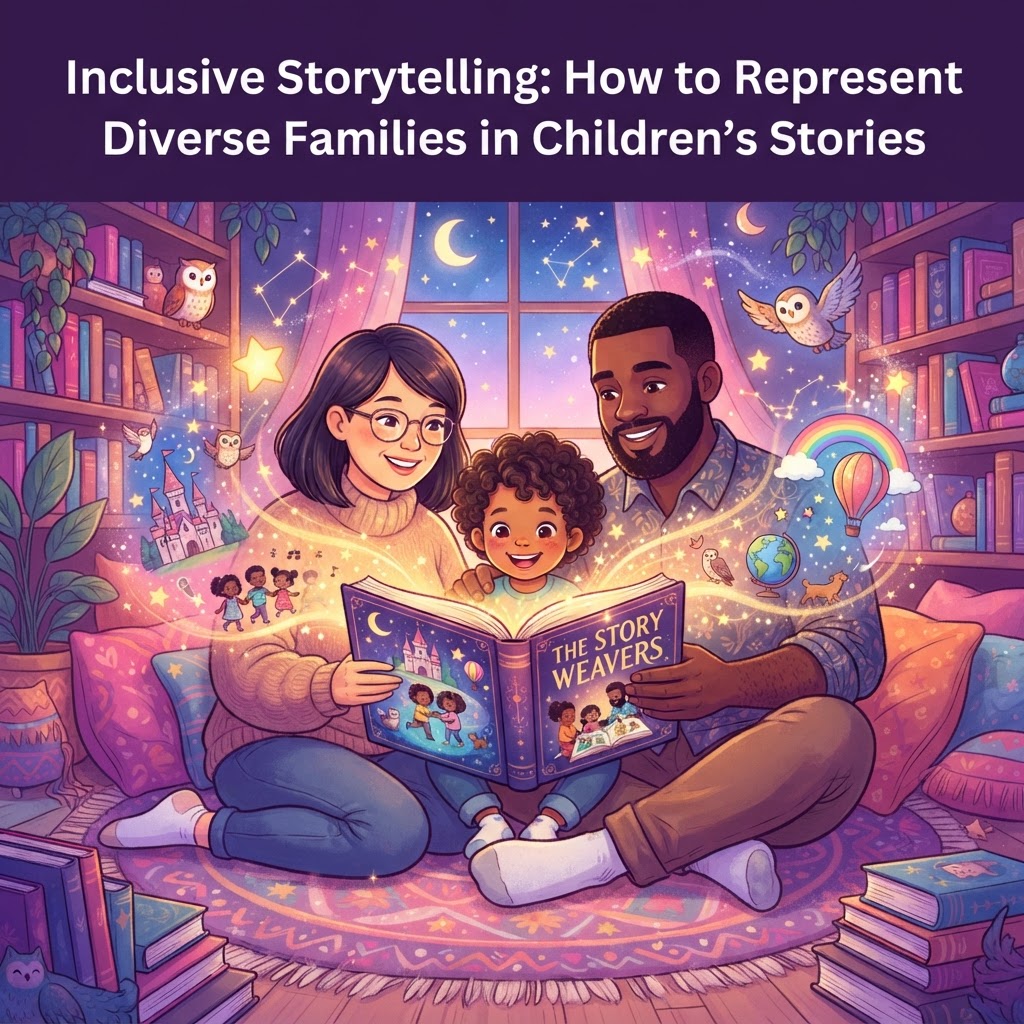
Children notice who appears in stories—and who does not. Inclusive children's stories help children feel seen, valued, and connected to others by reflecting the many ways real families live, love, and grow together. For parents and educators, thoughtful inclusive storytelling for kids is one of the simplest ways to support empathy, identity, and belonging at home and in the classroom.
People Also Ask
Why is representation important in children's stories?
Representation helps children feel that they belong and that their lives matter. It also helps children understand and respect people whose experiences are different from their own.
How do you write inclusive children's stories about different families?
Start by treating every family structure as valid and ordinary. Focus on love, routines, adventures, and relationships rather than making the family’s difference feel like a problem to solve.
What are mirror and window books?
“Mirror” books reflect a child’s own identity, family, or culture back to them. “Window” books let children learn about other people’s lives, which supports empathy and social understanding.
Can AI help create inclusive bedtime stories?
Yes, when used thoughtfully, AI can help parents and educators personalize characters, settings, and family details. This makes it easier to create stories that feel familiar, affirming, and relevant to each child.
Why does representation in children's books matter?
Representation in children's books matters because stories shape how children see themselves and others. When children find their family, culture, language, or abilities in books, they receive an important message: “You belong here.”
Educator Rudine Sims Bishop famously described books as mirrors, windows, and sliding glass doors. Some stories reflect a child’s own life back to them, while others offer a view into someone else’s experience. This idea remains central in literacy education because both kinds of reading support identity development and empathy.
Research and child development guidance support this. The American Academy of Pediatrics emphasizes the value of shared reading for social-emotional growth, language, and connection. Organizations such as Reading Rockets also note that diverse books can help children build background knowledge and a broader understanding of the world.
For children from underrepresented groups, a lack of inclusive stories can feel isolating. For all children, exposure to diverse families in stories helps normalize difference and reduce stereotypes early.
How can stories reflect diverse family structures naturally?
Stories reflect diverse family structures best when they present them as a normal part of life, not as a lesson or issue. A child can go on a dragon hunt, solve a playground problem, or bake cookies with two moms, one dad, a grandparent, or a blended family—and the story still works beautifully.
Inclusive family representation can include:
- Single-parent families
- Same-sex parent families
- Blended and stepfamilies
- Adoptive families
- Foster families
- Multigenerational households
- Families with grandparents or other caregivers as primary parents
The key is to avoid defining the entire story by the family structure. Instead, show everyday warmth: school drop-off, bedtime routines, silly jokes, chores, celebrations, and shared adventures.
For example, a story about a child nervous about the first day of school can include two dads offering encouragement without making that the “special” part of the plot. That is what strong inclusive storytelling for kids looks like: specific, respectful, and natural.
If you want more examples, our guide to inclusive children’s stories about diverse families explores this in more depth.
How should you portray single-parent, same-sex, blended, and adoptive families?
Portray these families with warmth, realism, and variety. The goal is not to flatten differences, but to show that every family can be loving, stable, playful, and worthy of being centered in a story.
A few practical guidelines help:
- Single-parent families: Avoid framing them as incomplete. Show competence, support networks, and everyday joy.
- Same-sex parent families: Focus on the family’s relationships and routines. Do not turn the story into a debate about their validity.
- Blended families: Acknowledge adjustment if relevant, but include cooperation, affection, and new traditions.
- Adoptive families: Be careful not to imply that adoption is a secret, a rescue fantasy, or a source of shame. Center belonging and connection.
- Foster families: If included, portray stability, care, and respect for the child’s feelings and history.
Small details matter. Names, celebrations, family traditions, and how adults speak to children all contribute to authenticity. Inclusive stories are often strongest when they show a family doing ordinary things well.
Parents looking for story ideas that also support social growth may enjoy our article on stories that teach inclusion to kids.
How can children's stories include disability respectfully?
Children’s stories can include disability respectfully by showing disabled characters as full people, not symbols or side lessons. A child who uses a wheelchair, hearing aids, or a communication device should still get to be funny, brave, curious, stubborn, creative, and central to the story.
Respectful disability representation often means:
- Leading with the child’s personality and interests
- Including accessibility as part of the world, not a dramatic obstacle every time
- Avoiding “inspiration” narratives where disabled characters exist mainly to teach others gratitude
- Showing friendships, family life, and problem-solving in realistic ways
The CDC’s developmental disability resources offer useful background for adults who want accurate, child-centered information. When possible, it also helps to seek stories created by disabled authors, illustrators, or consultants.
In bedtime storytelling, disability can be woven in naturally. A hero might use a mobility aid on a treasure hunt, sign with a sibling before bed, or use sensory tools to feel calm during a storm. The character is not reduced to one trait.
How can you include diverse cultures and languages without stereotyping?
Include diverse cultures by focusing on lived details, not clichés. Food, language, clothing, celebrations, family roles, and values can enrich a story—but they should come from real experience and respectful research, not generic “exotic” markers.
A few best practices can help:
- Be specific rather than broad: “Tamil lullabies” is better than “Asian culture.”
- Include everyday moments, not only festivals or holidays.
- Avoid making one child represent an entire group.
- Use home languages naturally, with enough context for understanding.
- Check details with families or trusted cultural sources when writing for a classroom.
The National Association for the Education of Young Children regularly shares guidance on developmentally appropriate, culturally responsive teaching. Their work reinforces a simple truth: children thrive when their home lives and identities are respected in learning spaces.
This applies to story settings too. A family might live in a city apartment, on a farm, in a bilingual household, or near grandparents in another country. Those details deepen story quality and strengthen representation in children's books.
How can parents and educators choose better inclusive children's stories?
Choose inclusive stories by looking for authenticity, balance, and joy. A strong story should not only include difference; it should present children and families as believable, capable, and emotionally rich.
Use this quick checklist:
- Does the story show diverse families in stories as normal and valued?
- Are characters more than a label or teaching device?
- Is the language respectful and age-appropriate?
- Does the plot allow the child character to have agency?
- Is there a balance of “mirror” and “window” reading in your home or classroom?
It also helps to pair inclusive books with conversation. Ask:
- “What did you notice about this family?”
- “What is similar to our family?”
- “What is different?”
- “How did the character feel?”
For classroom use, InstaTales for teachers can support personalized literacy activities, while teaching teamwork through bedtime stories offers another way to connect stories with social learning.
How does InstaTales support inclusive storytelling for kids?
InstaTales supports inclusive storytelling by letting adults customize characters, family details, and settings so children can see themselves in the story. That personalization can make bedtime reading feel more affirming, especially for children who do not often find their exact experience on the bookshelf.
With the AI bedtime story generator, families can create stories that reflect:
- Different family structures
- Cultural traditions and languages
- Children with disabilities
- Familiar home routines or community settings
- Favorite themes, including animal stories for children
This can be especially helpful when you want a child to hear a story where their two moms, step-siblings, grandparent caregiver, or adopted family story simply exists as part of the adventure. If you want to try it without commitment, the free AI bedtime story generator makes it easy to explore personalized stories.
For more inclusive reading ideas, you can also browse the InstaTales blog or read our parent-friendly guide to stories that help kids manage big emotions, since emotional safety and representation often go hand in hand.
What does inclusive storytelling look like in everyday practice?
In everyday practice, inclusive storytelling looks simple, consistent, and intentional. It means children regularly hear stories where many kinds of families belong, many kinds of bodies and minds are valued, and many cultures are treated with respect.
That might look like:
- Rotating bedtime stories with different family structures
- Personalizing stories to match a child’s life
- Using inclusive language during read-alouds
- Inviting children to talk about fairness, kindness, and belonging
- Making sure classroom reading corners include a wide range of identities and experiences
Inclusive storytelling does not require a perfect script. It requires attention, curiosity, and a willingness to widen the stories children hear. Over time, that can shape how they see themselves—and how they treat others.
Frequently Asked Questions
What are inclusive children's stories?
Inclusive children's stories are stories that reflect a wide range of identities, families, abilities, and cultures with respect and authenticity. They help children feel seen while also teaching them about lives different from their own.
How do diverse families in stories help children?
They help children understand that families can look different and still be loving, safe, and complete. This supports belonging for some children and empathy for others.
What does mirror and window mean in children's literature?
A “mirror” story reflects a child’s own experience, identity, or family. A “window” story gives a child a view into someone else’s life and helps build understanding.
How can I make a bedtime story more inclusive?
Include details that reflect the child’s real family, community, culture, or needs. You can also choose stories with varied characters and ask thoughtful questions during reading.
Can teachers use personalized AI stories in the classroom?
Yes, personalized AI stories can support engagement, identity affirmation, and differentiated instruction when used thoughtfully. They work best alongside high-quality books and guided discussion.
Are inclusive stories only for children from diverse backgrounds?
No. Inclusive stories benefit all children by expanding their understanding of people and experiences beyond their own. They are an important part of raising kind, curious, socially aware readers.
Get a new bedtime story every week
Free, personalized, and delivered to your inbox. No spam, ever.
Ready to Create a Personalized Bedtime Story?
Use our free AI bedtime story generator to create a personalized illustrated story for your child in 30 seconds — no credit card needed.
Popular story types:
Maya Rodriguez
Lead Content Editor & Early Literacy Specialist
Maya is a former early childhood educator and literacy specialist with over a decade of experience helping children develop a love of reading. She leads content at InstaTales, where she writes about the science of storytelling, child development, and how families can use personalized AI stories to build literacy and emotional resilience.
instatales.ai