Co-Creating Stories With Kids: Step-by-Step Guide
How to co-create stories with your child — a step-by-step guide to involving kids in choosing characters, settings, and plot twists with free AI story tools.
✦ Key Takeaways
- •**Co-creating stories with kids supports language and literacy development** because children practice describing characters, predicting events, and organizing ideas into a beginning, middle, and end.
- •**Collaborative storytelling with children can be adapted by age**: toddlers do best with simple choices, preschoolers enjoy imaginative details, and older children can help shape conflict, plot twists, and character motivation.
- •**Interactive story making with kids strengthens parent-child connection** because children feel heard and invested when their ideas become part of the story.
- •**AI tools can make child story creation easier** by offering guided choices for characters, settings, and second characters while still keeping the child’s voice at the center.
- •**Short, repeatable storytelling routines work best**; even 5-10 minutes of shared story building can become a powerful bedtime or classroom habit.
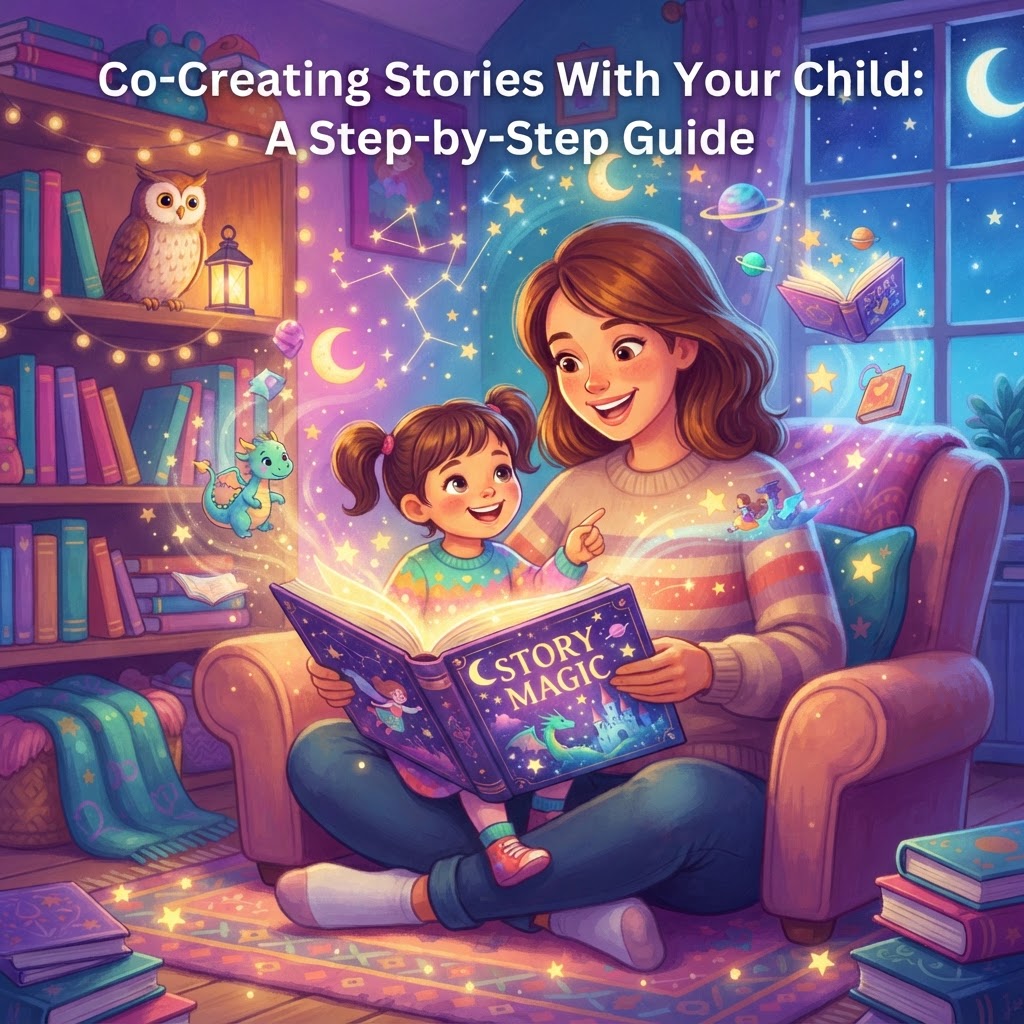
Co-creating stories with kids is one of the simplest ways to build imagination, language, and connection at the same time. When children help choose the character, setting, and plot twist, they are not just listening to a story — they are practicing creative thinking, sequencing, empathy, and early narrative skills in a playful, low-pressure way.
People Also Ask
How do you start co-creating stories with kids?
Start with two simple choices, such as “Should our hero be a bunny or a dragon?” and “Should the story happen in a forest or in space?” Simple choices lower pressure and help children join in quickly.
What age can children start making up stories?
Children can begin participating in story creation as early as age 2 through choosing characters, sounds, or repeated phrases. As language grows, children can add actions, feelings, and simple plot ideas.
Does collaborative storytelling help with reading?
Yes, collaborative storytelling with children supports early literacy by building vocabulary, comprehension, sequencing, and prediction. These are core skills children later use when reading and writing independently.
What if my child says “I don’t know” during story time?
Offer narrower options instead of open-ended questions. You can also use supports like story templates or try a few playful story prompts for reluctant readers.
Why does co-creating stories with kids matter so much?
Co-creating stories with kids matters because it builds creativity, oral language, and confidence in a way that feels like play. Children learn how stories work when they help invent them, and they feel a stronger sense of ownership than when they only listen.
Research supports this. The Harvard Center on the Developing Child highlights how back-and-forth interactions help build language and thinking skills. Story co-creation is a natural form of that serve-and-return interaction: your child offers an idea, and you respond by expanding it.
Collaborative storytelling with children also supports social-emotional growth. When a child decides that the shy bear feels nervous or the dragon needs a friend, they are practicing perspective-taking. Organizations like Reading Rockets have long emphasized that oral language experiences help prepare children for later reading and writing success.
For families, there is another benefit: co-creation turns story time into connection time. This can be especially helpful if you are trying to create a calmer evening routine, like the ideas in this guide to screen-free bedtime with stories.
How can you co-create a story step by step?
The easiest way to do child story creation is to move through four simple steps: choose a character, choose a setting, add a problem, and imagine a resolution. This structure gives children freedom without overwhelming them.
Try this step-by-step approach:
- Step 1: Pick the main character. Ask, “Who should the story be about?” Younger children may choose from two options. Older children can invent their own hero.
- Step 2: Choose the setting. Ask where the story takes place: a jungle, castle, moon, school, or undersea cave.
- Step 3: Add a second character or helper. This is where friendships, teamwork, and funny contrasts begin.
- Step 4: Introduce a problem. Keep it child-friendly: something is missing, someone feels nervous, or a map leads to a mystery.
- Step 5: Invite a plot twist. Ask, “What surprising thing happens next?”
- Step 6: End with a resolution. Let your child decide how the character solves the problem or what they learn.
If you want support generating ideas quickly, an AI bedtime story generator can help you shape these choices into a full bedtime story while keeping your child involved in each decision.
How should collaborative storytelling with children change by age?
Collaborative storytelling with children works best when the level of choice matches the child’s developmental stage. The right amount of structure keeps story making fun instead of frustrating.
Ages 1-3: What works for toddlers?
Toddlers do best with simple either-or choices, repeated phrases, and familiar themes. At this age, story co-creation is less about plot and more about participation.
Try prompts like:
- “Should the puppy be sleepy or hungry?”
- “Do we go to the farm or the beach?”
- “Should the duck say quack-quack or splash-splash?”
Let toddlers join through gestures, sound effects, or filling in repeated lines. According to the CDC’s developmental guidance, young children learn through responsive interaction and repetition, so keep the structure predictable.
Ages 4-6: What works for preschoolers and kindergartners?
Children in this stage usually love big imagination, silly combinations, and emotional storytelling. They can help choose characters, name places, and suggest simple problems.
Try prompts like:
- “Our rabbit is going to a cloud castle. Who goes too?”
- “What did the little tiger lose?”
- “Should the surprise be funny or magical?”
This is a great age to explore themes like kindness, patience, and inclusion through stories. You can also build on topic-based ideas like stories that teach patience or inclusion stories for kids.
Ages 7-10: What works for older children?
Older children are ready for deeper plots, motives, twists, and longer story arcs. They often enjoy helping design the whole narrative.
Try prompts like:
- “Why does the inventor want to find the hidden island?”
- “What secret is the second character hiding?”
- “What mistake causes the big problem?”
- “How should the ending change the hero?”
At this age, children can also revisit and revise earlier stories, compare different endings, or save favorites in your story library to reread later.
How can you involve kids in choosing characters, settings, and plot twists?
Children participate best when you give them meaningful choices at the right moment. Instead of asking for everything at once, guide them through one storytelling decision at a time.
For characters, offer categories that spark interest:
- animals
- children like them
- magical creatures
- vehicles with personalities
Animal heroes are especially popular with younger kids, so browsing animal stories for children can help spark ideas.
For settings, think in contrasts:
- cozy or adventurous
- realistic or magical
- familiar or surprising
Examples:
- bedroom or pirate ship
- school or moon base
- garden or dragon mountain
For plot twists, keep them playful:
- the treasure is a birthday cake
- the scary noise is a sneezing hamster
- the map was upside down
- the helper is secretly related to the hero
In interactive story making with kids, specific prompts usually work better than broad ones. “What color is the dragon’s backpack?” is easier than “Tell me everything about the dragon.”
How can InstaTales make child story creation easier?
InstaTales makes child story creation easier by turning a blank page into guided collaboration. Instead of asking your child to invent everything from scratch, you can use built-in choices to keep the process smooth and fun.
Here are a few features that fit co-creation especially well:
- Character selector: Let your child choose the hero based on what they love right now, whether that is unicorns, firefighters, kittens, or astronauts.
- Second-character option: Add a sibling, best friend, animal sidekick, or even a gentle rival. This is perfect for building stories about teamwork, friendship, or problem-solving.
- Collaborative story feature: Invite your child to help make decisions as the story develops, including the setting, challenge, and ending.
If your child wants to try it right away, a free AI bedtime story generator can be a low-pressure way to experiment with free stories, no signup or credit card required. For educators, InstaTales for teachers can also support classroom storytelling, writing warm-ups, or group literacy activities.
What are some easy prompts for interactive story making with kids?
The best prompts for interactive story making with kids are simple, vivid, and open enough for imagination. Good prompts invite one decision at a time and make it easy for children to add their own ideas.
Try these by age:
For ages 2-4
- “Should our bunny wear boots or a cape?”
- “Is the tiny adventure in the garden or the bathtub?”
- “Who says hello first: the cat or the moon?”
For ages 4-6
- “A little fox finds a glowing key. What does it open?”
- “A dragon wants to make a new friend. Who does it meet?”
- “A bear packs for a trip. What silly thing does it forget?”
For ages 7-10
- “Two friends find a map inside a library book. Where does it lead?”
- “A child inventor builds something that works too well. What happens next?”
- “A team must solve a mystery before sunrise. What clues do they find?”
If your child needs extra help getting started, browse the InstaTales blog or use topic-based prompts connected to teamwork stories for kids.
What if your child loses interest or feels stuck?
If your child loses interest, simplify the choices and lower the stakes. Collaborative storytelling with children should feel playful, not like a test.
Try these strategies:
- Offer two choices instead of open-ended questions.
- Accept silly answers and build on them.
- Keep sessions short, around 5-10 minutes.
- Use repetition: the same character can go on a new adventure each night.
- Let your child stop after one idea if needed.
Some children prefer to listen first and contribute later. That is still valuable. In fact, many reluctant participants become more engaged when they see their ideas appear in the story the next night or when they can revisit favorites in a saved collection.
How can parents make co-created stories a regular habit?
The best way to build a storytelling habit is to attach it to an existing routine, such as bedtime, quiet time, or after school. Consistency matters more than length.
A few easy ways to make it stick:
- Keep a “story starter” list nearby.
- Reuse favorite characters across many stories.
- Save especially loved stories for rereading.
- Let siblings take turns choosing one story element each.
- Pair story nights with family reading goals or weekly reading challenges.
You can also invite children to share favorite creations in a safe, positive way through a community story gallery, especially if they are proud of recurring characters or funny twists.
Frequently Asked Questions
Is co-creating stories with kids good for literacy?
Yes. Co-creating stories with kids helps build vocabulary, sequencing, comprehension, and oral language, all of which support later reading and writing development.
How long should collaborative storytelling with children take?
It does not need to take long. Even 5-10 minutes of collaborative storytelling with children can be meaningful, especially when it becomes a regular routine.
Can AI help without taking over the story?
Yes, if used well. AI works best as a support tool that offers structure, choices, and inspiration while the child still makes key decisions about characters, settings, and plot twists.
What if I have children of different ages?
Let each child control one part of the story. A younger child can choose the character, while an older child chooses the problem or ending.
Should I correct my child’s story ideas?
Usually, no. Unless something is upsetting or inappropriate, it is better to follow the child’s imagination and gently model language rather than interrupt the creative flow.
Get a new bedtime story every week
Free, personalized, and delivered to your inbox. No spam, ever.
Ready to Create a Personalized Bedtime Story?
Use our free AI bedtime story generator to create a personalized illustrated story for your child in 30 seconds — no credit card needed.
Popular story types:
Maya Rodriguez
Lead Content Editor & Early Literacy Specialist
Maya is a former early childhood educator and literacy specialist with over a decade of experience helping children develop a love of reading. She leads content at InstaTales, where she writes about the science of storytelling, child development, and how families can use personalized AI stories to build literacy and emotional resilience.
instatales.ai