Bedtime Story Routine School Age: Easy Guide
Want to create a bedtime story routine for your school-age child? Here's a step-by-step guide to making story time a calming nightly ritual.
✦ Key Takeaways
- •A bedtime story routine matters because it gives school-age kids a clear signal that the day is ending and sleep is coming next.
- •An ideal elementary bedtime routine is short, predictable, and calming.
- •Story time should happen near the end of the bedtime routine, after washing up and before lights out.
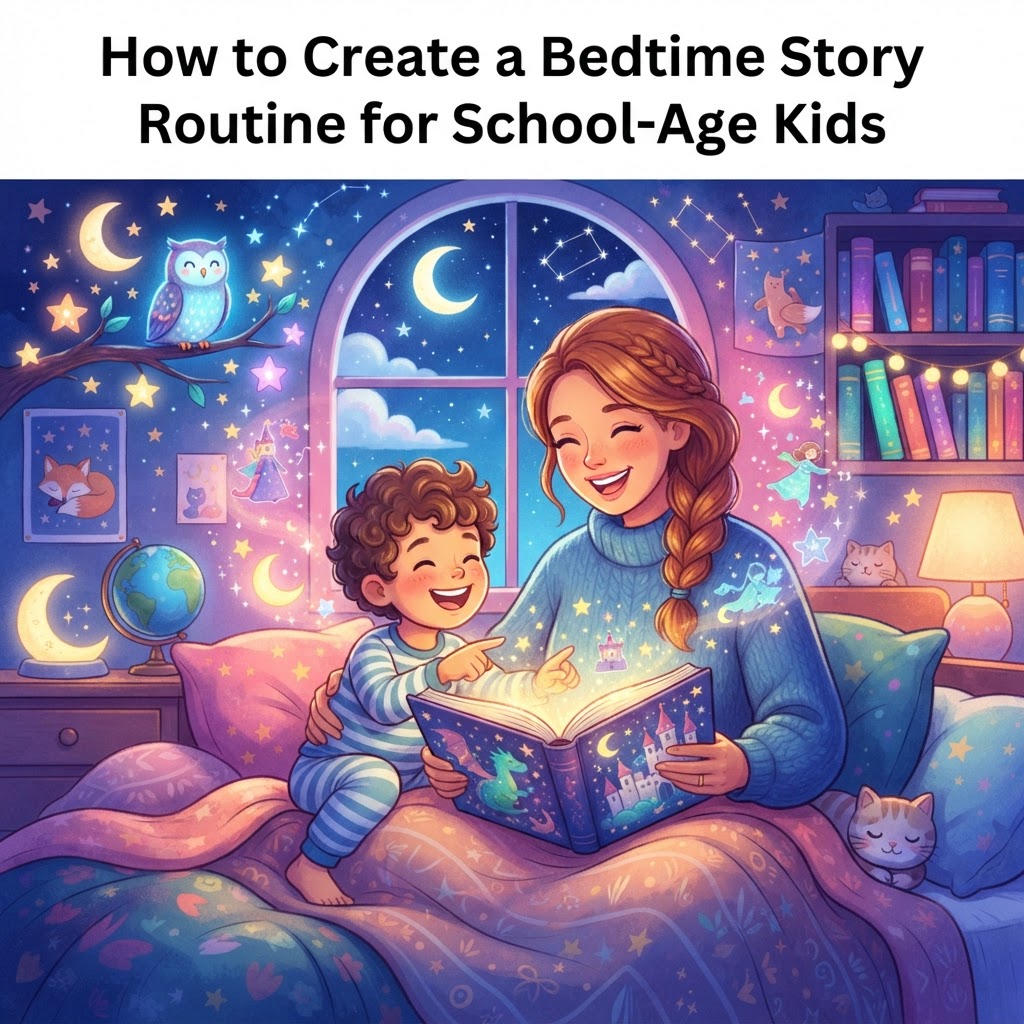
A bedtime story routine for school age kids can do more than make evenings feel cozy. It can help children settle their bodies, organize their thoughts, and end the day with connection instead of conflict. For children in elementary school, that predictability matters: the American Academy of Sleep Medicine says kids ages 6-12 need 9-12 hours of sleep per 24 hours, and the CDC notes that regular, sufficient sleep supports attention, learning, and behavior.
The good news is that you do not need a perfect Pinterest bedtime. You need a simple elementary bedtime routine that works most nights, includes school-age story time, and is easy enough to repeat when life gets busy.
Why does a bedtime story routine matter for school-age kids?
A bedtime story routine matters because it gives school-age kids a clear signal that the day is ending and sleep is coming next. Consistent routines are linked with better sleep habits, and child sleep experts regularly recommend predictable pre-bed steps for this age group.
By elementary school, children may look independent, but their nervous systems still respond well to rhythm and repetition. A familiar sequence helps reduce bedtime stalling, lowers emotional intensity, and gives parents a natural time to reconnect after busy school days.
Stories add a few unique benefits:
- They slow the pace of the evening
- They support language, comprehension, and imagination
- They create a safe space to talk about school worries, friendships, or big feelings
- They turn bedtime into a relationship ritual, not just a shutdown procedure
The American Academy of Pediatrics, through HealthyChildren.org, emphasizes that healthy sleep routines support overall wellbeing. In practice, that means the bedtime story is not an “extra.” It is often the calmest and most effective part of the routine.
What does an ideal elementary bedtime routine look like?
An ideal elementary bedtime routine is short, predictable, and calming. For most school-age kids, 30-45 minutes is enough from the start of the routine to lights out.
A simple routine often works better than a long one. Try this order:
- Finish snacks 60-90 minutes before bed
- Turn off stimulating screens at least 30-60 minutes before bed
- Bath or wash-up
- Pajamas and toothbrushing
- Quick room reset or next-day prep
- School-age story time
- Goodnight phrase, cuddle, lights out
This structure helps children know what comes next, which reduces negotiation. If your child has younger siblings, you may also like this guide to a preschool bedtime routine or these simpler steps for toddlers, especially if you are trying to align multiple ages in one household.
One helpful tip from both educators and sleep specialists: keep the order the same even if the timing shifts a little. Consistency is more powerful than perfection.
When should story time happen, and how long should it last?
Story time should happen near the end of the bedtime routine, after washing up and before lights out. For school-age kids, 10-20 minutes is usually the sweet spot.
If stories come too early, children may get re-energized by play, homework, or screens afterward. If stories come last, they act as a bridge between active family time and sleep.
A good timing guide looks like this:
- Ages 5-7: 10-15 minutes
- Ages 8-10: 15-20 minutes
- Longer chapter books: read one clearly defined section and stop at a natural pause
Keep the ending predictable. You might say, “One chapter, one cuddle, then lights out.” Clear limits help children enjoy the ritual without turning it into a delay tactic.
Research on bedtime habits consistently shows that regularity supports better sleep outcomes. Screen-free wind-down time is especially important, since blue light and highly stimulating content can interfere with sleep onset. If your child is struggling to settle, make story time calmer, not longer.
How do you choose the right books for school-age story time?
The right bedtime books for school-age kids are engaging but not overstimulating. Choose stories that feel absorbing, warm, and emotionally safe at the end of the day.
Good bedtime choices include:
- Gentle chapter books with short sections
- Familiar favorites your child enjoys hearing again
- Humorous stories that end calmly
- Character stories about everyday school-life problems
- Low-stakes adventures with a reassuring tone
Try to avoid books that are:
- Too scary or suspenseful right before sleep
- So exciting your child cannot stop after “one more page”
- Emotionally heavy if your child is already dysregulated
For many families, bedtime is also a great time to support social-emotional learning. You can rotate in stories that model empathy, impulse control, or cooperation. If you want ideas, these articles on teaching self-control through stories, teaching teamwork through bedtime stories, and teaching inclusion through bedtime stories can help you match books to real-life school challenges.
A practical rule: let your child help choose between two or three parent-approved options. That gives them autonomy without opening the door to 15 minutes of book debates.
How can you make a bedtime story routine school age kids actually want to follow?
You make a bedtime story routine school age kids will follow by giving them structure, choice, and connection. Children are more cooperative when they know the routine, get a small sense of control, and feel that story time is truly shared.
Here are strategies that work well:
- Use the same routine words each night: “Wash, pajamas, book, bed.”
- Offer limited choices: “Poetry or chapter book?” “You read first page or I do?”
- Use visual checklists for younger elementary children
- Keep the reading spot cozy and consistent
- End with the same closing cue, like a hug or a short goodnight phrase
Many families also enjoy creating custom stories based on the child’s interests. A child who resists books may be more interested in a story where they are the main character, or where the plot includes soccer, space, dragons, or classroom friendships. If that fits your family, you can create your own personalized bedtime story and save favorites in your story library for easy rereading.
Repetition helps. Even older children often love returning to the same characters or story patterns because familiarity feels regulating at bedtime.
What should you do if bedtime stories start causing delays or power struggles?
If bedtime stories are causing delays, keep the ritual but tighten the boundaries. The goal is not to remove the story; it is to make story time predictable enough that it stays calming.
Common problems and fixes include:
“My child keeps asking for one more book.”
- Decide the number before you start
- Use a visible rule: one book, two short books, or one chapter
- Preview the ending: “After this page, lights out”
“My child gets silly during story time.”
- Move bedtime 15 minutes earlier; overtired kids are often more dysregulated
- Shorten the book and lower your voice
- Choose calmer material for a week
“My child reads alone and does not want me there.”
- That is okay; shared reading can evolve
- Try a hybrid routine: they read independently for 10 minutes, then you read 5 minutes aloud
- Keep a brief connection point, such as discussing one favorite moment
“Homework or activities push bedtime too late.”
- Protect the story, even if it becomes short
- Read a poem, a picture book, or one chapter instead of skipping entirely
- Build earlier transitions after dinner
According to sleep experts, consistency matters more than length. A five-minute story every night is more regulating than a 30-minute story once or twice a week.
Can personalized or AI-generated stories fit into a healthy routine?
Yes, personalized or AI-generated stories can fit into a healthy routine if they are used thoughtfully. The best bedtime stories for school-age kids are calm, age-appropriate, and easy to repeat, whether they come from a printed book or a digital tool.
For bedtime, choose stories that:
- Have a soothing tone
- End with safety, comfort, or resolution
- Match your child’s developmental level
- Avoid fast visuals or interactive distractions right before sleep
If you are using digital story tools, treat them like books, not entertainment apps. Read together, keep the brightness low, and avoid switching into games or videos afterward. Pre-made story templates can also save time when your child wants something familiar but fresh.
This can be especially helpful for reluctant readers, children with strong special interests, or families who want stories that reflect the child’s own experiences. Personalized stories are most effective when they support the routine instead of replacing parent presence.
How can you keep the routine working as your child grows?
You keep the routine working by adjusting the format while preserving the structure. School-age children change quickly, but they still benefit from a predictable wind-down.
As children get older, bedtime story routines often shift from picture books to:
- Short chapter readings
- Read-aloud novels
- Alternating parent-child reading
- Quiet independent reading followed by a brief check-in
The ritual can mature without disappearing. Many children who can read on their own still benefit from being read to. In fact, educators often see older children open up more during read-aloud moments because the pressure is off and the connection is high.
If you want more ideas for building reading habits beyond bedtime, the resources on the InstaTales blog can help families turn daily reading into something steady and enjoyable.
A strong bedtime routine does not need to be elaborate. It needs to be calm, repeatable, and centered on connection. For most families, that makes school-age story time one of the easiest ways to support better sleep, stronger relationships, and a more peaceful end to the day.
Frequently Asked Questions
What time should a school-age child start their bedtime routine?
Most school-age children do well starting their routine 30-45 minutes before lights out. Work backward from the wake-up time your child needs for school so they can get the recommended total sleep.
How long should school-age story time last?
For most children, 10-20 minutes is enough. The key is consistency, not length, so even a short nightly story can be effective.
Should my child read alone or should I read aloud?
Both can work well. Many families use a mix: the child reads independently for a few minutes, then a parent reads aloud to end the routine with connection.
What if my child only wants funny or action-packed books?
That is fine, as long as the book does not leave them overstimulated. Save the most intense or cliffhanger-heavy books for earlier in the day and choose calmer favorites at bedtime.
Is it okay to use personalized digital stories at bedtime?
Yes, if the experience stays calm and screen exposure is limited. Keep brightness low, read together, and avoid jumping to games or videos afterward.
Ready to Create a Personalized Bedtime Story?
Use our free AI bedtime story generator to create a personalized illustrated story for your child in 30 seconds — no credit card needed.
Popular story types:
Maya Rodriguez
Lead Content Editor & Early Literacy Specialist
Maya is a former early childhood educator and literacy specialist with over a decade of experience helping children develop a love of reading. She leads content at InstaTales, where she writes about the science of storytelling, child development, and how families can use personalized AI stories to build literacy and emotional resilience.
instatales.ai