6 Light and Shadows Stories for Kids
Make science fun with stories that teach kids about light and shadows — imagination meets real science in these engaging tales.
✦ Key Takeaways
- •Stories work because they make abstract science concrete.
- •The best light and shadows story ideas combine wonder with one clear scientific idea.
- •InstaTales’ educational story type helps you turn a science topic into a child-friendly narrative in minutes.
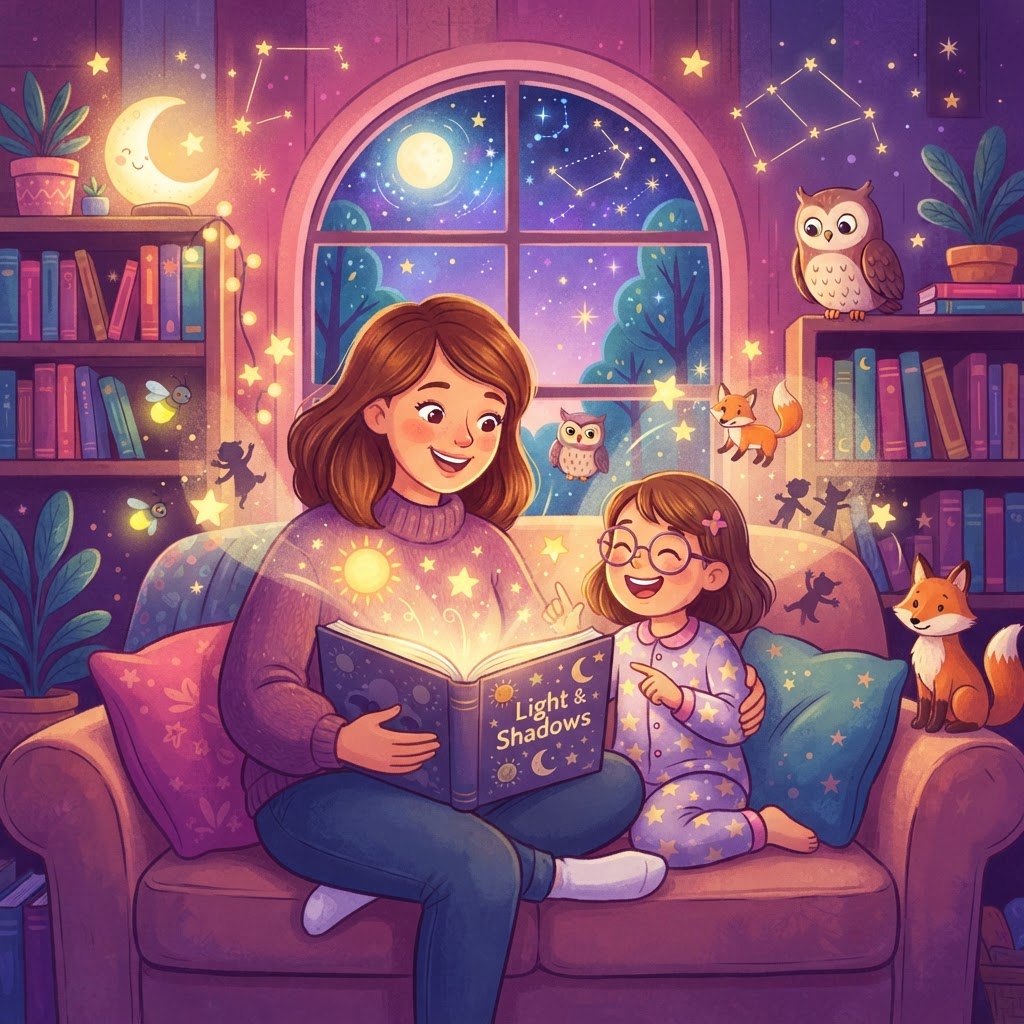
If you want to make science feel magical, light and shadows stories for kids are one of the best places to start. Children naturally notice flashlight beams, sunny windows, night lights, and the funny shapes their bodies make on the wall, so stories about light and shadows turn everyday curiosity into real learning.
The good news is that teaching light and shadows to children does not have to feel formal. With a strong story, one or two simple facts, and a playful prompt, you can help children ages 1-10 understand how light travels, how shadows form, and why the sky and Moon look different at different times. If your child already enjoys science tales like gravity adventures, water cycle stories, or photosynthesis tales, this theme is a natural next step.
Why are light and shadows stories for kids such an effective way to teach science?
Stories work because they make abstract science concrete. Instead of memorizing a definition, children see a character notice a shadow, ask a question, test an idea, and discover an answer.
This fits what early childhood experts recommend. The National Association for the Education of Young Children (NAEYC) emphasizes that young children learn science through observation, conversation, and playful exploration. Story-based learning also supports language growth, memory, and emotional engagement, which helps kids hold on to new concepts longer.
For parents and teachers, kids light and shadows stories are especially useful because the science is visible right away. A child can hear a story about a long evening shadow and then step outside to see one. That immediate connection between fiction and real life is powerful.
What are the best light and shadows story ideas for children?
The best light and shadows story ideas combine wonder with one clear scientific idea. Below are six story starters you can use at bedtime, in a classroom, or when you create your own personalized bedtime story with InstaTales.
The Flashlight Forest
- Story concept: A child explorer enters a dark blanket fort with a flashlight and discovers that every toy makes a different shadow creature on the wall.
- Real science facts: Shadows form when an object blocks light. When an object moves closer to a light source, its shadow usually looks larger.
- AI prompt: Write a gentle bedtime story for a 4-year-old about a child in a flashlight forest who discovers why toy shadows grow and shrink. Keep the tone cozy and include one simple science explanation.
Why Is My Shadow So Long?
- Story concept: On the way to the playground, a child notices their shadow is long in the morning, short at noon, and long again in the evening.
- Real science facts: The Sun appears to move across the sky because Earth rotates. That changing Sun angle makes shadows change length and direction, as explained by NASA’s day-and-night resources.
- AI prompt: Create an educational story for ages 5-7 about a curious child tracking their shadow through the day and learning why it changes.
Luna and the Moonlit Path
- Story concept: A rabbit named Luna follows pale shadows in a moonlit garden and learns that the Moon is not making its own light.
- Real science facts: Moonlight is reflected sunlight. Moon shadows are usually softer and dimmer because the light is much weaker than sunlight; NASA’s Moon overview is a helpful reference.
- AI prompt: Write a calm bedtime story about a rabbit walking under moonlight and learning that the Moon reflects the Sun’s light. Include soft imagery and one science fact.
The Silhouette Museum
- Story concept: A family visits a museum where every exhibit only appears as a dark outline until a guide explains silhouettes.
- Real science facts: A silhouette is the dark shape of an object seen against a brighter background. Opaque objects block most or all light, which creates clear shadows.
- AI prompt: Tell a story for a 6-year-old about a child visiting a silhouette museum and learning what makes a crisp shadow outline.
The Lantern Parade of Three Windows
- Story concept: Three friends carry lanterns past a clear window, a frosted window, and a curtain, and each one changes the light in a different way.
- Real science facts: Transparent materials let most light through, translucent materials let some light through, and opaque materials block light. These differences affect whether a shadow looks sharp, fuzzy, or very dark.
- AI prompt: Write a story about three children in a lantern parade who discover transparent, translucent, and opaque materials through a nighttime adventure.
The Secret of the Garden Sundial
- Story concept: A grandparent and child use a garden sundial to solve a tiny mystery: when should the flowers be watered?
- Real science facts: Sundials tell time by tracking the position of a shadow. The changing shadow works because sunlight hits Earth from different angles as Earth rotates.
- AI prompt: Create a warm intergenerational story about a child and grandparent using a sundial in the garden to learn how sunlight changes shadows during the day.
How can you use InstaTales’ educational story type for light and shadows?
InstaTales’ educational story type helps you turn a science topic into a child-friendly narrative in minutes. It is especially useful when you want a story to be accurate, age-appropriate, and personalized.
Here is a simple way to use it:
- Choose the educational story type.
- Add your child’s age, favorite setting, and a simple science goal, such as “learns how shadows form.”
- Include 1-2 facts you want the story to teach.
- Ask for a gentle ending and one follow-up question.
For example, you might request: “A bedtime story for a 5-year-old about a girl and her cat discovering why shadows get bigger near a lamp.” If you want faster setup, start with one of the story templates. If your child wants to hear the same story again tomorrow, save it in your story library for easy rereading.
For educators, the same approach works well in group settings. Teachers can build themed science reading time, center activities, or simple writing extensions with InstaTales for teachers. It also pairs nicely with other science themes from the InstaTales blog, including stories about plants, weather, and animals.
How can you turn a bedtime story about light and shadows into real learning?
The best follow-up is simple, hands-on, and short. A five-minute activity after reading often teaches more than a long explanation.
Try one of these:
- Shine a flashlight on a toy and move it closer and farther away.
- Trace your child’s shadow outside in the morning and later in the afternoon.
- Test household items to see whether they are transparent, translucent, or opaque.
- Make hand shadows on the wall and ask, “What changed when we moved our hands?”
This kind of guided play supports what the National Science Teaching Association recommends: children learn science best when they predict, observe, and talk about what they notice. Even simple questions like “Why do you think that shadow got bigger?” build early scientific thinking. If your child loves themed learning, you can rotate this with insect science stories or dinosaur story adventures.
What real science facts about light and shadows should kids learn first?
Start with the basics: light travels, objects can block it, and shadows change depending on the light source. Young children do not need a full physics lesson to understand the core idea.
The most useful beginner facts are:
- Light needs a source, such as the Sun, a lamp, or a flashlight.
- A shadow appears when something blocks light.
- Shadow size and direction can change.
- Some materials let light through better than others.
- The sky’s light can look different at sunrise or sunset because sunlight scatters in the atmosphere, a process explained clearly by NOAA.
These short facts keep teaching light and shadows to children accurate without making it overwhelming.
Frequently Asked Questions
What age is best for light and shadows stories for kids?
Children can enjoy these stories as early as toddlerhood. For ages 1-3, keep it sensory and simple; for ages 4-10, add cause-and-effect science facts and prediction questions.
How do I explain shadows to a preschooler?
Say, “A shadow happens when something blocks the light.” Then show it with a flashlight, a toy, and a wall so the idea becomes visible right away.
Are light and shadows stories good for classroom learning?
Yes. They work well for circle time, science centers, and early writing activities because they combine literacy with observation and discussion. Teachers can personalize them for seasons, weather, or current classroom themes.
What should I include in an AI prompt for a science story?
Include the child’s age, the topic, one or two facts, the tone, and the setting. A strong prompt might ask for a cozy bedtime story that explains why shadows change during the day.
Can bedtime stories really teach science?
Yes, especially when the science connects to something children can observe the next day. Story plus conversation plus a quick experiment is an effective learning combination.
How can I keep these stories accurate but still fun?
Use one clear concept per story and check simple facts against trusted sources like NASA or NOAA. Imagination works best when it sits on top of real, understandable science.
Get a new bedtime story every week
Free, personalized, and delivered to your inbox. No spam, ever.
Ready to Create a Personalized Bedtime Story?
Use our free AI bedtime story generator to create a personalized illustrated story for your child in 30 seconds — no credit card needed.
Popular story types:
Maya Rodriguez
Lead Content Editor & Early Literacy Specialist
Maya is a former early childhood educator and literacy specialist with over a decade of experience helping children develop a love of reading. She leads content at InstaTales, where she writes about the science of storytelling, child development, and how families can use personalized AI stories to build literacy and emotional resilience.
instatales.ai