15 Minute Stories for Kids Ages 6-10
Older kids can enjoy longer stories. These 15-minute stories are perfect for elementary-age children.
✦ Key Takeaways
- •15-minute stories are a strong fit for children ages 6-10 because they match their growing attention span, imagination, and understanding of plot.
- •Longer bedtime stories help elementary-age children build listening stamina, deeper comprehension, and emotional understanding.
- •The best way to keep older kids engaged for 15 minutes is to make the story interactive without making it overstimulating.
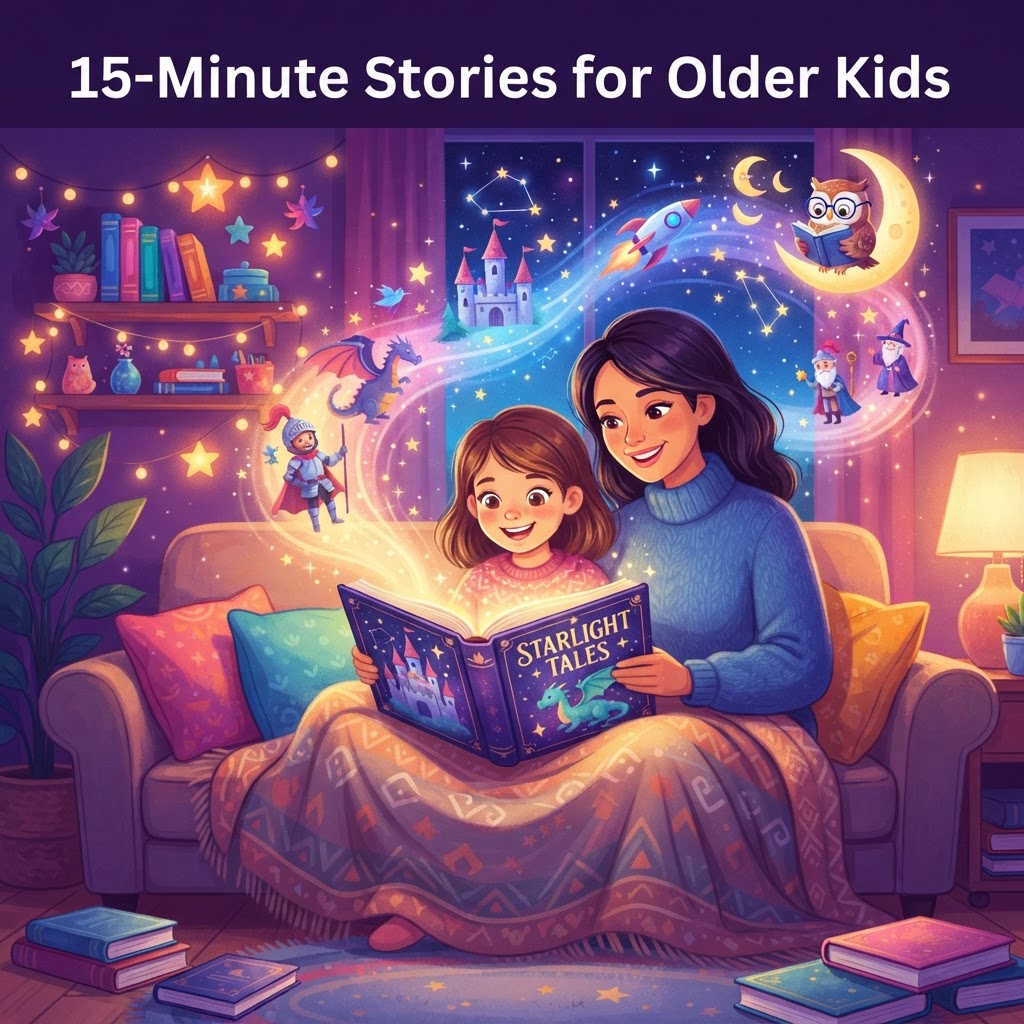
If your child has outgrown very short picture-book reads, 15 minute stories for kids can be the perfect next step. Elementary-age children are often ready for richer plots, bigger emotions, and more imaginative details—especially at bedtime, when a longer story helps them slow down and settle in.
For many families, the challenge is not whether older kids can listen longer. It is knowing how to choose longer bedtime stories that still feel calm, engaging, and age-appropriate. This guide explains why stories for elementary kids benefit from a 15-minute format, how to keep children listening all the way through, five story ideas that work well, and how to use InstaTales’ long story setting to create a better bedtime routine.
Why are 15 minute stories for kids a great fit for elementary ages?
15-minute stories are a strong fit for children ages 6-10 because they match their growing attention span, imagination, and understanding of plot. Older kids can usually follow more events, remember character goals, and enjoy suspense in a way younger children often cannot yet do.
By elementary school, many children are ready for stories with:
- A clear beginning, middle, and end
- A problem that takes time to solve
- Supporting characters
- Emotional growth or a lesson
- More vivid world-building
This matters because listening to stories is not just entertainment. It also supports language, comprehension, and social-emotional learning. The American Academy of Pediatrics has long encouraged regular shared reading because it strengthens both literacy and parent-child connection.
A 15-minute story can also feel more satisfying to an older child than a very quick read. If your child says, “That was too short,” it may be a sign they are ready to move beyond the rhythm of 5-minute bedtime stories and into more developed narratives.
What do older kids gain from longer bedtime stories?
Longer bedtime stories help elementary-age children build listening stamina, deeper comprehension, and emotional understanding. They also create space for children to practice patience, prediction, and reflection in a relaxed setting.
Here are some of the biggest benefits:
- Stronger comprehension: Longer plots ask children to remember details and connect events across the story.
- Better vocabulary exposure: Richer stories naturally include more descriptive words and varied sentence patterns.
- Improved attention stamina: Listening for 15 minutes helps children practice sustained focus.
- Deeper emotional learning: Children can see how characters handle mistakes, fear, friendship, and problem-solving.
- A calmer bedtime transition: A fuller story often gives older kids enough time to truly unwind.
Research on child development consistently shows that children build important thinking skills through language-rich interactions. The Center on the Developing Child at Harvard University highlights how experiences that support memory, attention, and self-regulation help children grow into stronger learners. A thoughtful bedtime story does exactly that in a warm, low-pressure way.
For many families, longer bedtime stories are also a bridge to independent reading. Children who enjoy listening to multi-part stories are often more willing to try longer books on their own later.
How can parents keep older kids engaged for 15 minutes?
The best way to keep older kids engaged for 15 minutes is to make the story interactive without making it overstimulating. Elementary kids stay with a longer story when the pacing is clear, the stakes are understandable, and they feel personally connected to what happens next.
Try these practical strategies:
- Choose one strong story goal. A child listens better when the character wants something clear, like finding a lost map or helping a dragon get home.
- Use age-matched complexity. A 6-year-old may enjoy one main problem; a 9-year-old may enjoy twists, clues, or a mystery.
- Ask one or two prediction questions. Try: “What do you think is behind the door?” This boosts comprehension without breaking the calm.
- Include familiar interests. Space, soccer, animals, school adventures, and magical quests all work well.
- Keep the emotional tone safe. Suspense is great; bedtime is not the time for scary or confusing endings.
- End with closure. Older kids still sleep better when the story resolves peacefully.
If your child is still adjusting to longer stories, build up gradually. Start with 10-minute bedtime stories, then extend to 15 minutes once they can follow a fuller plot comfortably.
One more tip from literacy educators: discussion matters. Organizations like Reading Rockets often emphasize that asking children to retell or predict during reading supports comprehension. Even one quick question before lights-out can make a story more memorable.
What are five story ideas that work especially well for elementary kids?
The best stories for elementary kids combine adventure, emotional growth, and just enough complexity to feel exciting. A 15-minute format gives these ideas room to breathe without becoming too long for bedtime.
1. A mystery at school?
A missing class pet, a secret note in a library book, or strange footprints near the playground can hook older kids quickly. School-based mysteries feel familiar, which makes them easy to follow and fun to solve.
2. A magical quest with a clear mission?
This could be a journey to return a glowing crystal, wake a sleeping forest, or help a tiny dragon learn to fly. Quest stories work well as longer bedtime stories because they naturally include stages, helpers, and a satisfying resolution.
3. A friendship problem with a gentle emotional arc?
Elementary kids relate strongly to stories about teamwork, misunderstandings, and making things right. These stories are especially helpful when a child is navigating real-life social challenges.
4. A science-themed adventure?
Stories about space explorers, underwater inventors, or kids building a weather machine can blend imagination with curiosity. These are excellent stories for elementary kids who love facts as much as fantasy.
5. A “what if” world-building story?
What if animals ran the town for one night? What if every dream left a clue in the morning? What if a child found a map inside their backpack that led to a hidden kingdom? Older kids often love these bigger-concept stories because they invite imagination and discussion.
If you want a faster starting point, using pre-made story templates can make it easier to match the story idea to your child’s age and interests.
How can parents use InstaTales’ long story length setting well?
InstaTales’ long story length setting helps parents create more developed bedtime stories that feel just right for older children. It is especially useful when your child wants more than a quick tale but still needs a calm, bedtime-friendly pace.
A simple way to use it well is to:
- Start by choosing to create your own personalized bedtime story
- Select the long story length setting
- Add your child’s age, interests, and preferred tone
- Include one main challenge and one comforting ending
- Save favorites to your story library for easy re-reading
For example, instead of prompting “Write a story about a boy and a dragon,” try: “Write a 15-minute bedtime story for an 8-year-old about a kind dragon and a child who solve a mystery in a moonlit forest, with gentle suspense and a peaceful ending.”
That extra guidance helps the story stay age-appropriate and structured. It also reduces the chance of the plot wandering, which matters more in 15 minute stories for kids than in shorter formats.
If your child enjoys routine, you can also create themed story nights—mystery Monday, adventure Wednesday, animal Friday—or revisit saved favorites from your story library. Some families even turn story listening into playful reading goals with weekly reading challenges.
When should parents choose a 15-minute story instead of a shorter one?
Choose a 15-minute story when your child wants more depth, can follow a multi-step plot, and settles well with listening. Shorter stories are still useful, but older kids often benefit from having the option of something more substantial.
A 15-minute story is often a good choice when:
- Your child is in elementary school and asks for “one more chapter”
- They enjoy character development and plot twists
- Bedtime feels rushed and they need a longer wind-down
- You want to support listening comprehension and reading stamina
A shorter story may still be better when:
- Your child is overtired
- The bedtime routine is already running late
- They are sick or dysregulated
- You are introducing a new storytelling habit
There is no single perfect length every night. Some families rotate between shorter and longer reads depending on energy, schedule, and mood. If you are exploring options, the InstaTales blog has ideas for different ages and attention spans, including younger children who may do better with 3-minute stories for toddlers.
Frequently Asked Questions
Are 15 minute stories too long for bedtime?
Not usually for elementary-age children. If the story is calm, age-appropriate, and ends gently, 15 minutes can actually help older kids settle more fully before sleep.
What age are 15 minute stories best for?
They are often best for children around ages 6-10. Readiness matters more than age alone, so pay attention to whether your child can follow a longer plot and enjoys it.
How do I know if my child is ready for longer bedtime stories?
A good sign is when your child asks for more detail, remembers story events, or stays engaged through 10-minute reads. If they seem frustrated by very short stories, they may be ready for a longer format.
What kinds of stories work best for elementary kids at bedtime?
Mysteries, quests, friendship stories, and gentle adventures tend to work very well. The best bedtime stories for older kids are engaging without being overstimulating or scary.
Can personalized AI stories support reading development?
They can, especially when parents choose age-appropriate prompts and talk briefly about the story afterward. Personalized stories can increase motivation because children are more likely to listen closely when the themes match their interests.
Should I use the same long story more than once?
Yes. Re-reading or re-listening helps children notice vocabulary, remember plot structure, and feel secure in the bedtime routine.
Ready to Create a Personalized Bedtime Story?
Use our free AI bedtime story generator to create a personalized illustrated story for your child in 30 seconds — no credit card needed.
Popular story types:
Maya Rodriguez
Lead Content Editor & Early Literacy Specialist
Maya is a former early childhood educator and literacy specialist with over a decade of experience helping children develop a love of reading. She leads content at InstaTales, where she writes about the science of storytelling, child development, and how families can use personalized AI stories to build literacy and emotional resilience.
instatales.ai