Reading to an Active Child Who Won’t Sit Still
Does your child wiggle and squirm during story time? Here are strategies for reading to active kids who won't sit still.
✦ Key Takeaways
- •Most children who squirm during books are showing normal development, not bad behavior.
- •Yes, story time still counts even if your child is standing, bouncing, or playing nearby.
- •The best way to help is to change the routine, not force more stillness.
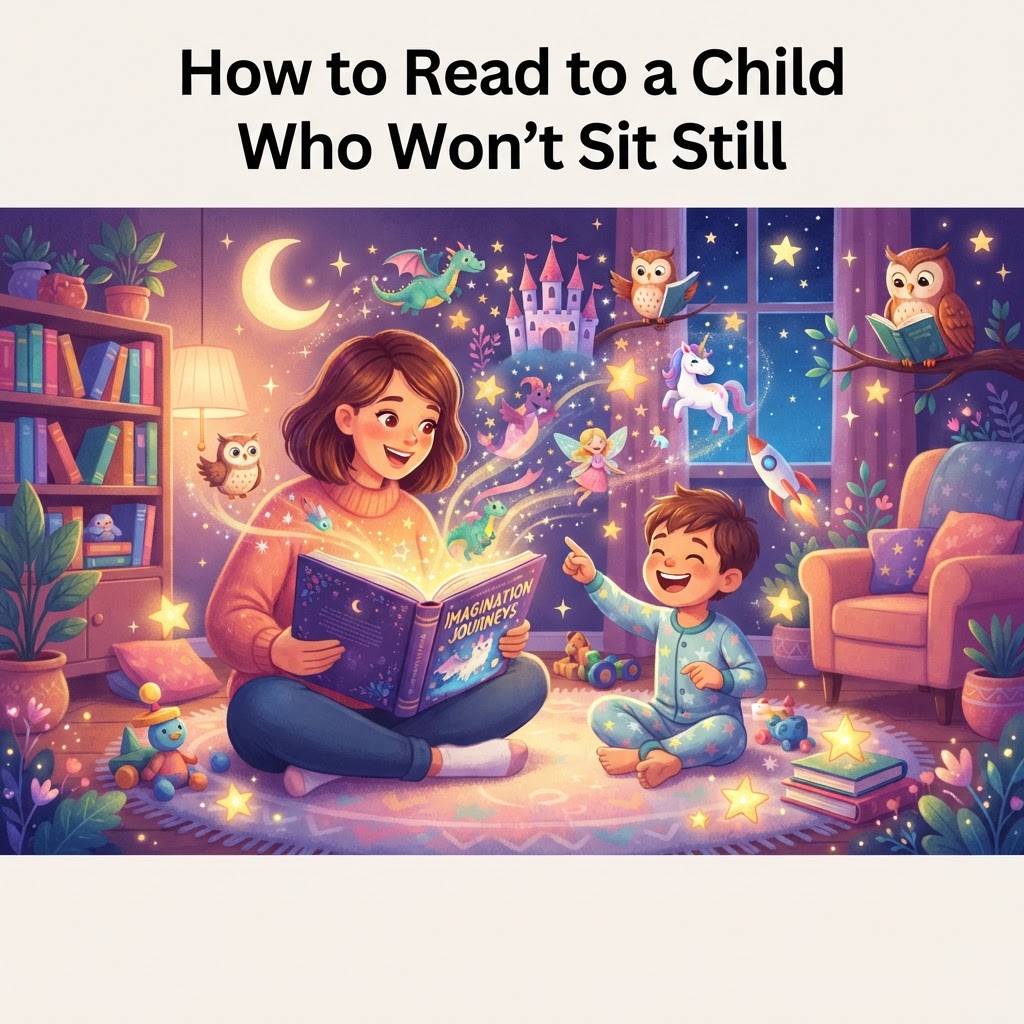
If your child rolls, climbs, wiggles, or wanders off halfway through a book, you are not failing at story time. Reading to an active child often looks different from the calm, cuddly picture many parents expect. The good news is that children can still learn, connect, and enjoy stories even when their bodies are busy.
Many families worry because their child won't sit still for stories. In most cases, that is a sign of normal development, not a sign that reading “isn’t working.” With a few smart adjustments, reading to wiggly kids can become easier, warmer, and much more fun.
Why can’t some children sit still for stories?
Most children who squirm during books are showing normal development, not bad behavior. Sitting still, listening, looking, and controlling impulses all depend on self-regulation, and that skill grows slowly over time.
Young children are built for movement. Toddlers and preschoolers especially learn through touch, motion, and repetition. Even many school-age children listen better when their hands or legs are busy. The CDC’s developmental milestones and Harvard’s work on executive function and self-regulation both show that attention and impulse control develop gradually.
A few common reasons children move during story time include:
- Temperament: Some kids are naturally more energetic.
- Sensory needs: Movement helps some children feel calm and focused.
- Timing: They may be overtired, overstimulated, or not ready to wind down.
- Book mismatch: The story may be too long, too hard, or not interesting enough yet.
- Developmental stage: A two-year-old should not be expected to listen like a six-year-old.
When parents understand this, story time becomes less of a behavior battle and more of a relationship moment.
Does story time still count if your child is moving?
Yes, story time still counts even if your child is standing, bouncing, or playing nearby. Listening comprehension does not always require a still body.
The American Academy of Pediatrics recommends reading aloud because it supports language, bonding, and early literacy. None of those benefits disappear just because a child is upside down on the sofa.
Many active children absorb more than adults realize. They may not look at every page, but they hear rhythm, new words, repeated phrases, and your voice. If your child later quotes a line, answers a question, or asks for the same book again, they were listening.
This matters because parents often stop reading too soon. If you assume movement means disinterest, you may miss a child’s real learning style. For some children, the goal is not “sit perfectly.” The goal is stay connected to the story in whatever way works.
How can you adapt story time for a child who won’t sit still for stories?
The best way to help is to change the routine, not force more stillness. Small changes often make a big difference for a child who won’t sit still for stories.
Try these practical strategies:
- Keep it short. Start with 3 to 5 minutes, not 20.
- Read earlier. If bedtime is too tiring, try books after bath, after dinner, or in the afternoon.
- Let them hold something. A stuffed animal, blanket, or quiet fidget can help.
- Offer one simple expectation. Try, “You can stand or wiggle, but stay near me.”
- Use your voice like a tool. Whisper, pause, and change tone to pull attention back.
- Choose fewer words per page. Dense text loses active listeners fast.
- Read while they move. Some children listen well while coloring, building, or rocking.
- Stop before it falls apart. Ending on a good note builds success.
It also helps to match books to your child’s stage. If you are moving from short, sturdy books to longer stories, this guide on switching from board books to picture books can help. If story time itself brings pushback, our article on what actually helps with bedtime story resistance offers more gentle strategies.
A predictable routine matters too. Many active children settle better when books happen in the same order each night. You can explore age-based ideas for a bedtime routine for toddlers, a calm story routine for preschoolers, or a school-age bedtime story routine.
What kinds of stories work best for reading to wiggly kids?
The best stories for active children invite participation. Books with rhythm, repetition, action, and clear page turns are usually easier than long, quiet narratives.
Look for stories with:
- Repeated phrases children can join in on
- Movement prompts like stomping, clapping, stretching, or tiptoeing
- Sound effects such as animal noises or vehicle sounds
- Predictable structure so the child knows what is coming next
- Strong visual action with something happening on every page
- Short scenes that reward attention quickly
“Movement stories” work especially well. These are books or stories where children can act out the plot. If a character jumps over puddles, your child can jump. If a bear tiptoes through a cave, your child can tiptoe too. Movement turns story time into active learning.
Personal interest also matters. A child who ignores one book may focus deeply on a story about trucks, dinosaurs, ballet, sharks, or their own family. Personalized stories can be useful here because familiar names and favorite themes increase attention. If that fits your child, you can create your own personalized bedtime story around what they already love.
How can interactive reading keep an active child engaged?
Interactive reading works because it gives a child a job. Instead of asking them to sit quietly and receive the story, you invite them to help tell it.
Research supports this approach. In classic studies on dialogic reading, Grover Whitehurst and colleagues found that children build stronger language skills when adults ask questions, expand on answers, and make reading a back-and-forth conversation. This is especially helpful for children who lose interest in passive listening.
Try simple prompts like:
- “Can you find the puppy?”
- “What do you think happens next?”
- “Show me how the robot walks.”
- “What sound would this truck make?”
- “Is the character feeling happy or frustrated?”
You do not need to ask a question on every page. That can feel like a quiz. Instead, aim for a playful rhythm: read a little, pause a little, respond warmly, then keep going.
For active children, interactive reading can also be physical:
- Tap the page when you spot something
- Act out feelings with your face
- Use hand motions for repeated lines
- Let the child turn pages
- Invite them to “read” the refrain with you
This approach keeps connection strong without demanding stillness that may be unrealistic.
When is it okay to let your child move during story time?
It is okay to let your child move during story time as long as the movement is safe and does not completely break the connection. For many children, moving is how they regulate attention.
A child can listen while:
- Lying on the floor
- Standing next to you
- Rocking in a chair
- Holding a soft toy
- Walking in a small loop nearby
- Coloring or stacking quietly
What matters most is whether they are still engaged in some way. Are they listening? Responding? Glancing back? Asking for more? If yes, the reading is working.
It is still reasonable to set gentle limits. For example:
- “You may wiggle, but books stay gentle.”
- “You can stand, but stay where you can hear.”
- “You may bounce after this page turn.”
If movement becomes unsafe, very distressed, or impossible across many settings, it may be worth mentioning to your pediatrician. The concern is not story-time wiggling by itself. It is when high activity comes with big struggles in sleep, language, daily routines, or preschool and school participation.
Most of the time, though, parents can exhale. A child does not need to look calm to be learning.
How can parents make story time feel successful again?
Success starts with changing the goal. The goal is not a perfectly still child. The goal is a positive reading relationship that grows over time.
Try thinking of story time as practice, not performance. One good minute today can become five tomorrow. A child who listens while hopping may become a child who curls up with a chapter book later on.
Celebrate what is going well:
- They stayed for one page longer
- They joined a repeated phrase
- They asked for the book again
- They laughed at a character
- They made a connection to real life
That is real literacy growth. Warmth, repetition, and flexibility matter more than picture-perfect behavior. When adults stay calm and responsive, children are more likely to see books as safe, enjoyable, and worth returning to.
Frequently Asked Questions
Is it normal for toddlers to walk away during story time?
Yes. Toddlers often move in and out of activities as part of normal development. Keep reading for a minute or two and see whether your child still listens or comes back.
Should I stop reading if my child leaves?
Not always. If your child wanders but still seems to hear you, you can keep going briefly. If they are clearly done, end calmly and try again later rather than turning it into a struggle.
How long should story time be for a wiggly child?
Start small. For many active children, 3 to 10 minutes of happy reading is better than 20 minutes of conflict.
What if my child only wants the same short book again and again?
Repetition is helpful, not harmful. Re-reading familiar books builds vocabulary, memory, confidence, and participation.
Are audiobooks helpful for active kids?
They can be. Audiobooks are useful for car rides, quiet play, or winding down, but they work best as a supplement to shared reading, not a replacement for it.
If your child seems to bounce through every book, you are not alone. With flexible expectations, interactive reading, and stories that match your child’s body and brain, reading can still become one of the best parts of the day.
Ready to Create a Personalized Bedtime Story?
Use our free AI bedtime story generator to create a personalized illustrated story for your child in 30 seconds — no credit card needed.
Popular story types:
Maya Rodriguez
Lead Content Editor & Early Literacy Specialist
Maya is a former early childhood educator and literacy specialist with over a decade of experience helping children develop a love of reading. She leads content at InstaTales, where she writes about the science of storytelling, child development, and how families can use personalized AI stories to build literacy and emotional resilience.
instatales.ai