Bilingual Kids Stories That Build Vocabulary
How bilingual bedtime stories build vocabulary in two languages — research-backed strategies and free AI story tools for dual-language families.
✦ Key Takeaways
- •**Bilingual storytime supports vocabulary growth in both languages** because children hear words repeated in meaningful contexts, which improves understanding and recall.
- •**Research on bilingualism suggests cognitive benefits**, including stronger attention control and mental flexibility, especially when children regularly use and hear two languages in everyday life.
- •**Dual language stories can support translanguaging**, a natural process where children draw on all their language knowledge to make meaning rather than keeping languages completely separate.
- •**Consistent bedtime routines matter more than perfect pronunciation or grammar**; even 10-15 minutes of regular story exposure in two languages can support dual-language literacy.
- •**AI tools can make bilingual reading easier** by helping parents generate the same story in multiple languages, adjust reading level, and revisit favorite themes.
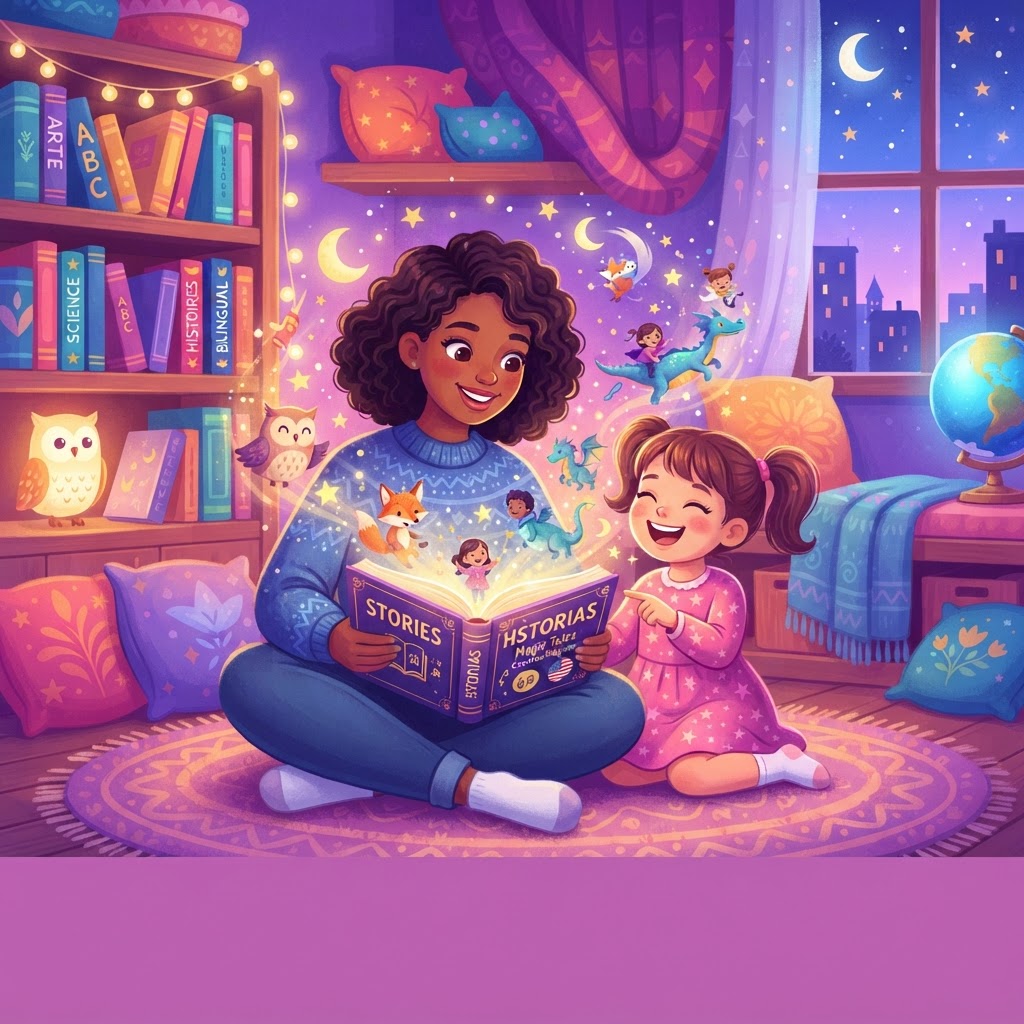
For many families, bedtime is one of the few calm moments in the day—and it can also be one of the best times to grow language. Bilingual kids stories help children connect words, feelings, and ideas across two languages in a low-pressure way. When children hear stories in two languages for kids, they build vocabulary through repetition, context, and conversation, while also strengthening their bond with family, culture, and routine.
People Also Ask
Do bilingual stories confuse children?
No. Young children are fully capable of learning more than one language, and mixing languages is often a normal part of development. It usually shows that a child is using all of their language resources to communicate.
What is the best age to start bilingual bedtime stories?
The best age is as early as possible, including infancy. Babies benefit from hearing the rhythm and sounds of both languages long before they can speak.
Should parents translate every page when reading in two languages?
Not necessarily. Some families alternate languages by page, paragraph, or reading session, while others retell key parts in the home language. What matters most is that the child understands and stays engaged.
Can AI help create stories in two languages for kids?
Yes. AI can make it easier to generate personalized stories with the same characters, themes, and plot in multiple languages. This is especially helpful for busy families who want more consistent bilingual reading routines.
Why do bilingual kids stories help children learn more words?
Yes—bilingual kids stories are a powerful way to build vocabulary because stories make words meaningful. Children do not learn new words best from isolated flashcards; they learn them when words are tied to actions, emotions, pictures, and repeated events in a story.
When a child hears “forest,” “run,” “soft,” or “brave” in a story, they can connect each word to what is happening. If they hear the same story in two languages, they begin to map meaning across both. That is one reason dual language stories are so useful for bilingual children vocabulary development.
Story reading also creates natural repetition. The same key words often appear several times in one book or bedtime story. Repetition helps children store and retrieve vocabulary, especially when adults pause to point, gesture, or ask simple questions like “What do you think happens next?”
Researchers at Harvard’s Center on the Developing Child emphasize that back-and-forth interaction is essential for language growth. A story shared with a warm adult gives children exactly that kind of responsive language experience.
What does research say about stories in two languages for kids?
Research consistently shows that bilingual exposure is not harmful and can be beneficial for language and cognitive development. Children can successfully learn two languages at once, especially when they hear rich, meaningful input in both languages over time.
A helpful overview from Cornell University explains that bilingualism can support literacy and learning when both languages are valued and used. Studies also show that strong skills in one language can support learning in the other, especially for vocabulary, comprehension, and narrative skills.
For families, this means stories in two languages for kids are not “extra.” They are a practical literacy tool. Hearing the same plot in both languages helps children compare sentence patterns, infer meaning, and notice how ideas transfer across languages.
Research on dual-language literacy also suggests that home language support matters. When parents maintain the family language through stories, songs, and conversation, children are more likely to preserve vocabulary depth and cultural connection over time.
How does translanguaging support bilingual children vocabulary?
Translanguaging means children use their full language system to understand and communicate, instead of keeping each language in a separate mental box. In practice, that may look like a child answering in English after hearing a question in Tamil, or naming an animal in Urdu while describing its actions in English.
This is normal and useful. Rather than treating language-mixing as a problem, many educators see translanguaging as a bridge to deeper understanding. Children often understand more than they can express in one language alone, and dual-language storytime gives them space to use both.
For example, if you read a story first in English and then discuss it in Bengali, your child may connect ideas across both versions. That supports bilingual children vocabulary because meaning comes first; precise production can grow later. Families exploring heritage-language reading may also enjoy region-specific resources like these guides to Bengali stories for kids, Tamil bedtime stories, or Urdu stories for children.
Can hearing stories in two languages strengthen executive function?
Yes, it can help. Executive function includes skills like attention control, flexible thinking, and working memory. These skills are important for learning, self-regulation, and school readiness.
Some research suggests that bilingual experience may strengthen these systems because children regularly switch attention, monitor meaning, and manage two linguistic codes. The National Institutes of Health has published research exploring links between bilingual language experience and cognitive control, though results can vary by study and context.
In storytime, this looks very practical. A child listening to the same character names, events, and emotions in two languages is practicing mental flexibility. They learn that one idea can be represented in different words, and that skill supports comprehension as well as attention.
That said, the goal of bilingual reading is not to “boost intelligence.” The more grounded benefit is this: children who hear rich language in both languages get more chances to understand, remember, and use words well.
What does a strong bilingual bedtime routine look like?
A strong bilingual bedtime routine is simple, repeatable, and enjoyable. You do not need perfect balance every night. You just need consistent exposure and warm interaction.
A good routine often includes:
- 10-15 minutes of reading or listening
- the same order each night, such as bath, pajamas, story, cuddle
- one or both languages used naturally
- brief discussion before or after the story
- regular re-reading of favorites
If your child loves animals, familiar themes can make bilingual reading easier. You might start with animal stories for children because repeated characters and actions support vocabulary learning.
Here are four easy routine examples:
One story, two languages
Read the story in the home language first, then retell or reread it in the second language. This works well for younger children who benefit from hearing the same plot twice.
Alternate by night
Use one language on Monday, Wednesday, and Friday, and the other on Tuesday, Thursday, and Saturday. On Sunday, let your child pick their favorite version.
Page-and-chat method
Read a page in one language, then pause to discuss the picture or main event in the other. This supports comprehension without making the reading feel too long.
Parent-grandparent partnership
One adult records or reads the story in one language, and another adult shares it in the other. This is especially helpful in multilingual families where caregivers have different strengths.
How can parents use AI to create dual language stories at home?
AI can make bilingual reading much easier by helping families generate the same story in two languages without starting from scratch each night. This is especially useful when parents want personalized stories but cannot always find matching books in both languages.
With an AI bedtime story generator, you can create a bedtime story around your child’s interests—dinosaurs, birthdays, space, or family traditions—and then generate that same story in another language. InstaTales supports 40+ languages, which is especially helpful for dual-language and heritage-language families.
A few practical ways to use AI well:
- Generate one story in English and one in your home language.
- Keep the character names and plot the same across versions.
- Save favorites in your story library for rereading.
- Use story templates when you want a faster bedtime option.
- Try a free AI bedtime story generator if you want to test a no-signup option first.
If you are building a regular reading habit, you can also turn bilingual storytime into a family goal with weekly reading challenges. And for parents who want more ideas by language or age, the InstaTales blog has additional reading tips.
Which bilingual story strategies work best for different families?
The best strategy is the one your family can keep doing. Bilingual development does not require a perfect system; it requires meaningful exposure, connection, and repetition.
Here are a few practical matches:
- For busy working parents: Use short AI-generated bedtime stories in two languages 3-4 nights a week.
- For heritage-language families: Read in the home language and discuss in the school language to support both identity and school readiness.
- For mixed-language households: Let each caregiver read in their strongest language.
- For teachers and homeschoolers: Use paired stories for compare-and-contrast activities and vocabulary review. Classroom educators may also find InstaTales for teachers useful for literacy extensions.
Families looking for specific language support can also explore guides for Telugu stories for kids or Indonesian stories for children, depending on their home language needs.
How can parents make bilingual storytime more effective without pressure?
The best way to improve results is to keep storytime interactive, not perfect. Children learn more when adults respond, explain, and revisit words than when they simply read straight through.
Try these simple habits:
- Point to pictures and name key objects in both languages.
- Repeat new words 2-3 times naturally.
- Ask open questions like “How does she feel?”
- Invite your child to retell one part of the story.
- Re-read the same story over several nights.
Most importantly, follow your child’s attention. If they want to talk about one picture for five minutes, that conversation may do more for vocabulary than finishing the whole book.
Frequently Asked Questions
How often should I read bilingual kids stories to my child?
Daily is ideal, but consistency matters more than frequency. Even a short routine a few times a week can help build vocabulary when stories are interactive and repeated.
Is it better to read the same story in two languages or different stories?
For vocabulary learning, the same story in two languages is often more effective. The familiar plot reduces cognitive load and helps children focus on new words and sentence patterns.
What if I am not fluent in one of the languages?
You can still support your child by using audio, AI-generated stories, or help from relatives and community members. Warm engagement matters, even if your pronunciation is not perfect.
Do dual language stories help with school readiness?
Yes. Dual language stories support listening comprehension, vocabulary, narrative understanding, and attention—all important early literacy skills. They can also strengthen confidence in children who use more than one language at home.
Are personalized AI stories good for bilingual children?
They can be very helpful because familiar characters and interests increase engagement. When children care about the story, they are more likely to listen closely, remember new words, and ask questions.
Get a new bedtime story every week
Free, personalized, and delivered to your inbox. No spam, ever.
Ready to Create a Personalized Bedtime Story?
Use our free AI bedtime story generator to create a personalized illustrated story for your child in 30 seconds — no credit card needed.
Popular story types:
Maya Rodriguez
Lead Content Editor & Early Literacy Specialist
Maya is a former early childhood educator and literacy specialist with over a decade of experience helping children develop a love of reading. She leads content at InstaTales, where she writes about the science of storytelling, child development, and how families can use personalized AI stories to build literacy and emotional resilience.
instatales.ai