Talking to Kids About AI-Generated Stories
A parent's guide to talking with kids about AI-generated stories — what children understand at each age and how to frame AI as a creative tool.
✦ Key Takeaways
- •**Children do not need a complex definition of AI to understand it.** Most kids can grasp that AI is a computer tool that helps create ideas, especially when parents compare it to drawing tools, musical instruments, or building blocks.
- •**The best way to introduce children and AI stories is with honesty and collaboration.** Present AI story generation as something people guide, check, and improve rather than as magic or a human replacement.
- •**Co-creating stories with AI can build media literacy and critical thinking.** When children help choose characters, settings, and plot details, they learn that technology outputs are made, shaped, and reviewed by people.
- •**A child’s age matters when discussing AI.** Toddlers need simple language, preschoolers can understand “a computer helper,” and elementary-age children can begin discussing accuracy, creativity, and how tools can make mistakes.
- •**Parents play the biggest role in AI literacy for children.** Shared use, open questions, and follow-up conversations matter more than giving a perfect technical explanation.
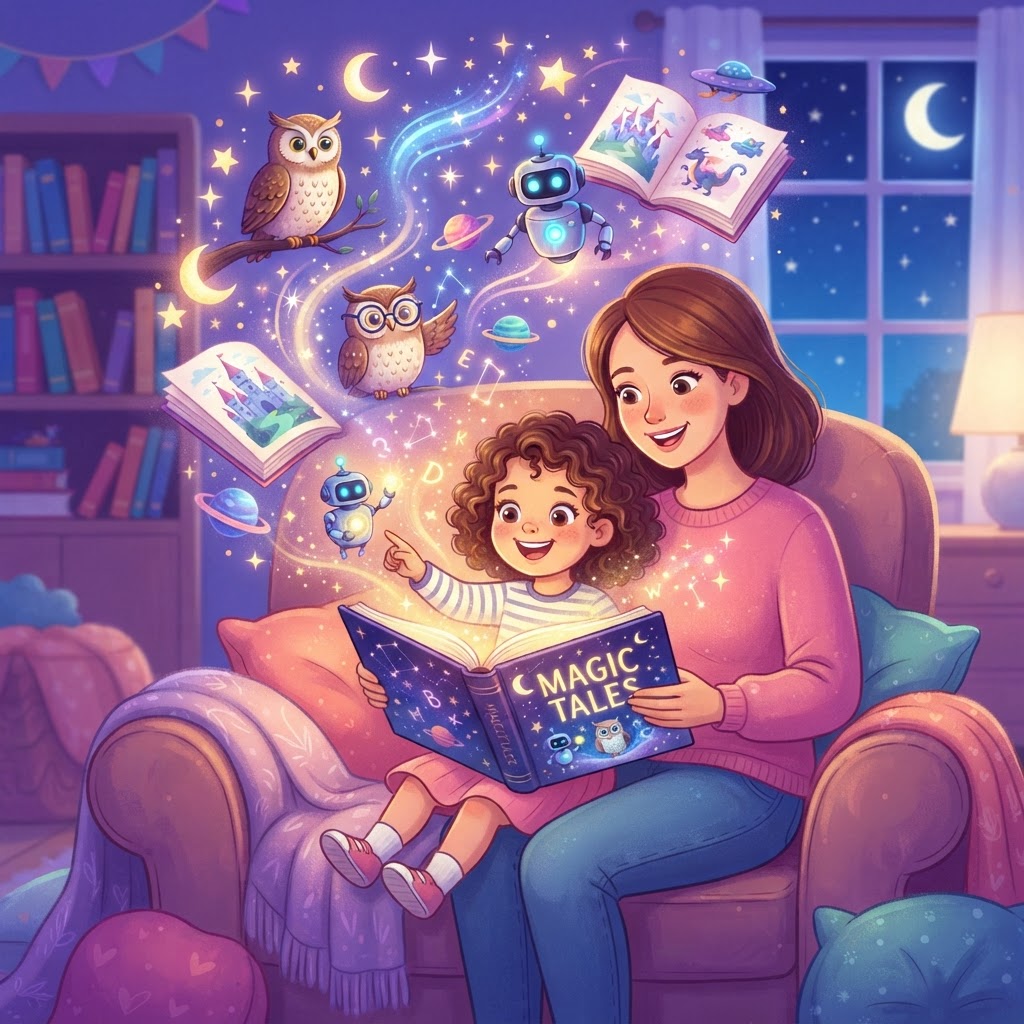
AI-generated stories for kids can be a wonderful way to spark imagination, but many parents wonder how to explain them honestly and simply. The good news is that talking to kids about AI does not need to feel technical. When you frame AI as a tool people use to make stories together, children can start building healthy AI literacy for children from an early age.
People Also Ask
How do I explain AI-generated stories to a young child?
Start with simple language: “This story was made with a computer tool, and we helped choose what happened.” Young children do best when AI is described as a helper, not as something magical or alive.
Are AI-generated stories bad for children?
AI-generated stories for kids are not automatically bad or good; their value depends on how they are used. When parents co-read, discuss, and guide the experience, AI stories can support creativity, language, and reflection.
Can AI stories help children learn critical thinking?
Yes, especially when children are invited to question what the story says and suggest changes. Asking “Does that make sense?” or “What should happen instead?” teaches kids that technology should be thought about, not just accepted.
At what age should children learn about AI?
Children can begin learning basic ideas about AI in the preschool years through simple, concrete explanations. As they grow, parents can add more detail about how AI works, what it can do well, and where it can make mistakes.
Why should parents talk openly about AI-generated stories?
Parents should talk openly because children benefit from honest explanations about the tools they use. Clear conversations help prevent confusion, reduce the “magic” effect, and support healthy digital habits.
Research in child development consistently shows that children learn best through guided interaction with trusted adults. The American Academy of Pediatrics emphasizes that media use is most beneficial when adults stay involved and engaged with children’s experiences. That applies to story technology too: when parents sit with children, ask questions, and explain what is happening, kids develop stronger understanding and better judgment.
Open conversations also support media literacy. If a child thinks a computer “knows everything” or “made the story all by itself,” they may miss an important lesson: tools need human direction. Framing children and AI stories this way helps kids understand that stories come from prompts, choices, edits, and imagination.
What do children understand about AI at different ages?
Children’s understanding of AI develops gradually, so the explanation should match their age. In general, younger children need concrete, simple ideas, while older children can handle more nuance about creativity, accuracy, and technology.
Toddlers and young preschoolers ages 1-3
At this stage, children do not need a real definition of AI. They understand routines, familiar characters, and cause-and-effect. A simple explanation works best: “We used the computer to help make this story about your puppy and the moon.”
Keep the focus on shared experience. Young children benefit more from naming what is happening than from understanding how it works. If you use an AI bedtime story generator, treat it like any other read-aloud tool: warm, interactive, and guided by you.
Preschoolers ages 3-5
Preschoolers can start to understand AI as a “computer helper.” They often enjoy hearing that a person gives the computer ideas, and the computer helps turn them into a story.
This is also a good age to avoid misleading language. Instead of saying, “The computer made this all by itself,” try: “We told the computer what kind of story we wanted, and then we picked our favorite parts.” That simple shift supports early ai literacy for children.
Early elementary ages 6-8
Children in this age group can understand that AI follows patterns and suggestions. They can also begin to grasp that AI can make mistakes or include silly details that need changing.
This is a great age for collaborative editing. Ask questions like:
- “Does that sound right?”
- “Should the dragon be kind or grumpy?”
- “What should we change?”
These moments build both creativity and judgment. According to the National Association for the Education of Young Children, young children learn deeply through play, language, and guided exploration, which makes co-created storytelling a strong fit.
Older elementary ages 8-10
Older children can begin discussing how AI is trained on lots of examples and does not “think” like a human. They are often ready to talk about bias, mistakes, originality, and why people still matter in storytelling.
This age group may enjoy comparing a child-written ending with an AI-suggested one. That kind of contrast helps children see AI as a tool, not an authority. It also supports the broader goal of talking to kids about ai in ways that build discernment.
How can parents frame AI as a creative tool instead of magic?
The best framing is simple: AI helps, but people decide. Children should hear that a person starts the idea, guides the story, checks the result, and changes what does not fit.
This matters because children are naturally drawn to magical thinking, especially in the preschool years. If adults describe AI in overly mystical ways, children may confuse fantasy with reality. Instead, compare AI to familiar tools:
- A paintbrush helps you paint, but it does not choose the picture
- A camera helps you take photos, but you decide what to capture
- A computer can help make a story, but people choose the characters and meaning
When families use story templates or customize characters together, that collaboration becomes visible. Children can literally see that human choices shape the outcome.
Why does co-creating stories with AI build critical thinking?
Co-creating stories with AI builds critical thinking because it turns children from passive consumers into active participants. They learn to question, revise, compare, and improve what they read.
This idea connects with child development research on “joint media engagement,” where children learn more when adults participate in digital experiences with them. Researchers at the Joan Ganz Cooney Center have written extensively about how guided digital use can support learning and conversation. In story creation, that means the richest learning happens when parents ask children what they notice, prefer, or want to change.
For example, if a child says the fox should not live underwater, that is critical thinking. If they notice a story feels unfair, confusing, or too scary, that is media literacy. If they suggest a better ending, that is creativity in action.
This can be especially helpful when using stories to explore real-life themes, such as moving to a new home, sibling rivalry, or grief and loss. Stories become a safe place to think, question, and rehearse feelings.
What are the best conversation starters for each age group?
The best conversation starters are short, concrete, and playful. Good questions help children understand that AI-generated stories for kids are something to explore together, not something to accept without thought.
For toddlers and preschoolers
- “Should our story be about a bunny or a bear?”
- “Did we help make this story?”
- “What should happen next?”
These questions reinforce agency. They tell the child: your ideas matter.
For ages 5-7
- “We asked the computer for a story. What part did we choose?”
- “Does this part make sense?”
- “What would you change?”
These prompts introduce the idea that stories can be reviewed and improved.
For ages 8-10
- “Why do you think the AI chose that ending?”
- “Do you think this story feels original?”
- “What did the computer do well, and what did people do better?”
These questions support reflection and build deeper ai literacy for children.
If your child loves specific themes, familiar topics can make these conversations easier. A child who enjoys animal stories for children may find it simpler to focus on the storytelling process when the subject already feels fun and comfortable.
How can parents use AI-generated stories safely and thoughtfully?
Parents can use AI-generated stories safely by staying involved, checking story quality, and choosing age-appropriate prompts. Shared reading and co-creation are usually better than handing the tool over without guidance.
A few practical guidelines help:
- Read the story before or with your child
- Adjust any details that feel too scary, confusing, or off-topic
- Remind children that computers can make mistakes
- Encourage children to add their own ideas after the story is generated
- Save favorite stories to revisit and discuss later in your story library
For families who want to try collaborative storytelling without a complicated setup, InstaTales offers a free AI bedtime story generator and lets parents and children shape stories together. The value is not just in getting a story quickly. It is in using the story as a conversation, creativity, and connection tool.
How can AI stories support learning at home and in the classroom?
AI stories can support learning when adults use them as prompts for reading, discussion, and creative extension. The strongest educational use happens when children respond to stories, not just consume them.
At home, parents might ask children to draw a new scene, rewrite the ending, or act out a favorite part. In classrooms, teachers can use story generation to spark vocabulary work, sequencing, and perspective-taking. For educators exploring this area, InstaTales for teachers can support guided literacy activities.
AI stories may also help children work through everyday challenges in engaging ways, such as potty training or picky eating. When stories reflect a child’s real life, they often invite stronger attention and richer conversation.
What should parents remember most about children and AI stories?
The most important thing to remember is that AI should be introduced as a human-guided tool for creativity. Children do not need fear-based messages or exaggerated promises; they need calm, honest support.
When parents practice talking to kids about ai in everyday language, they help children become thoughtful readers, makers, and question-askers. That is the heart of AI literacy for children: not memorizing technical facts, but learning how to use new tools with curiosity, judgment, and imagination.
Frequently Asked Questions
Are AI-generated stories for kids appropriate for bedtime?
Yes, as long as parents guide the experience and check that the tone is calm and age-appropriate. Bedtime stories work best when they feel comforting, predictable, and emotionally safe.
How do I explain that AI is not a real person?
Use simple, direct language: “AI is a computer tool that helps with ideas, but it does not feel or think like people do.” This helps children enjoy the tool without confusing it with a human relationship.
Can AI-generated stories replace regular reading with parents?
No. AI stories work best as a supplement to shared reading, not a replacement for it. The parent-child interaction is still the most important part of literacy and emotional connection.
Do AI stories help children become more creative?
They can, especially when children help choose details, change parts they dislike, and invent new endings. Creativity grows when kids actively shape the story rather than passively listen.
What is the best age to start talking to kids about AI?
Most children can begin with simple explanations during the preschool years. The key is to match the conversation to the child’s developmental stage and keep building understanding over time.
Get a new bedtime story every week
Free, personalized, and delivered to your inbox. No spam, ever.
Ready to Create a Personalized Bedtime Story?
Use our free AI bedtime story generator to create a personalized illustrated story for your child in 30 seconds — no credit card needed.
Popular story types:
Maya Rodriguez
Lead Content Editor & Early Literacy Specialist
Maya is a former early childhood educator and literacy specialist with over a decade of experience helping children develop a love of reading. She leads content at InstaTales, where she writes about the science of storytelling, child development, and how families can use personalized AI stories to build literacy and emotional resilience.
instatales.ai